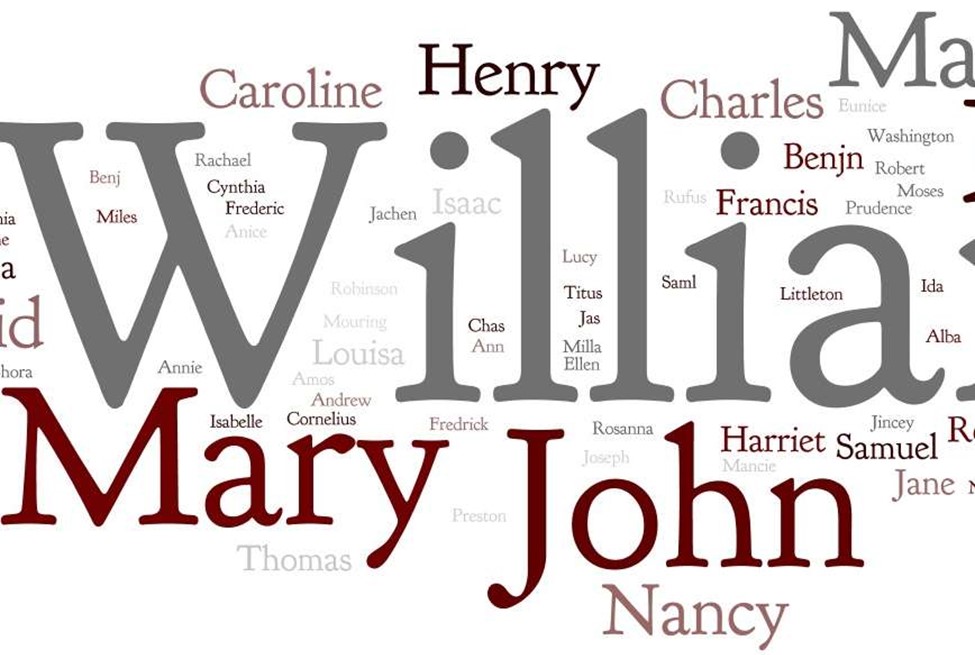
What’s in a name?

William Shakespeare asked that question in Romeo & Juliet. “What’s in a name? That which we call a rose by any other name would smell as sweet.” Juliet was not allowed to associate with Romeo because he was a Montague. If he had any other name, it would have been fine. She was complaining that his name is meaningless. If the rose had any other name, it would still be the same. So, with Romeo- he would still be the same beautiful young man even if he had a different name.1

Our name is how we are identified from birth.  It represents us conceptually to others.  Hearing someone’s name that we know often brings their face, personality, or character to mind.  We can remember conversations, funny anecdotes, or life encounters that inform our opinion of who they are. When we hear a stranger’s name it is just a name until we have information to associate with it.  Information may come in the form of gossip passed along from another person, social media viewed online, or news reports. 

Back in the day before the internet, employers would review applications and resumes to screen for potential job candidates.  Calls or letters would be sent to verify employment history.  References would be contacted to gain information necessary to inform the hiring process.  Businesses routinely run background checks on job candidates and active employees to determine if they should be disqualified from employment opportunities. Once I was fingerprinted because the FBI had to check to ensure that I did not have any mafia connections when I applied to work as the lab manager at a landfill.

Modern hiring practices have changed significantly because of the potential of litigation regarding the release of information that could be considered negative regarding a former employee.  Your previous employer will now only confirm that an individual worked for the company.  To get information, many employers have turned to third party companies that collect massive amounts of information about individuals from a wide variety of companies and government agencies that have commoditized their vast databases.  Information about credit worthiness, social media posts, along with court filings and criminal convictions are available instantaneously. 

I was recently fired from a job after 6½ years because of a change in hiring policy.  When I was first hired the policy was that you could not have a criminal conviction in the last 7 years.  A new change to the policy specified that you could not have certain specific convictions period. My employer knew who I was based on years of interaction- a hardworking, intelligent, dedicated, and loyal employee. Yet based on a single entry in a background check I was dismissed without any opportunity to explain.

The issue with computer data has always been “Garbage In, Garbage Out”.  The information is only as good as the source.  While it may be useful in this age of information overload to get information in small, overly simplified bites, context is everything, as it is in life.  When we spend our lives with a person, we will have a much better image of who they are than if we only read the sensationalized headlines about what might be the worst day in someone’s life.  And yet it is those snapshots, those life events presented without context by which our society makes life altering decisions about other people.

Case in point is SORNA, the Sex Offender Registration and Notification Act.  In 1994 the Wetterling Act established baseline standards for states to register sex offenders.  Megan’s Law in 1996 mandated public disclosure of information about registered sex offenders and required states to maintain a website containing registry information.  The Adam Walsh Child Protection and Safety Act, which includes SORNA, created a new baseline of sex offender registration and notification standards.2 The registering and tracking sex offenders went from being a tool useful to law enforcement to a modern-day Scarlet Letter.  It is the public shaming, disenfranchising and discrimination of people who, in addition to many serving long jail/prison sentences, now face additional civil penalties including restrictions on where they can live and who they can live with.

In July of 2025 President Trump signed an executive order entitled “Ending Crime and Disorder on America’s Streets”.3  In Section 3 the order zeroes in on registrants who are homeless, instructing the Department of Justice to “substantially implement and comply with” the Sex Offender Registration and Notification Act (SORNA) for individuals with no fixed address. It calls for mapping and monitoring the locations of homeless sex offenders, effectively treating poverty as a risk factor warranting heightened surveillance.

The order goes even further. If a homeless individual is arrested for a federal crime, they may be evaluated under 18 U.S.C. § 4248, a statute that allows for indefinite civil commitment of individuals deemed “sexually dangerous”—even after they’ve completed their sentence. That’s not rehabilitation. That’s preemptive detention.

This isn’t about protecting the public or preventing new offenses. It’s about maintaining a narrative that portrays registrants as permanent threats, regardless of evidence. And it comes at the expense of people who are already marginalized—those struggling with mental illness, addiction, or simply trying to survive without stable housing in a system designed to push them out.

Supporters of the executive order may argue it’s a step toward restoring order. However, safety rooted in fear and endless punishment is not justice; it’s containment. What this order reveals isn’t reform, but the further cementing of a system that punishes for life, with no offramp, no redemption, and no demonstrated public benefit.4

In the Old Testament King Solomon wrote in Proverbs 22:1 “A good name is more desirable than great riches; to be esteemed is better than silver or gold.” This verse emphasizes the importance of a good reputation and the value of being respected over material wealth.  It suggests that a good name reflects one’s character and integrity, which are more enduring and impactful than material possessions.5  This is a lesson that anyone who has been to prison learns the hard way. Not everyone that gets convicted is a “hardened” criminal.  And once your good name is gone, it is impossible to get it back.

Many people that I met in prison were there because of one bad choice that was not in line with who they are, how they were living or their belief system.  The downfall of Adam and Eve in Genesis chapter 3 was that they believed the lies of the Satan and ate of the forbidden fruit.  Romans 3:23 says that “all have sinned and fall short of the glory of God.” Yet the Bible is a narrative on redemption.  In both the Old and New Testaments God used people that went to prison to do great things. I have a tee shirt that says, “All my role models went to prison: Joseph, Paul, Peter, John, Daniel and Jesus.”  God used ordinary people, fallen people, people who sinned.  He redeemed them, he changed them, and he used them for His glory.

In our society we have lost this prospective.  Forgiveness has been replaced by Condemnation.  Restoration has been replaced by Punishment. Redemption has been replaced by Damnation. There were two other people crucified on Golgotha with Jesus. Their choices are the same ones that we must all make.  Either we choose to believe or we choose to reject the promise of eternal life.  Yet it is the crowd surrounding the condemned that were jeering, hostile and calloused to the barbarous, gruesome execution taking place. These people are the true face of evil.

“There but for the grace of God go I” is an old proverbial phrase used to express empathetic compassion and a sense of good fortune realized by avoiding hardship. An early version was ascribed to the preacher John Bradford who died in 1555. 6  The Keryx volunteers that go into prisons say the same thing.  There isn’t much that separates them from those in prison, just that they did not get caught.  What our society needs today is more John Bradford’s and more Keryx volunteers.  Men and Women of faith that acknowledge the saving grace of Jesus, not just in their own lives but in the lives of others.  People that get involved, get to know people for who they are, not a stereotype or a caricature. 


End Notes
1          ‘What’s In A Name’: Phrase Meaning & History✔️

2          Legislative History of Federal Sex Offender Registration and Notification | Office of Sex Offender Sentencing, Monitoring, Apprehending, Registering, and Tracking

3          Ending Crime and Disorder on America’s Streets – The White House

4          Trump’s Executive Order Confirms the Registry Machine Isn’t Going Anywhere – Women Against Registry

5          What does Proverbs 22:1 mean? | BibleRef.com

6          Quote Origin: There But For the Grace of God, Go I – Quote Investigator®

Second Chances

There has been much said about whether or not those convicted of committing a crime should be given a second chance.  A wide variety of voices in our culture have made their opinions perfectly clear.  “Tough On Crime” was a political approach that emphasizes strict enforcement of laws and harsher penalties for offenders, often associated with policies aimed at reducing crime rates through increased policing and incarceration. This strategy has been a significant part of political discourse, particularly in the United States, and has seen a resurgence in recent years among various political leaders. But does it really work? 

The Southern Poverty Law Center reports that Mandatory minimums effectively shift the power of sentencing from judges to prosecutors, resulting in less objective and more politicized outcomes. Although they are largely used for drug and other nonviolent crimes, mandatory minimum sentences can apply to a wide range of offenses. When mandatory minimums are in effect, the ultimate sentence will be based on the specific offense charged. This means that prosecutors have enormous, unchecked power because by choosing which charges to bring, they are also selecting the sentence the person will receive if convicted. This results in an imbalance of power and a high risk of unfair outcomes. For example, regardless of guilt, the threat of specific charges that carry stiff mandatory minimums may encourage people to plead guilty to a different crime with lower penalties. Furthermore, the exploitation of mandatory minimums effectively prevents judges from considering the totality of the circumstances when determining an appropriate sentence after a person has been found guilty of a crime. Historically, one of the roles of judges was to adjudicate an appropriate punishment. Usurping the judges’ role is especially problematic considering 98% of federal convictions are the result of guilty pleas over which prosecutors completely control the terms; very few people resolve their case with a trial.

A primary rationale behind mandatory minimum sentences was to deter crime. Today, the average federal sentence for people convicted of a mandatory minimum offense is 151 months; when the mandatory minimum is for drug offenses, it is 138 months.  Contrary to the notion that these sentences will have a deterrent effect, ample research demonstrates that mandatory minimums do not decrease crime and, in fact, they likely generate more crime. Ample research concludes that imprisoning people not only does not lessen the likelihood that people will reoffend, but it can actually increase it. This may be for a multitude of reasons: Prisons are a place of trauma, people released from prison face stigma and economic hurdles, and people may struggle to return to families and communities after being away for so long. A policy of seeking harsh sentences will not improve public safety, but it will certainly destroy communities.1

There’s a growing movement to replace the tough on crime approach with a more evidence-based, data-driven, and compassionate approach to criminal justice. This “Smart On Crime” approach seeks to reduce the number of people behind bars, while still protecting public safety, by focusing on evidence-based policies that have been proven to be effective at reducing crime and recidivism.

One of the key components of the smart on crime approach is a focus on rehabilitation and reentry. This means investing in education, job training, and mental health and substance abuse treatment programs to help people who’ve been incarcerated successfully reintegrate into society and avoid reoffending. By investing in these programs, we can reduce the number of people who end up back in prison, while also improving public safety.2

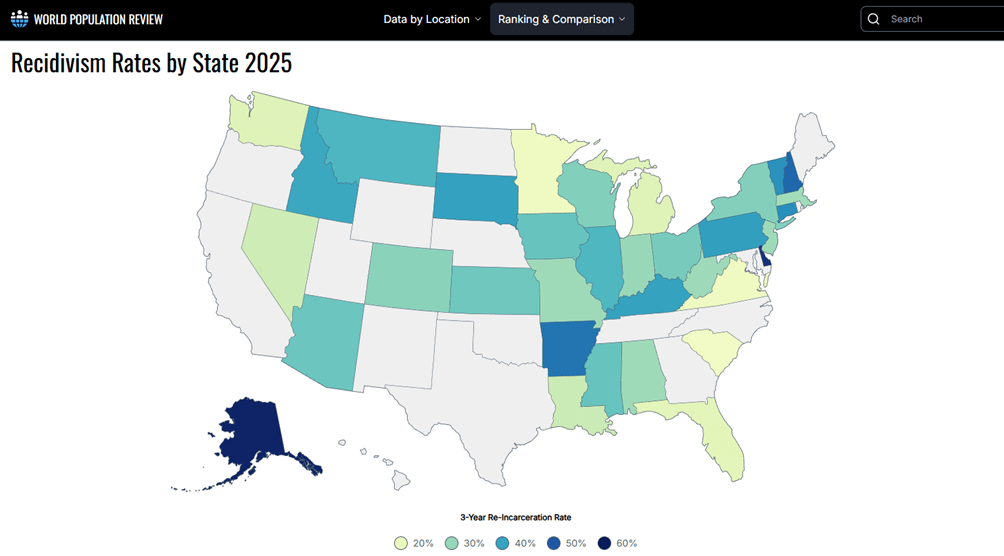
Recidivism is the tendency of a convicted criminal to repeat or reoffend a crime after already receiving punishment or serving their sentence. The term is often used in conjunction with substance abuse as a synonym for “relapse” but is specifically used for criminal behavior. The United States has some of the highest recidivism rates in the world. According to the National Institute of Justice, almost 44% of criminals released, returned before the first year out of prison. In 2005, about 68% of 405,000 released prisoners were arrested for a new crime within three years, and 77% were arrested within five years.

Factors contributing to recidivism include a person’s social environment and community, their circumstances before incarceration, events during their incarceration, and one of the main reasons, difficulty adjusting back into normal life. Many of these individuals have trouble reconnecting with family and finding a job to support themselves. Incarceration rates in the U.S. began increasing dramatically in the 1990s. The U.S. has the highest prison population of any country, comprising 25% of the world’s prisoners. Prisons are overcrowded, and inmates are forced to live in inhumane conditions, even those who are innocent and awaiting trial.

The United States justice system places its efforts on getting criminals off the streets by locking them up but fails to fix the issue of preventing these people from reoffending afterward. This is why many believe that the U.S. prison system is greatly flawed. Recidivism affects everyone: the offender, their family, the victim of the crime, law enforcement, and the community overall. Crime can affect anyone in any community. If a previously incarcerated person is released only to repeat an offense or act out a new crime, there will be new victims. Furthermore, taxpayers are impacted by the economic cost of crime and incarceration as the average per-inmate cost of incarceration in the U.S. is $31,286 per year.

Steps can be taken during incarceration to decrease recidivism. First is assessing the risks for reoffending and the criminogenic needs that contributed to breaking the law, such as a lack of self-control or antisocial peer group. The second is to assess their individual motivators, followed by choosing the appropriate treatment program. The fourth step is to implement evidence-based programming that emphasizes cognitive-behavioral strategies, coupled with positive reinforcement that can help them recognize and feel good about positive behavior. Lastly, the formerly incarcerated need ongoing support from a good peer group, as repeat offenders who were in gang culture have the greatest challenge to stay away from that behavior.3

The Second Chance Act, officially known as H.R. 1593, was enacted on April 9, 2008. Its aim was to improve the reintegration of formerly incarcerated individuals into society. The Act provided federal grants to state and local governments and nonprofit organizations to support reentry programs.

Goals of the Act

Reduce Recidivism: The Act focuses on lowering the rates of reoffending among released individuals.

Enhance Public Safety: By supporting successful reintegration, the Act aims to improve community safety.

Support Services: It provides funding for various services, including:

  • Employment assistance
  • Substance abuse treatment
  • Housing support
  • Family programming
  • Mentoring services

Nationally

Since its passage in 2008, the Second Chance Act has invested $1.2 billion, infusing state and local efforts to improve outcomes for people leaving prison and jail with unprecedented resources and energy. Over the past 15 years, the Bureau of Justice Assistance and the Office of Juvenile Justice and Delinquency Prevention have awarded funding to 1,123 Second Chance Act grantees to improve reentry outcomes for individuals, families, and communities.1 And critically, the Second Chance Act-funded National Reentry Resource Center has built up a connective tissue across local, state, Tribal, and federal reentry initiatives, convening the many disparate actors who contribute to reentry success.

The result? A reentry landscape that would have been unrecognizable before the Second Chance Act’s passage. State and local correctional agencies across the country now enthusiastically agree that ensuring reentry success is core to their missions. And they are not alone: state agencies that work on everything from housing and mental health to education and transportation now agree that they too have a role to play in determining outcomes for people leaving prison or jail.

Community-based organizations, many led or staffed by people who were once justice involved themselves, are contributing passion and creativity, standing up innovative programs to connect people with housing, jobs, education, treatment, and more. Researchers have built a rich body of evidence about what works to reduce criminal justice involvement and improve reentry outcomes, allowing the National Reentry Resource Center to create and disseminate toolkits and frameworks to support jurisdictions to scale up effective approaches. And private corporations that once saw criminal justice involvement as fatal to a candidate’s job application are now using their platforms to champion second chance employment as both a moral and business imperative.

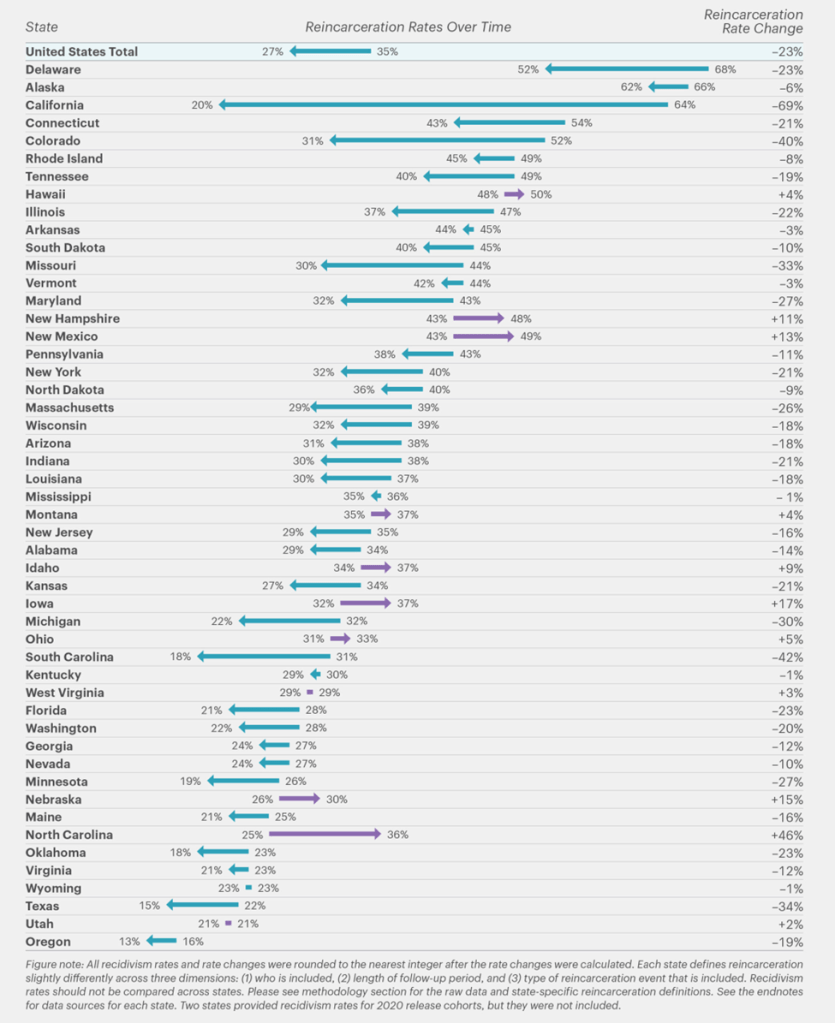
The efforts of these key stakeholders are bigger, bolder, and better coordinated than ever, and they are producing results. Recidivism has declined significantly in states across the country, saving governments money, keeping neighborhoods safer, and allowing people to leave their justice involvement behind in favor of rich and meaningful lives in their communities.4

Closer to home

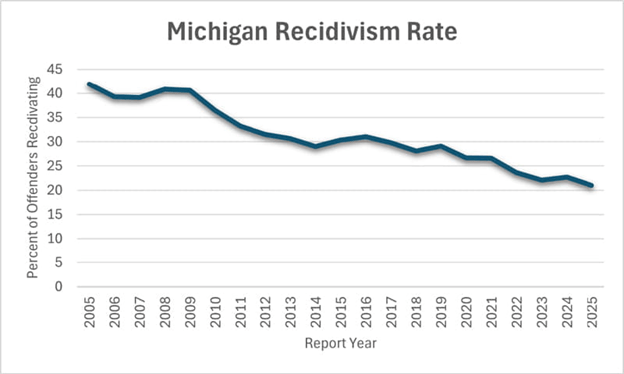
Michigan currently has a recidivism rate measured at 21.0%, the lowest rate on state record. The rate measures those who are three years from their parole date and records how many individuals have reoffended and returned to prison within that timeframe. The latest report shows a 79.0% success rate of those paroled not returning to prison.

MDOC has undertaken numerous evidence-based programs to continue reducing the state’s recidivism rate including supporting access to vital documents, housing, and recovery resources; job placement assistance; and effective supervision and care while individuals are incarcerated and on parole.

Prison educational programs have been seeing significant success with thousands of graduates since their inception. There are now 14 skilled trades programs and 12 post-secondary education programs operating in correctional facilities across the state, with additional programs expected to be added next year.

“This report shows that when we provide a full circle support system to those reentering our communities, they are less likely to return,” Director Heidi E. Washington said. “I am proud of our dedicated MDOC staff, and appreciate the support of our partners, all of whom help motivate and lift up those we are welcoming back into our communities. With increased support for reentry programing, we are very likely to see the state recidivism rate continue to decline.”

This report connects directly with a recently released MDOC prison population report which showed the lowest prison population since 1991, with 32,778 incarcerated individuals statewide, down from a peak of 51,554 individuals in 2007, illustrating success in rehabilitating offenders.5

Why this matters today

The Second Chance Act is up for reauthorization again this year.  It has not attracted much public attention with all the other actions taking place in Washington that have overshadowed this crucial piece of legislation. The Second Chance Reauthorization Act of 2025 (H.R. 3552/S. 1843) aims to enhance rehabilitation efforts for individuals transitioning from incarceration back into their communities.

Key Provisions

Grant Programs

  • Reauthorization: Extends grant programs for five additional years.
  • Support Services: Provides funding for reentry services, including housing, employment training, and addiction treatment.

Focus Areas

  • Substance Use Treatment: Enhances services for individuals with substance use disorders, including peer recovery and case management.
  • Transitional Housing: Expands allowable uses for supportive housing services for those reentering society.

Impact and Importance

  • Recidivism Reduction: Research indicates that effective reentry programs can reduce recidivism rates by 23% since 2008.
  • Community Safety: By supporting successful reintegration, the Act aims to improve public safety and reduce the burden on the criminal justice system.

The Senate passed the Act on October 9, 2025, as part of the National Defense Authorization Act, and it is now awaiting consideration in the House of Representatives.  Tell your Representatives to pass this bill and see it enacted in law so that the progress made in reducing recidivism and US prison populations will continue.

Find Your Representative | house.gov


End Notes

1 https://www.splcenter.org/resources/guides/trump-tough-on-crime-memo-faq/

2 Why the Tough on Crime Approach is Failing and What We Can Do About It – LAMA

3 Recidivism Rates by State 2025

4 50 States, 1 Goal: Examining State-Level Recidivism Trends in the Second Chance Act Era – CSG Justice Center


Testimony

In April of 2025 I was given the opportunity to give my testimony to a group of Keryx volunteers preparing for a Keryx Weekend Spiritual Retreat at Mid-Michigan Correctional Facility.  Prior to Covid they were able to conduct these retreats twice a year.  After Covid it took several years to even begin having weekly groupings with outside volunteers.  Currently they are only allowed to have one weekend retreat per year.  Covid had a significant impact on the Keryx ministry as it did on so many other faith-based ministries.  The need to recruit and train new volunteers means that about one third of the men for the upcoming weekend had never been involved previously.  In preparation for the Keryx Weekend the volunteers gather for three weekend training events.  One of the highlights of this training is that the Rector for the weekend will invite a former inmate who was part of Keryx to come and speak to the group about the impact that Keryx has on the participant’s lives both in prison and after release.  This testimony allows the ministry volunteers to understand how vitally important and life changing these weekends can be for the inmates who attend.


“My name is Tim and I sat at the table of Timothy here in St. Louis level 1 at Keryx 9.”

“I am here to give my testimony and to speak specifically about the Impact that Keryx can have on those who attend a weekend and get involved in regular Keryx meetings while serving time and after they are paroled back into their communities.”

“I grew up in a Christian home and regularly attended church my whole life.  I attended Spring Arbor College and earned a BA in Chemistry and Biology in 1986.  I did a Master’s program in Environmental Studies at Michigan Technological University. Education is a major indicator of whether or not a person is likely to go to prison.

“After graduation I took a job working for an engineering firm and got married to a college sweetheart.  One of my job assignments was to perform asbestos air monitoring behind the walls of the old prison in Jackson in the intake unit. For a week, every day I was escorted thru the cell block and locked in the attic.  We were chaperoned by a guard and took our breaks on the yard.  I told myself after that experience that I would never see the inside of a prison again.  In less than 2 years I was headhunted by an Environmental Laboratory in Ann Arbor.  We moved there and started a family.  Having a stable family life and work environments is another indicator of whether or not someone might go to prison.

“We attended the local Free Methodist church near where we lived in Ypsilanti. I was involved in couples and men’s groups.  For 20 years I was a sound man running AV for the church. I was elected to the church board, served as a trustee and on the Pastor’s cabinet. Having deep social and spiritual connections is yet another indicator of whether or not someone might go to prison.

“In 2008 I defied the odds and was sentenced to serve 8-12 years in the MDOC.  While waiting in the Washtenaw County jail for sentencing, I was served with divorce papers for our 20th anniversary and had my parental rights terminated for my 17-year-old daughter.  I spent the first 5 ½ years of my sentence in Jackson at Cotton Correctional.  I started in level 4 and worked my way down to level 1.  While I was serving time I worked as a tutor in the GED program.  I attended the Protestant church services on Sunday’s.  There isn’t a Keryx program at Cotton. I worked on my spiritual growth by reading all of the books by Chrsitian authors I could get my hands on and memorizing scripture. But my spiritual life was dry, it felt like my prayer’s were going unanswered.”

“The only outside contacts I had were my parents.  They faithfully supported me and encouraged me.  They came every month almost without exception for 8 years.  It was from them that I learned about the earthly manifestation of unconditional love.”

“I was jumped by a gang member in a hit, because another member had gotten caught breaking into my bunkie’s locker. They thought I was a snitch. While I was being attacked in the bathroom, the gang was ransacking my locker.  God intervened and a CO passing by the bathroom stopped the attack.  I was taken into protective custody and transferred to St. Louise level 1.  The COs recovered most of my earthly possessions, which fit into a footlocker and a duffle bag.  When I went to the property room, the CO told me that the power cord had been cut on my TV.  Normally that would mean that they wouldn’t give you back the TV, but the CO surprised me by saying that they were going to repair it.  I was able to pick it up the next day after they had put a new cord on it. No one on the inside that I spoke to said they had never heard of that happening before.”

“I had seen a posting in my housing unit for a Keryx weekend and sent a kite to the chaplain’s office.  I had heard from some of my church brothers in the housing unit that this was a great opportunity.  I was again attending Sunday service and Tuesday night Bible study, but it wasn’t meeting my needs by just having access to a worship service, Bible study and spiritual reading material.  I was again jumped by two gang members on the yard at the direction of my gang leader bunkie, because he thought I had snitched on his spud juice storage location.  In prison, everything is always someone else’s fault, that getting caught couldn’t possibly be because of anything you did, because you’re slick and the COs couldn’t possibly find out without someone telling.  This was regardless of the fact that anyone walking by our cube could smell it from 20 feet away.”

“Instead of being rode out, I was moved from the west side to the east side of the prison.  I again meet church brothers who encouraged me to apply when the next Keryx weekend was posted.  I got accepted and that weekend changed my life.  I had reached the point after being jumped twice in less than a year where I was losing hope.  I felt like my prayers were hitting the ceiling.  My hope for release at my ERD seemed slim based on what the parole board was doing to the guys I knew that had seen the board and been denied. The future looked bleak and my faith was beginning to crumble. The idea of having family, meaningful employment, community and spiritual connections was a fading dream that I didn’t believe I would ever have after I eventually got paroled.”

“Keryx changed that.  I found community and spiritual connection.  I served on three Keryx weekends.  I was a soundman for two and had the privilege of serving in the prayer room for my last.  The outside volunteers that I met treated me like a person and not a number. Their faithfulness in showing up every week for grouping meant more than I can possibly express.  That includes a number of you here in this room.  It is because of Keryx that I regained the spiritual fire that had once burned in me.  In Keryx I found likeminded brother’s in Christ, who encouraged me as I encouraged them.  My prayer’s now reached heaven and answers began to rain down.”

“I was paroled at my ERD.  I was a prodigal son who was welcomed home and given the family credit card.  I served most of my parole as care giver to my mother.  She’s had two knees, two hips, a shoulder and an ankle replaced, so far. I was able to attend my parent’s church and got to taste again the spiritual and community relationships that had come to mean so much to me in Keryx.  My first job working outside of the house was working as a dishwasher at a restaurant where half the staff was wearing a GPS tether. After parole, I began the process of looking for real, meaningful employment. I had the experience of having an application ripped out of my hands before I could even complete it, because of an instant background check.  The lady said she was sorry for my wasting their time.”

“I did find a job where the criminal background check was only focused on the last 7 years, and I got hired.  I started at the bottom as a media blaster cleaning metal engine parts.  That was 5 ½ years ago.  Now I am one of two regional project managers for a quality inspection company overseeing projects all over southeast Michigan.”

“In the last two weeks of my parole I met an old friend who’s father had just passed away.  She and her mother came to church to see friends and to say “thank you” for all the support the church had been providing to them as they mourned.  Leanne and I have been married for four years now.  A Keryx volunteer and pastor named David officiated our backyard wedding during Covid-19.”

“I had written to Wayne, care of the Keryx mailing address after I had been released.  He couldn’t reply to me obviously, but he did pass my contact information to David, who reached out to me about this new ministry that was starting in the Detroit area.  It was there that I met Scott.  Freedom Dreamers has a small group component.  When Covid-19 shut down society, Scott, myself and another brother DJ who had served time, grouped on line with visits from other Freedom Dreamer and Keryx brothers.”

“Scott and his wife became closes friends and my wife helped care for her from time to time during her illness, and was one of the last people to be with her before she lost consciousness and passed.”

“Jesus promised life and not just life, but abundant life.  There was a time before Keryx where my faith wasn’t strong enough to believe that.  A time when everything that I had worked so hard for was taken from me.  A dark place where I didn’t think that I would ever see the light of day again. But Keryx was that light shining in the darkness.  Keryx outside volunteers became the hands and feet of Jesus, bringing more than donuts and songs.  Keryx lead me to service with Freedom Dreamers.  Keryx helped me find my voice.  I have published a blog with over 100,00 words called Christ, Crime and Punishment at www.ccpministries.org, where I reflect on my time in prison, the correction system, societies impressions of crime and punishment and the Christians place in the criminal justice system.”

“I believe that without Keryx I would not have been able to endure prison, like Job endured Satan’s testing.  My life after prison has been richer and more fulfilling than I could have ever dreamed.  I came out of the fiery furnace like Shadrach, Meshach, and Abednego praising God and not smelling even like smoke.  I survived the Lion’s den like Daniel.  I have experienced Peter’s forgiveness and Paul’s enlightenment.”

“That doesn’t mean that my life hasn’t been without difficulties or pain.  My daughter has chosen not have a relationship with me.  At the holiday’s I learned thru a prayer by my father when he thanked God for his children, grandchildren and great grand child, that I had become a grandfather.  I don’t even know my grandson’s name and will probably never get to know him.  But I trust in, cling to and rely on God to provide for me, and that everything rests in God’s hand and His perfect timing.  Just like when God brought you and your ministry into my life.”


Sharing my testimony not only brought tears to my eyes, but to many men in the room.  For now, it is as close as I can get to participating in Keryx as an outside volunteer. But my hope and prayer is that someday I will be blessed with the opportunity to go inside the walls and minister to my brothers through this powerful ministry that is impacting so many in such miraculous ways.