Mountain Top Experience

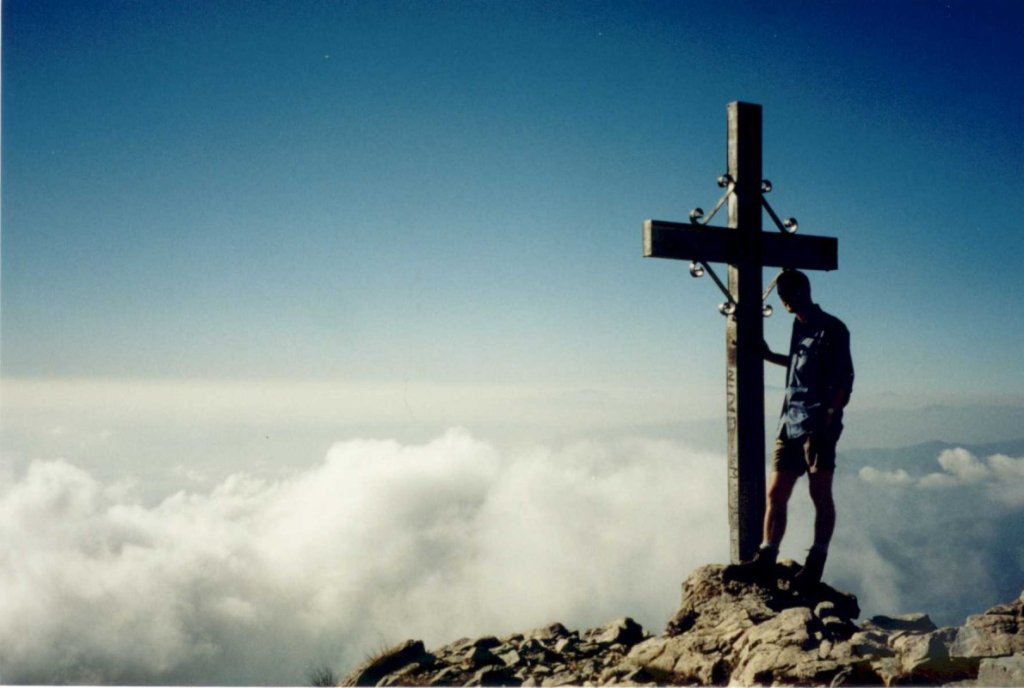
A mountain top experience is a time in your life when you experienced God in a deeply profound and meaningful way. A time when you felt closer to God than any other time in your life. It is the pinnical of both emotional and spiritual awareness. It is a life altering encounter with the Almighty. While the euphoria of the emotional component made fade over time, the power of the spiritual component should grow and increase.

The mountain top is not the culmination of the journey, but is in many ways the starting point of the next. You can’t live your life on the mountain top, as much as you would like to. Life is really lived out on the hills, valleys, and plains.

They say that lightning never strikes the same place, in the same way twice but mountain tops are a frequent target. We need to take the energy we absorbed on the mountain top and channel it into action. This may be to prune away the old dead parts of our lives and burn them up. It may be in stepping out in obedience to follow a call into ministry. Or it may be to return to our daily lives with renewed purpose and vigor.

Mountain top experiences are something that every Christian has at least once in their lives, when they are born again. But God wants us to continually seek him and when we do we will continue to have new mountain top experiences. Each one a unique and personal encounter with the living God, who loves us and wants our undivided attention, so that we can clearly hear the message He has especially prepared for us.


I wrote this meditation after I participated in a Keryx spiritual formation weekend while I was incarcerated in the MDOC.  This is a three-day short course in Christianity modeled after the Cursillos in Christianity.

Cursillos in Christianity (Spanish: Cursillos de Cristiandad, “Short courses of Christianity”) is an apostolic movement of the Roman Catholic Church. It was founded in Majorca, Spain, by a group of laymen in 1944, while they were refining a technique to train pilgrimage Christian leaders.

Cursillo is the original three-day movement, and has since been licensed for use by several mainline Christian denominations, some of which have retained the trademarked “Cursillo” name, while others have modified its talks/methods and given it a different name. In the United States, Cursillo is a registered trademark of the National Cursillo Center in Jarrell, Texas.

The Cursillo focuses on showing Christian laypeople how to become effective Christian leaders over the course of a three-day weekend. The weekend includes fifteen talks, called rollos, which are given by priests and by laypeople. The major emphasis of the weekend is to ask participants to take what they have learned back into the world, on what is known as the “fourth day.” The method stresses personal spiritual development, as accelerated by weekly group reunions after the initial weekend.

Today, Cursillo is a worldwide movement with centers in nearly all South and Central American countries, the United States, Canada, Mexico, Puerto Rico, Great Britain, Ireland, France, Spain, Portugal, Italy, Germany, Austria, Australia, New Zealand Aotearoa, Japan, Korea, Taiwan, the Philippines, Sri Lanka and in several African countries. The movement is recognized by the Holy See as member of the International Catholic Organizations of the Pontifical Council for the Laity in Rome.

This retreat is also used by Episcopalian/Anglican Cursillo, Presbyterian Cursillo/Pilgrimage, Lutheran Via de Cristo, Mennonite Way of Christ and various interdenominational communities as Tres Días.

Analogous retreats: The Cursillo method is used by ACTS, Encounter, Antioch, Search, Awakening (college students), Cum Christo, DeColores (adult ecumenical), the Great Banquet, Happening, The Journey (United Church of Christ), Kairos Prison Ministry, Kairos (for older teenagers), Emmaus in Connecticut (for high school age teens), Gennesaret (for those living with a serious illness), Koinonia, Lamplighter Ministries, Light of Love, LOGOS (Love Of God, Others, and Self) (Lutheran teen), Teens Encounter Christ (teen ecumenical), Residents Encounter Christ (REC) (a jail/prison ministry), Tres Dias, Unidos en Cristo, Via de Cristo (Lutheran Adult), Chrysalis Flight (Methodist Youth), Walk to Emmaus (Methodist Adult), The Walk with Christ (interdenominational), Anglican 4th Day (Anglican Adult), The Way of Christ (Canadian Lutheran adult), Tres Arroyos (Charismatic Episcopal Church). and Journey to Damascus (Catholic hosted Ecumenical with weekly reunion groups for alumni) in the Corpus Christi, Houston, and Austin, Texas, areas.

Wikipedia
A Meditation on the Aspects of Prayer

(An attachment to the Summer 2018 News Letter)

I don’t often get distracted from listening to the pastor’s sermon while sitting in the church service.  I take notes and engage as an active listener to hear what God has for me as the Word is preached.  However, this week it was the congregational prayer that got me thinking.  As I listened to Pastor Sheila bringing forth specific needs and then leading us to the throne of grace, thoughts began to coalesce and take shape in my mind about the nature of prayer.  In my recent devotions I have been reading the collected works of Andrew Murray on prayer.  According to him prayer is every Christian’s responsibility and that regular, routine prayer is both the sign of a healthy spiritual life and the source of a believer’s power.

Meditation for me is the process by which I take information gathered from various sources and my life’s experience and organize them into a coherent form by which I can understand a topic by the inspiration of the Holy Spirit in order to incorporate the concepts into my life.  As the concepts came to me I jotted them down in the back cover of my sermon notebook.  They came in no particular order and as with all meditations have needed some time to organize and flesh out from bullet points to complete statements.  My initial meditation lasted only 20 minutes and while it was very productive in laying out my thoughts, I know it is nothing compared to those like Andrew Murray who are far wiser than I and have spent their lives contemplating prayer.  But I share it as an exercise to stimulate your own contemplation on what prayer means to you.

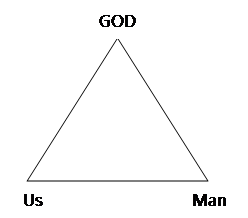
As I wrote my reflections I identified 3 major aspects that describe the relational nature of prayer as I’ve experienced it.  Prayer is often intercessory, it is an act of two-way communication, and incorporates both the attributes of humanity and divinity.  For each of these aspects I identified characteristics to describe them.  I am not talking about the actual parts of a prayer, the mechanics of how to pray, or the different types of prayers.  Rather this is a look at the relational aspects of prayer between us and God, us and man, and God and man.

We pray to God on behalf of others (and ourselves), God speaks/acts towards us, and God also speaks/acts towards others.  We have concerns for others and others often ask us to pray on their behalf.  This reflects the way Jesus taught the Disciples in the Lord’s Prayer in Matthew 6.

Prayer is…

A.     An Intercessory Act that encompasses the:

  1. International, national, and local communities we live in.
  2. Public and private aspects of life.
  3. Secular and sacred circles in which we interact.
  4. Physical, mental, emotional, and spiritual dimensions of individuals.
  5. Expression of both spoken and unspoken needs, wants, and desires.
  6. Time frame for actions that are both contemporary and eternal in scope.
  7. First act of hope and the last act of desperation in times of trouble.
  8. Passionate desire and compassionate intent to see God’s kingdom.
  9. Action of man in reaction to situations beyond our control both in the reality of today and our expectations for tomorrow.

B. Two-way Communication:

  1. Between humans and the Divine.
  2. Involving a call and response.
  3. Whether it is cried out loud, spoken in a whisper, or uttered in silence.
  4. That is occasionally eloquent but frequently tongue-tied.
  5. Regarding things asked for and received.
  6. Often asking questions and seeking answers.
  7. In which we remember the past and envision the future.
  8. Of ideas hidden in our hearts and yet already known to God.
  9. Best described as a child speaking to a parent and a parent speaking back to a child.
  10. Acknowledging our weakness and God’s strength.
  11. Expresses our heart broken condition and our heart-felt plea.

C. The intersection between Man’s attributes and God’s character:

  1. Man is broken and downtrodden by the cares of the world. God’s joyful response heals and uplifts us.
  2. Man’s desperate cry for help is heard by God whose peaceful Spirit comforts us.
  3. Man is powerless in his situation and reaches out to an all-powerful God for assistance.
  4. Frequently faithless man needs the reassurance of a faithful God.
  5. Man’s foolishness is often the source of his trouble and wisdom from God is the solution.
  6. Finite man is impatient for answers from the infinite God who is perseverant in responding.
  7. Uncertainty is the way of life for man while God is confident in all his ways.
  8. Man’s ignorance is far from blissful and only God’s knowledge can bring a state of contentment.
  9. Isolated and lonely man craves God’s familial relationship.
  10. Man’s sinful nature can communicate with a perfect God only by His grace.

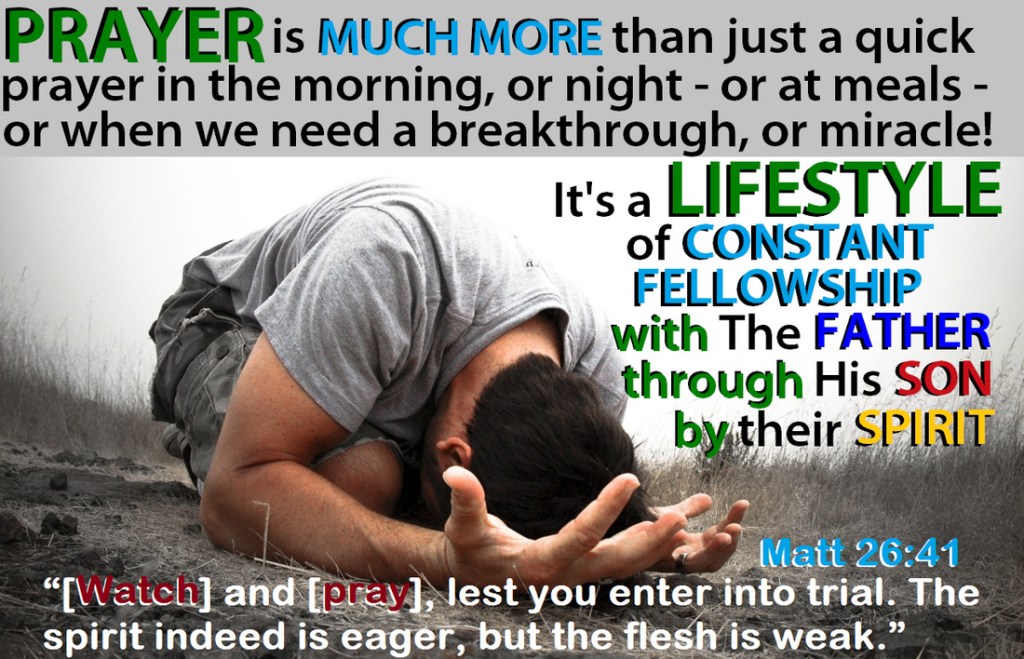
Prayer is a personal experience, no two people will have exactly the same encounter with God.  Our own experiences change over time as our spiritual health and maturity are not static.  Only God never changes.  Periods of spiritual dryness and silence in response to our prayers is a well-documented fact for even the most devote believers.  But Scripture is clear that this is only our perspective.  God will never leave us or forsake us.  We just need to trust and obey the admonition to pray without ceasing.