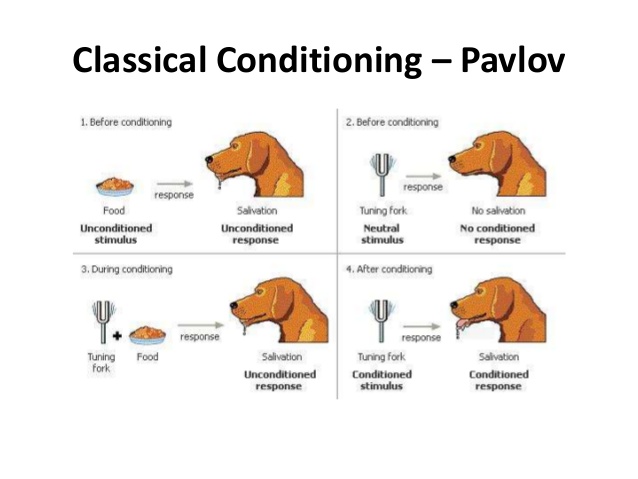
Ivan Pavlov is known for his work in Classical Conditioning back in the early Twentieth Century in which he was able to create a learned response in dogs by getting them to salivate when a bell was rung rather than by showing them food. In the MDOC something similar happens. Meal service begins morning, noon, and evening after count clears. The housing units are dismissed to the chow hall one at a time. There are different rules in different levels and the COs also enforce their own rules. In general, the lobby area is off limits until the unit is called to chow. The CO gets on the PA system and announces “Chow Time” to dismiss the unit to chow.
In level IV the inmates must be released from their rooms and they will then leisurely stroll to chow, drawing out the amount of time spent out of their cells to the maximum amount possible. There is no urge to be first because there is no sitting and enjoying the meal. You eat and you leave the chow hall under the strict watch of the COs. But level I and II are completely different.
In level I and II when the unit is called to chow it is a stampede. The door to the unit is a natural choke point and it gets pretty crowded with bodies jostling each other to get out. When you add canes and walkers, someone is likely to get run over. To alleviate this some facilities will call a special early chow for handicapped inmates. Those with canes or walkers find it difficult standing in line and given the distance from the housing unit to the chow hall would end up at the back of the line.
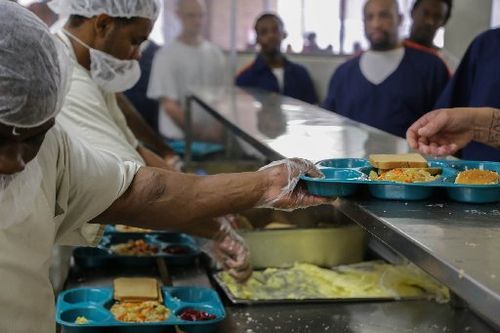
MDOC food service at an unnamed prison. ( Photo: Ryan Garza/Detroit Free Press)
Chow can take 1½ to 2 hours to run depending on the size of the chow hall and the number of inmates to be fed. Factors like food preparation issues can add additional delays. Aramark and Trinity had a history of problems like running out of food and were fined for it. Running out of chicken quarters on a Sunday could delay the release of the last unit while more is cooked or an alternative like chicken patties were prepared. In level I and II getting the last unit into the chow hall is the cue to open the yard. Prior to this movement is controlled. This means that after eating inmates return to their unit or go to callouts such as school or medical. When the yard opens inmates can go into the front yard and big yard. The reason for controlled movement is to among other things prevent inmates from slipping back into the chow hall.
Double dipping is a real problem. Portions are not big enough to satisfy most adults, so guys will try almost any way to get full. To control food costs the kitchen prepares a certain number of meals based on estimates of inmate and staff meal consumption from historical records. For instance, maybe only 50% of inmates at a given facility regularly eat breakfast, so only that much food will be prepared for oatmeal, grits or cream of wheat days. However, on waffle and sausage day 75% of the inmates will get up for breakfast so more food will need to be prepared that day.
From friends working in the kitchen I’ve heard reports of meal preparation exceeding 125% of the inmate population plus staff. To combat this the MDOC invested in a computerized system using bar code or magnetic strip readers to scan ID cards as people go through the serving line. But like the other cat and mouse games that inmates play they are always looking for ways to beat the system. I’ve seen guys duck under the rail to get back in line when the staff wasn’t looking. Guys passing trays from the line to others sitting nearby. Guys taking two trays off the line to get a second burger or hot dog and abandoning the tray when they leave the end of the line. Use someone else’s ID card who isn’t going to chow. And the old standby of having a friend on the serving line. All of this in addition to food service workers stealing food. No wonder the portion sizes are so small.
Not only do you leave the chow hall hungry but also disappointed because the food quality is so bad that some things had to be left on the tray as uneatable. Potatoes that were so over cooked that they are as hard as bricks. Under cooked rice. Over cooked greens. Polish sausage that is the texture and consistency of rubber hose. Fish that is mostly fins and scales.
There were rumors abound about boxes of food labeled “Not for Human Consumption” being delivered to food service for inmate meals. Newspaper articles appear from time to time documenting events where Aramark or Trinity were fined for attempting to serve food with maggots, rat droppings, or fished out of the garbage. The bottom line is the bottom line, food costs money. The goal is to feed an inmate for $1 a day and has been for years regardless of inflation. When buying the cheapest food isn’t enough food service management will do whatever it can to contain costs, even cut corners. I suspect that Pavlov’s dogs wouldn’t have salivated in anticipation of a meal at the MDOC.
Prison libraries have the smell of old books and the looks of a hoarders living room without the eclectic charm. Books were the only thing to keep me sane.
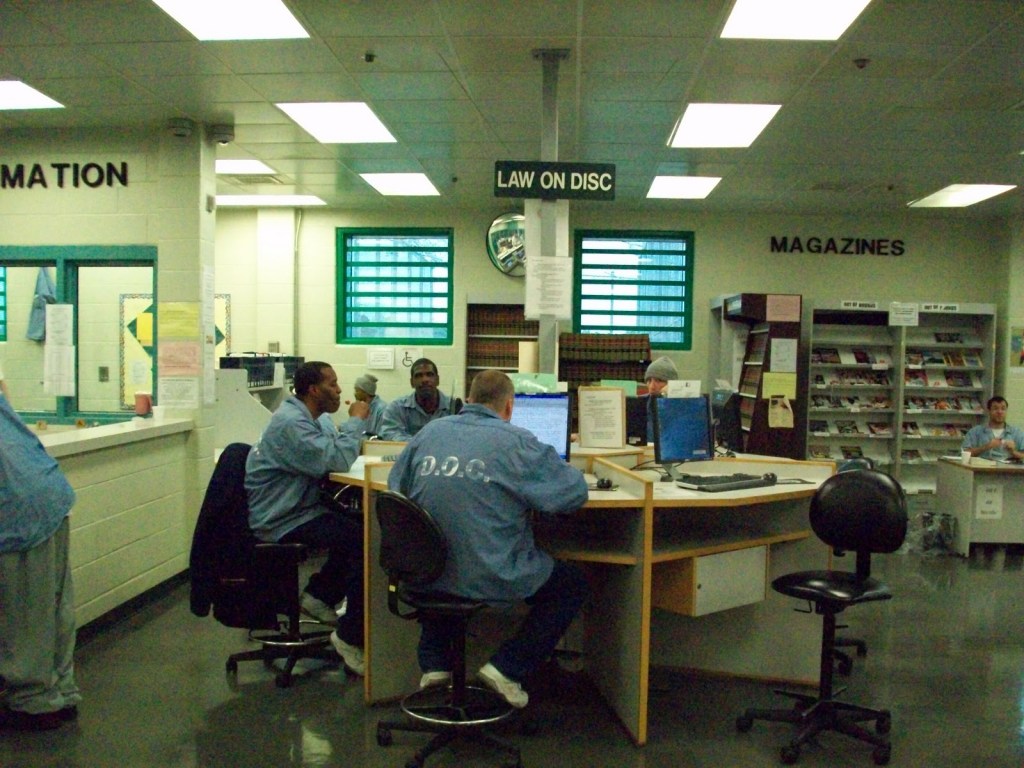
By law inmates are not allowed access to the internet so computer access is very limited and heavily restricted. The three places where inmates have access is the JPay kiosk for email in the housing units, educational software and GED test taking in the school, and the LexisNexis legal software in the Law Library. All of which were grudgingly adopted. The MDOC is not a 21st century institution.
This is a picture of a law library in a federal prison with the computerized work stations similar to the ones I saw while I was in prison.
The General Library on the other hand is as traditional and anachronistic as it gets. At my first facility it even had a card catalog. At my second, the catalog was computerized, but made available to inmates in a printout kept in a 3-ring binder. Fiction, Nonfiction, Reference, and Periodicals. Like the rest of the MDOC there is really no budget to update the libraries contents. Books have to be acquired creatively, such as donations of books removed from circulation in public libraries and inmate donations which comprise the majority of the library collection. The result is an eclectic conglomeration of incomplete series, authors no one has ever heard of, yellowing paperbacks and the odd best seller or two.
Reading 3 to 5 books per seek I probably read between 1200 and 2000 books. About my 3rd or 4th year I saw a guy with a notebook where he kept a log of everything he read. I wish I had thought of that. More than once I checked out a book that by the time I’d read the first chapter I realized I had already read it. The low-tech method of date stamping an index card utilized means that the library clerk can’t tell you whether or not you’ve read a particular book title.
Most prison libraries have an Inter-Library Loan program where inmates can borrow books from the local public library. The catch is there is no way to know what titles are actually in the library. You need to have the book title and author you want to request. After completing the ILL form and signing a blank disbursement form to pay for the book whatever the cost if something should happen and it is lost. Then wait three weeks to find out if it is available. The perfect system for people who have nothing but time on their hands.
The library is a very small space packed floor to ceiling with books and sometimes a waiting list of guys wanting to get on the call out. Frequently when I was reading a series I would have to wait weeks to get the next book. One of the most frustrating things about the library was the number of lost books. Guys rode out or go home and the books don’t get returned. Books lost in the housing unit often turned into wedges to prop up desks or bunks, or any number of tragic ends. It may take years for missing books to be removed from the catalog.
One of the blessings I received from my family was their willingness to order books for me from Amazon, an approved vendor for books that outside people could order from for us. I was able to plug the holes in several series that I was reading by donating the books after I read them.
Getting newspaper subscriptions was problematic. I had a subscription for my home town paper, but papers were frequently missing. Because of the indirect delivery system, the paper company did not give credit or refunds for the papers I did not receive. The alternative is to read newspapers at the library. With a short callout there wasn’t enough time to digest the whole weeks’ worth of papers, but at least I could look at the headlines so I could have some awareness of local events back home.
I couldn’t resist this bad prison pun. Early on I realized that there isn’t much humor in prison and made attempts to make light of the situation. While most guys could understand and tell dirty jokes most did not have the language skills for puns like this one.
Newspapers were generally available for 4 – 5 of the largest cities in Michigan so guys could keep on top of local news. Magazines mostly dealing with culture are also available. These varied greatly from facility to facility based on what requests the librarian was receiving from inmates. All paid for by the PBF.
Like most libraries prison libraries are quiet. At least relatively speaking in comparison to the rest of the facility. I was always amazed how quickly the time passed there. Whether wandering through the stacks perusing the title looking for just the right book to read or skimming the headlines, the time just flew bye and all too soon it was time to go home. If I hadn’t had a job working as a tutor I would have probably worked in the library.
While the callouts were always full, it represented only a small percentage of the inmate population. Too many men were functionally illiterate, others were poor readers who just didn’t enjoy it so won’t turn to it as a past time. When working with students in the school I always encouraged them to sign up for a General Library call out, find something you liked to read. I told than that the more they read the stronger they would get mentally. I compared it to weight lifting. The more you do it the stronger you’d get. It didn’t matter what the subject matter was just do it. With count tine occurring several times a day there was a 60-minute opportunity every day to exercise your mind. Unfortunately, few took me up on this suggestion.
At one facility the library offered a 363-certificate program called the Individual Resource Study Center (IRSC). It allowed inmates to independently study a variety of educational offerings. Course materials had homework and there was a final exam. You worked at your own pace. Course offerings ranged from high school social studies and math, advanced small business to empathy and leadership courses. The educational materials would help those who only had a GED to round out their education.
IRSC provided an opportunity for inmates to participate in self-help programming that was recognized by the parole board. Due to lack of over sight by the librarian, the library clerks working with the program were able to falsify student assignments and test results for profit, to assist those who tried to exploit the program for the purpose of trying to look good for the parole board without doing the work. As a result, the program was significantly curtailed, clerks were fired and greater oversight was instituted. The materials I found to be at least 10 years old and like so many other programs, it started out with good intentions suffered from neglect.
There are exceptions to every rule. There are personalities that don’t fit any profile. There is always one in every crowd. There are behaviors that defy explanation. There are people that beat the odds and succeed against all probability. Even a blind squirrel finds the occasional nut. Never say never. When it comes to the human spirit statistics are meaningless. Success is 5% genius and 95% perspiration. By the grace of God.
Whether you believe in fate, karma, luck, or Jesus one thing is certain. Some people will walk out of prison like Daniel from the lion’s den or the 3 Hebrew boys from the fiery furnace. And it probably won’t be the ones that you might have picked going in. Everyone responds differently to prison.
The pressure: the physical, emotional, mental, and spiritual pain that gnaws at you relentlessly. The conditions that make a diamond out of a lump of coal reduce everything else to dust. There really are no winners coming out of prison, everyone has lost something. But how you deal with adversity truly is a matter of character.
Do you make the best of a bad situation or roll over and die? Do you see the glass as half full, half empty, or as an opportunity to get more? Prison can make you bitter if you let it, but there is always a choice. Grow, change, adapt, learn, look to the future. Or you can cling to the past, resist, stagnate, and die.
Erma Bombeck once wrote a book entitled “The Grass Is Always Greener Over the Septic Tank.” Well prison is a septic tank and there is most certainly a lot of sh*t there. But it is all about how you deal with it. Prison makes very few people better for the experience. More people are appreciative of freedom having lost it for a period of time. Others found opportunities for education that they had failed to take advantage of in the world and leave with a degree or vocation. Some learn their lesson and go straight. All of these comprise a minority of those who are released. But they have one thing in common. They did it themselves. They didn’t expect the system to do it for them. They made conscious decisions that affected the outcome in a positive way rather than just sitting back and going along for the ride.
No matter where you came from or who your family is, or what happened to you before going to prison, what matters is how you used your time there. There are only two options: either you do your time or your time does you. Figuring this out is what separates the winners and losers in the prison lottery.
If your loved one is in prison make sure that they understand this. There is no magic trick, sleight of hand, or hocus pocus, only hard thankless hours of effort for which there is little short-term gain. The rewards are all long term, deferred until after they are released. If you can’t do right in prison, then you won’t do right in the free world. The system is against you, wants to break you, doesn’t care if you succeed. You have to reform yourself under the worst conditions imaginable. But to do so is to snatch victory from the jaws of defeat. To walk away from a fatal crash. To escape the maze. To show true character in the face of adversity. To be the one in a million.
Tom Modell, the spokesman for the Motel 6 lodging chain used to end his commercials by saying, “We’ll leave a light on for you.” A friendly way of letting people know that they were always prepared to receive guests. The MDOC by contrast is more like the “Hotel California” in that “you can check out any time you want but you can never leave.” Prison and county jails for many are like a rat’s maze that is difficult to navigate, full of many dead ends, and all the exits seem to lead right back in.
Like all areas of government in this day and age, financial resources are tight, yet jails and prisons are critically over crowded. Being asked to do more with less has resulted in a situation where jails and prisons more closely resemble warehouses than rehabilitation centers. It has reached the point where correction has been replaced with punishment. To most, the idea of pointless punishment is considered cruel and unusual, but for the MDOC it is business as usual.
After serving a sentence which is on average 127% of the minimum which is 120% of the federal average, many find themselves back on the streets with a large debt accumulated and limited prospects for an income sufficient to live on let alone spare resources to go toward retiring that debt.
It is the practice of county jails to charge booking fees for each suspect arrested and processed into jail. So, whether you are ultimately found guilty or not you have started accumulating debts which will add up. Many jails also charge inmates a daily rate. Any money found on your person at the time of processing immediately goes toward paying the bill. Any unpaid charges will follow you after your release.
In court you must have legal representation and if you can’t afford a lawyer on will be appointed to you. What used to be provided as a pro bono service by a local attorney or through a public defender’s office at no charge now comes with a significant price. When you pay for your own attorney you must pay up front prior to having services rendered. If you are indigent and can’t afford an attorney they will provide you one and then bill you later. In either case you are out thousands of dollars simply to “negotiate” a plea agreement and tens of thousands of dollars to fight your case in court. Only those with significant financial resources can afford to mount a rigorous defense.
Upon conviction, as part of the sentence agreement you will receive a bill for fines, restitution, and court costs. These will follow you to prison and under state law the MDOC will collect from your prison wages and any deposits to your trust account 50% of what you receive over $50 per month, and if you have multiple cases they can take up to your last $20 or $5 if there are federal charges involved.
To ensure that these costs are recouped, the MDOC has the power to seize your assets, and empty your bank accounts and investment savings -anything that is solely in your name. They don’t have the ability to seize anything that is in a joint account or has a second owner named such as a deed to a house or car.
After paying off the fines, restitution, and court costs including court appointed attorney, the MDOC can then charge prisoners a daily rate for their incarceration, until the seized financial resources have been consumed. Paying for your own room and board in prison does not entitle you to any extra privileges, no extra helping at chow, and no mint on your pillow.
In theory the prison chow hall diet is based on 2000 calories per day, but the reality is somewhat less than filling. Most people will lose 10-20 pounds in prison. Overweight people may lose 50 pounds or more as their fat reserves are tapped. For many, physical activity such as weight lifting, rigorous workouts, and sports are part of a daily routine in prison to help the time pass quicker. However, with increased physical activity comes a biological demand for more calories. To supplement the necessary caloric intake the commissary does a booming business. As this is not a basic necessity but is considered a luxury it comes with a steep price. In county jail a package of Raman noodles may cost a dollar, in prison it costs $0.34, while in the world they go for 10-15 cents each. With a captive market, prisoners pay exorbitant prices for low quality products. Catalog vendors, for instance charge $20 for a pair of sweatpants and another $20 for a sweatshirt that you could buy at WalMart for $15 for the set. Most of what is sold is seconds and irregulars, not high quality durable goods.
I found this picture of a prison TV for sale on an Etsy webpage.
Due to safety concerns TVs, radios, headphones, and other appliances approved for purchase must be made of clear plastic so that it is not possible to hide contraband inside. However, some of the plastics used are of an inferior quality and are subject to breakage under conditions of routine usage. A small 13-inch flat screen TV that you probably can’t even buy on the streets will cost you $200.
They say “it sucks to be poor” but it is even worse to be poor in prison. Since the majority of people in prison are from the lover socio-economic classes they and their families are the least able to afford it. Prison didn’t use to be this way. Society paid the cost of keeping the streets safe by paying to incarcerate the violent offenders. Then the “war on drugs” sent a large number of non—violent drug addicts to prison. Prison populations increased dramatically and so did budgets but not at the same rate. Prison officials needing to do more with less have sought ways to charge for services that they previously provided for free. When it’s time to leave prison, you have to turn in your state blues, the state will sell you a pair of khakis cut from the same uniform pattern for $50. Something you wouldn’t even want from the Salvation Army store at half the price.
Dealing with the Quarter Master can be like dealing with a used car sales man. If you lose a towel or a washcloth, they will charge you for them, luxury prices for third world quality. Underwear and socks that are ill fitting and shoes that will ruin your feet. Blankets and sheets are used until they are threadbare and then some. To save money they reduced the number of sets of state blues from 3 pair to 2. At some prisons laundry in only once a week, prisoners have to wear the same set of cloths for days on end.
The MDOC requires that prisoners either attend school or work. Students are paid $0.58 per day for a 5-day school week. Pay rates for the various jobs from porter to kitchen worker and wheel chair pusher to clerks and tutors vary significantly. Most jobs pay less than $1 per day. Depending on whether it is a 3, 4 or 5-day detail or has overtime available some earn as little as $10-15 a month while others may earn as much as $70-100. For those very few who are fortunate to work for the Michigan State Industries (MSI) or Braille Transcription Service income rates may be higher still. Pay rates for prisoners have been stagnate for years and in some cases have gone down significantly, such as when they eliminated bonuses for kitchen workers.
And the cost of living keeps rising so that what little buying power they had has eroded. Currently in the commissary prisoners are allowed to spend $100 per store every two weeks. From this they must purchase their necessary hygiene and food items. For an individual with no outside resources they must live on what little income they have earned from some type of hustle on the yard. There is a great gap between the haves and the have nots. A small bag of instant coffee costs $4, so for many it is the only luxury item they can afford and may preferentially choose that over soap and deodorant.
If you have need of medical service from Health Care there will be a $5 co-pay required for all routine services including teeth cleanings, eye exams, illnesses and non-job-related injuries. If you don’t have the money in your account, service will be rendered but they will take the money out first when some shows up. Additionally, over time the co-pay has been applied to chronic care visits for those with long-term and possibly life-threatening conditions that cause the person to seek medical services beyond the semi-annual exam.
For those who are unable to work or receive outside support, the Prisoner Benefit Fund (PBF) can provide $11 a month to those who meet the criteria for indigent status. This is a loan that must be paid back when there are funds in the inmate’s trust account. To qualify a person must have had no money in their account for the last 30 days. The funds provided are for necessary hygiene only.
Health Care no longer provides basic medical pharmaceuticals such as aspirin for headaches, cough drops, cold pills, antacid, fiber laxative or hemorrhoid cream. In the crowded living conditions colds and other illnesses spread rapidly throughout the population due to poor hygiene and sanitization. Those unable to afford the remedies available for purchase in the commissary must struggle through their illness without symptom relief.
With the inability to earn money to pay for the basic necessities and large debts assessed by the courts most prisoners leave prison without any financial resources at all only to find out that the debt accumulation is not over. On parole oversight fees and electronic tether monitoring fees can cost hundreds to thousands of dollars more. Depending on the type of programing required by the Parole Board there may be additional program fees incurred. All outstanding fees owed at the end of parole will be turned over to a private collection agency on behalf of the state.
The longer a person is on parole the higher the chances of violating that parole. Recidivism rates within the first 3 years of release from prison range as high as 75% for some categories of felonies. Random drug and alcohol testing, random curfew enforcement checks, failure to comply with reporting and work requirements can all result in the revocation of the parole and send you back to prison.
For some the only hope to break this cycle is to “max out” on their sentence so that they can avoid having to deal with parole. The result is that a person doing 2-10 years may be eligible for parole at their earliest release date (ERD) of 2 years may return to prison several more times due to parole violations and received a flop by the parole board and end up doing the full ten years on the installment plan.
For some this is not an option, since the tail on their sentences from multiple convictions have been stacked so that they have a potential 25 to life that they could theoretically have to serve in prison. But in either case it sets up a revolving door whereby a person can expect to return to prison for some additional period of time.
To address the high recidivism rates and the critics accusations of warehousing, the MDOC does offer programming for some categories of felonies. Violent offenders may be required to take Violence Prevention Programming (VPP) or Thinking for A Change. Sex offenders may be required to take Sex Offender Programming (SOP). Those that have drugs or alcohol involved in their cases may have to take Phase 1 and Phase 2 Substance Abuse and additionally have to take ASAP/RSAP which are residential treatment programs. Domestic abuse cases may have to take Bridges. There are group classes, some of which are conducted by Psych Services. Positive reports must be earned or else the parole board may not grant parole. For those without education or with learning and/or psychological disabilities this can be a challenge. Also, the mentality of so many prisoners is to resist authority, a “you can’t make me learn” mentality, or simply a person who likes who/what they are and doesn’t feel the need to change. These programs will do little good to ensure a positive outcome and successful rehabilitation for these people. For some repeat offenders who have completed all the applicable programming and returned with a new case for the same crime no additional classes may be assigned, not even a refresher course. The opposite is also a possibility, a person back on a parole violation may be required to complete the programming a second time even when the violation was on a technicality not a new conviction. In either case all they can do is hope for the best with the parole board. Just as it is true that you can lead a horse to water but you can’t make him drink. You can send a felon to prison but you can’t make him think.
Going to prison is costly both financially and in human terms. Lost productivity which can never be recouped, lost years of family time including weddings, births, and funerals. A debt to society that society refuses to accept payment for. Trust that has been broken by both parties in the relationship but for which separation is not an option. For many in prison the only light at the end of the tunnel is the oncoming train.
One of the most sought-after jobs for inmates in the DOC is Laundry Porter. At most facilities laundry is processed by unit laundry porters. Prison laundries are located either in the housing unit, a facility laundry or in a few rare instances at an off-site facility. With the doubling of the number of prisoners housed in each housing unit, like most ancillary infrastructure the laundry facilities did not increase. The result is a real need for 24/7 laundry operations in order to keep up with the demand. The washers and dryers are generally commercial/industrial grade in nature and most are decades old. The result is that there are frequent breakdowns with repairs conducted by in-house maintenance staff as long as there are parts available. Laundry detergent and bleach are delivered in 5-gallon pails which are hooked up by tubing to the washing machine and are automatically measured out and added to the wash, depending on the cycle chosen.
Laundry Porters are considered unskilled labor and are paid less than $1 per day but make a fortune in coffee and Raman noodles by providing special service. If you wanted your laundry to come back clean you contracted for about $3 per month with a laundryman to personally see to the washing of your clothes, especially items like sweats. If you didn’t pay to have your laundry done then it would likely be crammed into the washer with too many others’ bags. Laundry is placed into mesh bags with your prison ID and housing unit bunk number (called a lock). So, if you didn’t pay to have it washed separately it be washed in the bag and tended not to come clean due to the lack of agitation.
The standing joke was that laundry came back dirtier than when it was turned in. I proved this once by turning in a brand new white tee shirt and it came back gray. Leaving one to wonder if the laundry had been washed with the rag mop heads. Also, the odds of your laundry not coming back due to theft increased significantly if you didn’t pay. In one housing unit where I locked the laundry porter would put wet laundry bags on the heat register to finish drying where anyone had access, so laundry frequently turned up missing, especially items like sweats or new uniform blues.
Paying for a free service was the only way to get your clothes cleaned and returned each time. It wasn’t without risk but there isn’t any coin operated self-service alternative. At a different facility the laundry was a facility laundry so there were fewer problems with laundry theft, but the washing was really poor. I had to resort to hand washing my tee shirts in the bathroom sink and hang them over the end rail of my bunk to dry. Theoretically this is against the rules but a lot of guys who were concerned about their appearance did it all the time. Considering that you only got 3 tee shirts that meant sink washing 2-3 times a week.
Doing laundry was necessary since you have such a limited wardrobe, at least it should be. Not everyone was hygienically inclined and would wear their uniforms for days on end. Some of these were people with mental disorders and it would take a direct order from the CO to get them to shower and change clothes. In cases like this the laundry man would treat the dirty laundry like it was a biohazard and wash it separately. Laundry Porters had to trained to handle blood borne pathogens, since blood, urine, and fecal material are biohazardous. Since the washing process does not sterilize and the colored load doesn’t use bleach these could contaminate other people’s clothes and spread disease.
I knew one guy who had bowel troubles and he paid several laundry men to handle his biohazardous laundry so any time he had an accident he could get his soiled laundry cleaned. If he didn’t pay they wouldn’t touch his stuff. For someone who was disabled and unable to work this represented a financial hardship, but he didn’t have an option. The laundry porters treat their jobs like a business and aren’t into charity.
Corrections Officers (COs) are trained professionals, some with previous military or law enforcement experience, and a minimum of an associate degree from an accredited university. At each prison there is a command structure for custody staff similar to that found in most police departments: Captains, Lieutenants, Sergeants, Officers, and Inspectors. The custody staff reports in a silo to the Warden and Deputy Warden to carry out day-to-day custody operations. Where ever there are inmates there will be COs watching over them, often times directly, at other times by surveillance camera. At least that is the theory, however the reality of the situation is not so straight forward.
Officers conduct periodic rounds of their assigned areas to visually monitor inmate activity. Routine searches are conducted to look for contraband such as weapons, stolen property, alcohol, tobacco, illegal drugs, tattoo paraphernalia, and everything else forbidden to inmates by policy. Innates are subject to pat downs in any place at any time at the discretion of the officers. There is even a quota of random searches intended to make inmates think twice about participating in illegal activity.
Corrections Officers are all part of a union that advertises that theirs is the most dangerous job in Michigan. They lobby the legislature and administration continuously regarding staffing levels, compensation, prison closures, use of Tasers, prisoner personal clothing, and an endless list of wrongful termination cases to protect their fellow officers. From my personal observation the majority are overweight, out of shape and aging, especially in Level I. They sit around in offices, especially second and third shift, doing nothing but talking or surfing the internet. They don’t enforce the rules consistently and turn a blind eye to theft, illegal activity and bullying. They show favoritism and will single out inmates, often based on their crime for harassment or worse.
There used to be a position called Regular Unit Officer (RUO) and for each shift there would always be the same officers working in the housing units. They knew everyone’s names and faces. They knew who caused trouble, who was troubled, and those who stayed out of trouble. They received higher compensation for the position than COs that worked in other areas. The position was eliminated a few years back as a cost savings measure. The COs and their union were not happy about this. The COs that worked in the housing units tended to have higher seniority and resented the loss of income and position. Officers can now be assigned to other positions on their shift at will. The result has been a work slowdown, a form of silent protest. I watched it happen first hand.
Officers in the housing units still tend to be routinely assigned to the same unit, but they tend to do the bare minimum for their required duties. It is the younger officers that don’t routinely work in the housing units that are making the big busts, actively shaking bunks and inmates down. The older officers are too predictable in the timing of their rounds, lax in their searches, and even turn a blind eye to illegal activity. They spend their time in the office on the internet or phone. Loss of Privilege (LOP) is the restriction of an inmate to his cell or cube as a punishment for some ticketed behavior or activity is not enforced very strictly, to the point that inmates are on the phone or on the yard instead of on their bunks.
Unless you front-off a CO you can get away with almost anything. Rules enforcement is inconsistent at best. In an incident in a housing unit where I lived the CO put the following warning message on the board:
”Unless the spud juice stops tickets will be written no questions asked for the following:
Use of the bathroom during count time.
Going down the hall beyond your cube.
Use of the back bathroom, if you lock in the front hall.”
In other words, unless the drinking is brought under control we’ll actually have to do our jobs. Too bad they didn’t want to enforce the other rules like not cutting hair and no tattooing, since the bathroom is a barber shop/tattoo parlor, in addition to being a brewery. The CO actually thought that by making these threats that the inmates might either exercise self-control or positive peer pressure to bring the situation under control. During Emergency Count, two 5-gallon buckets of spud juice were placed in the toilet stalls on the toilet seats, since the COs would never check there. There are so many issues like this I don’t know where to start.
Sugar is the major ingredient in spud juice so they took it off the commissary, so instead it is stolen out of the kitchen in bulk. Officers fail to adequately monitor food service worker activity and the inmates are able to walk out with it hidden on their person or pass it off to others during chow. The 5-gallon plastic buckets are what the laundry soap, bleach, floor wax, and cleaning chemicals come in. The empties are not secured or rendered unusable and are easily procured by the inmates right in the housing unit. During fermentation the 5-gallon buckets are even vented out the window using plastic tubing to keep the smell down that might give the location away. Unit officers should be able to smell spud juice if it is in the cubicles since everyone else can. Brewing debris left in trash bags should also be a giveaway that there is spud juice in the unit.
One time an officer tried to write a ticket for the spud juice she found, the lieutenant made her tear up the ticket and just dump the spud juice down the drain. It is clear they know what’s going on and intentionally turn a blind eye to it.
The officer station is near the front entrance to the housing unit in the lobby. This allows them to keep an eye on who is coming and going from the unit. Only resident inmates are allowed in to unit (except for maintenance workers.) But with irregulars working in the units who don’t know names and faces the inmates will take advantage of this situation and slip in for various reasons, usually up to no good. Even with the regular officers there may be times when the front desk is unmanned and people can slip in and out. One time a group of gang members raided a unit by turning their orange knit caps into ski masks so they wouldn’t be recognized on camera. They went into a cube and beat a guy up who had done something they didn’t like. Like a smash and grab, in and out in 60 seconds, and they got away with it.
Televisions are a big-ticket item that cost nearly $200 new for a 13″ model you wouldn’t consider buying on the street. Nobody takes them home when they parole. They are sold on the black market. The prisoner’s ID is engraved by the Property Room before it goes to the owner. If you are caught with a that has someone else’s number you could get a theft ticket, even if you actually paid the owner for it since there is no legal way to transfer ownership. So, there is a hustle for guys that can sand off the old number and put a new one on. While it may pass a casual visual inspection under the low light conditions in the housing unit, the property records are available on the COs computer so they can easily determine whether or not an inmate legally possess that TV.
The officers know that the majority of the TVs in the unit are contraband but unless there is an incident that really pisses them off they will let sleeping dogs lie. More than a few times I’ve witnessed massive unit wide shake downs during Emergency Count where dozens of TVs are swept up as contraband. If someone in the unit is tipped off in advance, the TVs will vanish off the shelves to be hidden in lockers or footlockers until the all clear is sounded.
When TVs are confiscated it generally leads to a rash of thefts, as guys who lost theirs will secure another one. Sometimes the CO will make an announcement warning that the stolen needs to be returned, no questions asked and threaten additional retaliatory measures if not. The funny thing is, usually the stolen TVs to replace one confiscated ones come from another housing unit and have been transported across the front yard in plain view. The result is that the COs retaliatory round of contraband confiscation won’t turn up the stolen and only further propagates the problem. The amazing thing is this happened before flat screen were introduced into prisons. The old color CRT TVs were about 18-inch cubes. So how is it that something larger than a breadbox could be carried out of a cube, out of a unit, across the yard, into another unit, and into another cube when all of these are under video surveillance and the supervision of COs?
I would hope that I am not the only one who is sick and tired of COs undermining, thwarting, confounding, ignoring, or otherwise circumventing the purpose of discipline in prison as the primary means of correction through their willful negligence, lax rules enforcement, dysfunctional internal security, and poor job performance. No wonder prisons are so unsafe, the COs like it that way- job security.
Update to this essay- In the March 16, 2019 Detroit News there was an article regarding the lawsuite brought by the officers regarding the elimination of the Resident Unit Officer (RUO) positions in 2012. The state Supreme Court declinded to revisit the decision by the Court of Appeals ruling that affirmed the Michigan Civil Service Commission decision authorizing the state to reclassify nearly 2,500 correction works to lower paid jobs. If it takes nearly 7 years to resolve this dispute imagine how long it takes for those appealing their convictions.
My prison safe coffee cup. I kept it as a reminder of what I left behind and never want to return to.
One of the notable aspects of jail/prison is the removal of common items that could potentially be used as a weapon. Everyday items, creature comforts, or even basic hygiene supplies when they end up in the wrong hands can become dangerous. The higher the level of security the more items are restricted. For example, in quarantine which is in some ways like a level V, standard writing utensils have been replaced with less dangerous alternatives. Golf pencils instead of full size. Short stubby pens made from soft flexible material instead of hard plastic or metal. The idea being that they are too short to be fully griped in the hand and still penetrate deeply enough into flesh to cause significant injury.
The same approach was taken with tooth brushes. Full size tooth brushes made from plastic can be sharpened into a point. More over this has been across all levels. There does tend to be some inconsistencies. At one point while I was in prison travel tooth brushes were added to the commissary. The type where the handle doubles as a storage case. Less than a year later they were removed without explanation. If I had to guess one was used as a weapon. In an unusual move that was probably an oversight, an innate returning from county jail where he spent time while attending court was able to bring in as personal property a dozen long handled tooth brushes. He was able to sell them in the housing unit for two bags of coffee each, worth about $8 per tooth brush. For the guys that had the foresight to buy extra travel tooth brushes, these were going for a bag of coffee each. This just shows the value that some guys put on their teeth.
Razor blades have to be the all-time hair-raising security nightmare. The plain old disposable single blade type with a plastic handle that cut skin better than facial hair. In the county jail the razors were kept at the officer station and given out for use. The same technique was used in prison segregation. While I was in prison the MDOC removed razors from the population because of the number of incidents involving razor blades used as weapons. Instead inmates had to purchase battery powered electric shavers. As a concession the PBF bought razors for the indigent. A $1.50 razor was replaced with a $16 device that required AA batteries for an additional $3 per 4 pack. This is just another case were a few have ruined it for everyone.
When they took away the razor blades they also took away the pencil sharpeners for hobby craft that had a blade held in a plastic housing. Only the wall mounted rotary style was available in the housing unit. The classrooms had either those or electric pencil sharpeners. The unit sharpeners were generally so bad that they would eat an art pencil before ever giving a point sharp enough to draw with.
Scissors could only be children’s safety scissors. The type that you couldn’t hurt yourself with if you disregarded your mother’s admonition not to run with them. They could barely cut a sheet of paper, skin would be out of the question. Rulers could only be plastic; no wood or metal styles were permitted and no more than a foot long. Knitting needles were not allowed but crochet hooks were permitted. Paint brushes had to be short handled and thin bodied. Sewing needles were only sold as part of a small sewing repair kit and would break going through fabric let alone anything tougher like leather. Leather working as a hobby craft was eliminated with its stronger needles.
Wrist watches were allowed to only have basic day, date, time and stop watch functions. Count down timers were not allowed. The MDOC must have been afraid that MacGyver inspired inmates would make a bomb out of it or something. My first watch was a basic digital Casio with an Indiglow face. When that watch died I tried to order another but was denied. I had to settle for the same watch without the Indiglow face. The reason was that the catalog description for the two watches differed slightly, even though the only actual difference was the night light on the approved watch verses the Indiglow on the unapproved watch.
Legal pads and loose-leaf paper for writing but spiral bound notebooks or three ring binders were not allowed to be purchased because anything metal was contraband. I once purchased a foot-long florescent light so I could have adequate light to read in bed. A month after I purchased it a memo was issued requiring that the lamp be sent home or turned in. The catalog vendor had switched from the approved plastic body to a metal case. I still have it at home and use it in my garage workshop. Odds are after I moved to level I it would have been stolen.
Vaseline used to be sold in large containers with an easy opening lid. But when Vaseline and water are heated in a microwave it becomes a weapon when splashed in someone’s face. It is worse than plain boiling water because it sticks and causes greater damage.
Large mugs were removed from the commissary before I got there. Only 8 oz. coffee cups and 20 oz. plastic tumblers were available. The larger double walled mugs came with a plastic handle and a lid which kept the coffee warm longer. By limiting the volume of cups, it would thereby reduce the number and severity of incidents involving throwing liquids. The old mugs became a valuable commodity that would be resold over and over. Guys would have them painted in order to give them a unique appearance to reduce theft by making them one of a kind works of art. Floor wax sealer applied regularly would keep the paint protected.
Cleaning chemicals like bleach were supplied in a diluted form and even then, metering pumps were installed to dilute them further prior to use. It reduced waste when guys used chemicals for cleaning with the philosophy “if a little is good, more is better” in a vain attempt to kill more germs and kept chemicals that could cause harm if ingested or splashed in eyes from being readily available.
Tools from maintenance or vocational education must be accounted for at the end of every shift or class period. Contractors working in the facility must manifest in and out every tool. Many years ago, I worked as a contractor doing repairs in the ceiling above Cell block 7, the intake unit at the old walled prison and scalpels were part of my took kit. The COs had a cow about me needing to take them into the prison but there was no way to do my job without them. I had to account for them or I wasn’t going home.
Mirrors in the bathroom are made of either plastic or polished metal. No glass that could be smashed and the shards turned into weapons. Small plastic mirrors were available in the commissary and necessity since the bathroom mirrors were either oxidized or scratched so badly that they were practically unusable to use to see yourself shaving. Just before I came home one of the pole barns I lived in was being renovated and they put new mirrors in the bathrooms. I got to see myself clearly for the first time in years instead of the funhouse image I had to put up with previously.
Lawn mowers at the multi-level facility were the old fashion manual push mower because the higher levels weren’t allowed to have access to power mowers which could be used as a weapon apparently. At the level I only facility the yard crew had gas powered push mowers but maintenance had put a lock on the gas cap so the inmates could not steal the gas.
Except for the school the only calculators available have basic add, subtract, multiply, divide functions. The school has to supply a specific calculator for the GED program or they wouldn’t have them, again the MacGyver thing.
Typewriters that were available for purchase in the catalog came without memory because the legal beagles would use them to mass produce grievances. There were a few old ones around when I was in level II that had memory, so I’ve seen their power. I guess the MDOC believes that words can hurt.
In level II there were a lot of items that I saw that could no longer be purchased. Large ghetto blasters, TVs with internal speakers, black plastic headphones, and other items that were either held onto by the lifers or resold over and over again because they weren’t on people’s property cards and therefor would be confiscated if they tried to take it with them to another facility.
In the units with cells the MDOC had to install a fan as part of a settlement over the lack of air conditioning and heat related illness during the summer months. To keep from having to pay for replacement fans when those wore out the MDOC allowed inmates to purchase small personal fans from the catalog. The big ones did a good job moving air. I had one in my level IV and II cells. I had to purchase a personal fan when I got to level I. The problem was they were small and really didn’t move very much air to cool you off. Attempts to get a larger fan approved were denied because they said it posed a security threat. As if a bunch of hot and grumpy guys with short tempers wasn’t already a threat. It is amazing the devious uses guys with too much time on their hands, a temper, and who see little value in human life can come up with. Somebody once said to me that prison wouldn’t be such a bad place if it wasn’t for the people there.
One of the first things I noticed when I first went to jail and then prison was the odor. Not hospital antiseptic but of unwashed bodies and filth. In jail the water in the shower was ice cold and the lack of clean clothes to change in to meant that body odor stayed with you. In the higher security levels of prison, showers were only offered every other day while you could exercise every day. In the lower levels showers were accessible every day. This is where hygiene becomes the distinguishing characteristic and could make or break your relationship with your bunkie or cubemates.
Poor hygiene goes beyond access to showers. In a place where no one feels at home, many will make messes and simply walk away leaving them for others to take care of. Plugged toilets, hair trimmings in the sink, clogged shower drains, malfunctioning chemical urinals all contribute to making the bathrooms foul, disgusting, smelly places that don’t get cleaned nearly often enough.
An underlying issue is aging infrastructure. Many jails and prisons are more than 25 years old and some are more than 50 and in need of significant repairs and renovations. Coupled with prison populations that are double the original design specification there is significant pressure on sewage pipes. In one case these issues made the newspaper. Inmate maintenance crews were used to clean up raw sewage that had overflowed and one of the inmates on the cleanup crew contracted hepatitis due the lack of personal protective equipment.
At one of the prisons I was at there were problems with the drain pipes in the Level II chow hall backing up. Grease had plugged the pipes and overflowed all over the kitchen floor. The kitchen was closed for a day while the sewage pipes were snaked out and the kitchen cleaned thoroughly before food preparation could begin again.
Another time raw sewage was bubbling up out of the ground from a broken pipe coming from the Level IV housing unit. They had sewer problems there on a regular basis. To reduce pressure on the sewage system they installed controls on the toilets that prevented multiple flushes. In a unit where the toilet is in the two-man cells they used to do what was called a courtesy flush so that the smell of your waste would not be inflicted on your cell mate. With the controls in place limiting the number of flushes in a 5-minute period this practice could no longer be performed. In Level I the flush urinals were replaced with chemical urinals. These created a whole different set of headaches and after a couple of years they were removed, and low volume flush urinals were reinstalled.
In a place where the residence will purposely break or sabotage the facility, anything and everything will get flushed down the toilet. In the kitchenette there isn’t a garbage disposal so lots of food waste is poured down the drain. The result is a constant struggle by maintenance to keep the drains flowing, a losing proposition.
Example of front and back yards. The small white squares spaced around the track represent exercise stations.
At Level I and II general population facilities the great outdoors that is accessible to inmates is divided into the front and back yards. The front yard is the area in front of each housing unit and while the rules at each facility vary, the front yard is usually restricted to the residents of that unit. Like a front porch it contains benches and maybe picnic tables and phones. There may also be a basketball court. At times this area may be open while the backyard is closed.
The backyard is more like a park or playground. There will be baseball diamonds, soccer fields, horseshoe pits, a weight pit, benches, tables and exercise equipment. There will also be a walking path. The backyards vary greatly in size from facility to facility. Some were referred to as “the back 40” with plenty of room to spread out. Others were only a couple of acres, and there was no way to find space for a little peace and quiet.
The Prisoner Benefit Fund (PBF) at each facility pays from recreational facilities and equipment. The weight pits that I saw were unheated roofed pavilions with chain link fence walls, which could be wrapped in plastic during the winter months to keep out the elements. It was not your typical health club, just a limited number and variety of benches and racks of dumb bells and barbells. The weight pit is a very popular exercise destination. So much so that it must be signed up for through the Athletic Director’s office at many facilities. Further since it is a privilege it is often tied to a requirement that the inmate be ticket free for some period of time to be eligible for the weight pit call out.
Rain or shine, hot or cold, guys will be out there lifting iron. Inmates can purchase weight pit gloves through a catalog vendor. Some facilities will have weight lifting belts available, but that is about it. Guys take the weight pit seriously with workout routines and partners to push them and spot for them. Also, you need to have someone to watch your back, since some of the worst incidents of assault that I heard about occurred in the weight pit.
Team sports like softball, basketball, soccer, and volley ball will have organized leagues where competition will have a season and a playoff. At some facilities the champions may even receive some type of prize to go along with the bragging rights. Given the nature of inmates, the games could sometimes get a little rough and arguments could be fierce. The inmates would sometimes have to self-police in order to prevent a situation from getting out of hand and having the administration cancel to rest of the season.
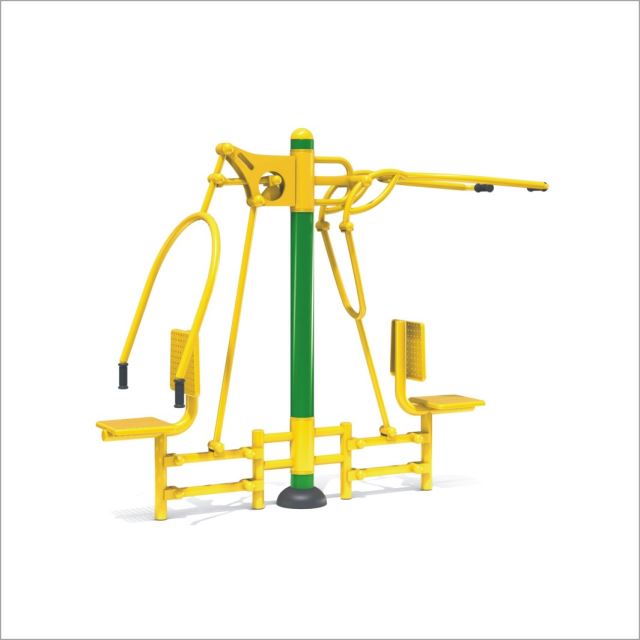
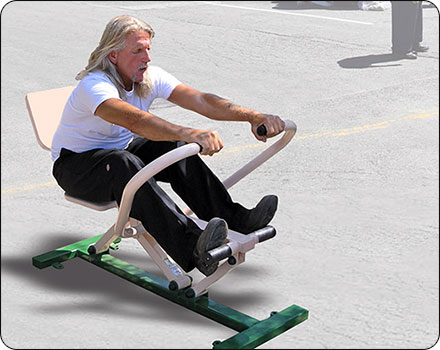
The walking/running track generally circles the perimeter of the yard and along the track will be various workout stations. At some facilities this may only be a simple chin-up bar, at others there be more elaborate setup including spots for chin-ups, push-ups, sit-ups, stationary bikes, rowing, and other workout contraptions.
At the last facility I was at the workout equipment was really nice stuff like you would find at a city’s community center fitness trail. Made up of tubular steel set into concrete pads. The variety of equipment really provided for a full body isometric workout circuit as you went from station to station around the track. But I can guarantee that the designers of the equipment never thought about how inmates would find creative alternative ways of using the equipment to either work alternate muscle groups or increase the resistance to increase the workout intensity. This unfortunately had the side effect of increased breakage of equipment that should have otherwise been nearly indestructible.
Examples of the type of exercise equipment installed at the last Level I that I served time at. A different machine was located at each workout station around the track.
The work to install and repair this equipment is performed by the facility maintenance crew. This work is not considered critical and is performed by inmates working under the supervision of a maintenance staff member, who generally only performs work for the PBF on overtime. Again, another opportunity to take advantage of prisoners by charging the PBF overtime rates for the maintenance staff member while the inmates only receive their standard rate.
In good weather the yard looks and sounds a lot like a school playground. Groups congregate together to plot & scheme, shoot the breeze, brag about the past and dream about the future. The yard is where you go to catch up your acquaintances or accomplices from other housing units to exchange information and gossip. It is the one place where you can truly choose the mates you want to hang out with.
Cameras watch and COs circulate to keep an eye on activities, bust up overly large groups and conduct random body searches looking for weapons and contraband. The yard is a place where you need to keep your head on swivel. I’ve seen more than one guy get hit by a foul ball or a homerun that he didn’t see coming. It is not a good idea to accidentally walk up on somebody from behind when they stop abruptly while walking. The yard is where deals are made, goods trade hands, and favors exchanged. I’ve seen guys smoking marijuana, engaging in sex, fights, and stabbings. The yard is safest in the morning and nothing good happens after dark.
For the 8 years I was in prison I never saw the stars. The facilities are lit up like Times Square. All around the perimeter to illuminate the fences and the no-man’s land, both inside and out. The yards are so well lit that you can read a book outdoors after the sun sets. Too bad the night is the only darkness banished in prison.
When writing about prison and what life is like in prison it is difficult to convey in words to someone who has not experienced it what prison is really like. It is like trying to retell a funny story that happened and the person you are telling it to just gives you a blank stare and doesn’t laugh, so you finish by saying, “I guess you just had to be there.”
Richard Wurmbrand, founder of ‘Voice of the Martyrs’ was imprisoned by the Nazis and then the Communists in Romania. In his book “If Prison Walls Could Speak” he described the struggle to explain what prison is like to those who have never been there.
“I do not publish my experiences in prison, but the words in which these experiences are expressed. There is a big difference. On one hand there is your experience, and on the other hand a very poor attempt to put it into words developed by men whose experiences have been totally unlike yours.”
Prison is an experience like no other and for the vast majority of those unfortunate enough to have spent time there they do not possess the communication skills to even make the attempt. There is a very strong correlation between education and prison. Those who fail to graduate from high school are far more likely than someone who has a college degree to end up in prison. I unfortunately defied those odds and came to prison with both an undergraduate and graduate level college education plus twenty years of work experience as a technical professional including work as an auditor.
After spending a total of ten years in prison and on parole I can speak from experience with insight about what life was like serving time in the Michigan Department of Corrections. My earnest desire is to convey a sense of the scope and magnitude of the issues faced by those hidden from sight behind walls and fences. Those forgotten men and women who are often thought of as both a menace to and a burden on society, who endure hardship and abuse at the hands of those in authority over them and from their own fellow inmates.
As referred to by Richard Wurmbrand, the key issue is language itself. Not only the language used to relate prison experiences, but also the language used by those who are experiencing it. They say that a picture is worth a thousand words, but I’m not sure this applies to the reality TV shows that try to depict what life is like behind bars is like by taking a camera crew into prisons or jails. As the narrator speaks the camera shows a bleak land scape of cinderblock walls, iron bars and reinforced glass, which is true. Prisons are very utilitarian structures meant to be both fire proof and escape proof, unfortunately they are not fool proof. And it is the foolish nature of the inmates and staff that is on display when the cameras are present.
The first thing the viewer notices is that the language used by everyone on camera is full of profanity that must be bleeped out. Cursing, swearing, vulgarity, obscenity or profanity, whatever you want to call it, it is the use of base, demeaning, degrading language that substitutes for civil discourse in prisons.
The punishment for using this type of language in an earlier era, when we were young children, was for our mothers to wash our mouths out with soap for using such filthy words. Now it is so commonplace that the animated TV series ‘South Park’ on Comedy Central, about a group of fourth grade boys, did a whole episode about the socially acceptable and unacceptable usage of the word S#*T. The acceptable usages involved swearing while the unacceptable usage involved its scatological meaning.
The explicative most commonly used in Michigan prisons is F#*k, the ‘F’ bomb. It is a word that is used as a noun, pronoun, adjective, verb and adverb, yet has no meaning of its own in the context in which it is used. It is simply a substitution for words that have actual meaning. The result is a conversation that is devoid of meaning unless the context is known.
According to Webster’s Dictionary the word ‘Ineffable’ (pronounced in-ef-a-ble) is an adjective that means- beyond expression, indescribable or unutterable. This would be something like trying to describe the glory of God in heaven, sitting on his throne. It is the frustrations and limitations of human language that the Apostle John experienced when he wrote the Book of Revelations.
In contrast to this is the common, base, vulgar cursing of man: “F’ing this” or “F’ing that.” Where we profane God and his creation in a way that is beyond belief, inarticulate, and unprintable. What I call “F’able” language is the lingua franca of prison.
Dietrich Bonhoeffer, the German theologian executed by the Nazis for his role in the failed attempt to assassinate Adolf Hitler, in his personal writings published in his ‘Letters and Papers from Prison’ commented on the coarseness of the language used in every day conversation between inmates and inmates and inmates and guards. Since his time, I can only imagine that the degradation of the language has only gotten worse. However, I shall attempt to translate for the reader so that the meaning is clear while still conveying the underlying tenor and veracity of the reality experienced by those I represent.
The language used to describe prison and the prison experience is what hinders understanding. In Genesis 11 in the account of the Tower of Babel the Lord says in verse 6, “Look, they are one people, and they have all one language; and this is only the beginning of what they will do; nothing they propose to do will be impossible for them. Come let us go down, and confuse their language there, so that they will not understand one another’s speech.” The result was the project to build the tower ended and the people where scattered. Language became the barrier to unity of purpose because of misunderstanding. Now even though the English language is the national language we can’t understand each other because we aren’t one people. We are separated by more than experience and barbed wire, we are separated by attitudes, opinions, ignorance, and fear. Communication is the only way to overcome this situation and this blog is my humble attempt to contribute to better understanding in the hope that positive lasting change can be achieved to address a shameful aspect of our society.








 Christ, Crime and Punishment