Getting dental services in prison is like pulling teeth. It may be more accurate to state that dental services in prison consists of pulling teeth and not much else. The year before I paroled the MDOC changed the policy so that anyone with less than two years in prison didn’t qualify for a teeth cleaning. With tooth brushes of such poor quality and the removal of dental floss from the commissary it would be very difficult to forestall serious degradation in oral health during this period. How can they justify this policy?
I met several men with such bad teeth that they purposefully did not brush in an attempt to get their teeth to rot enough that dental would have to pull them out and give them dentures. They had served long sentences and had lost enough teeth that chewing food was difficult and smiling was out of the question. Their bad breath went beyond halitosis and smelled of rot as they let nature take its course and dental one tooth at a time.
My first encounter with dental was while I was in quarantine at RGC. Upon arrival at prison after sentencing the first several days were filled with medical, dental and classification appointments. The dental appointment consisted of an exam to document the condition of my teeth. They took x-rays and performed a physical exam with a dental tool. Immediately afterwards I developed a gum infection that resulted in the significant loss of tissue around the base of my tooth. They don’t have alcohol-based mouth wash in prison so my only option was to get salt to gargle with. I suspect the dental tool was not properly sterilized.
While I was in Level I a gold crown came loose and fell out. I submitted an urgent kite to dental to have the dentist re-glue the crown. Several weeks later I got to see the dentist. It was a struggle to get the crown reinstalled, but he got it in. Five years later it came out again.
By then I was at a different facility. I submitted another urgent kite to dental and a month later they saw me. This time they said they would not re-glue the crown because the policy had changed. My option was to have the tooth pulled or leave it alone. Since I was only six months to my out date I elected to leave it alone. By the time I got to see a dentist out in the world the gap between my teeth had closed and the crown could not be reinstalled. I ended up spending $1400 to get a new crown.
I made sure to request teeth cleaning every year. The waiting list to get teeth cleanings was so long that several times the time between cleanings was closer to 1½ years. When I got home and had my first teeth cleaning the condition of my teeth and guns was poor enough that they scheduled additional teeth cleanings to address the issues.
My experience is typical. What is urgent and simple to fix in the world can’t be done in prison. Since when did pulling a tooth become cheaper than preferred to re-gluing my existing crown? I can understand not wanting to perform an expensive procedure like installing a new crown, but this wasn’t the case. Just some bean counter at the medical service provider made a cost cutting decision that is not medically sound.
I’ve already told my favorite dental horror story elsewhere about the guy who was mis-diagnosed and suffered a botched root canal and suffered with extreme pain due to a mis-diagnosis of his cancer.
For those who get their teeth pulled it was a painful, bloody experience. One of my bunkies got a tooth pulled and all they gave him were a small handful of aspirin packets to deal with the pain and gauze to repack the hole until the bleeding stopped. With his face swollen up like a chipmunk with a cheek full of nuts he was unable to sleep or eat for several days. All for a cavity they wouldn’t fill.
Even the dentists I dealt with were generally apologetic about the policies that prevented them from providing what would be considered reasonable services in the world. And they should know. The dentists either had a private practice in the local community and worked at the prison part time or retired from private practice and were just supplementing their retirement and keeping busy.
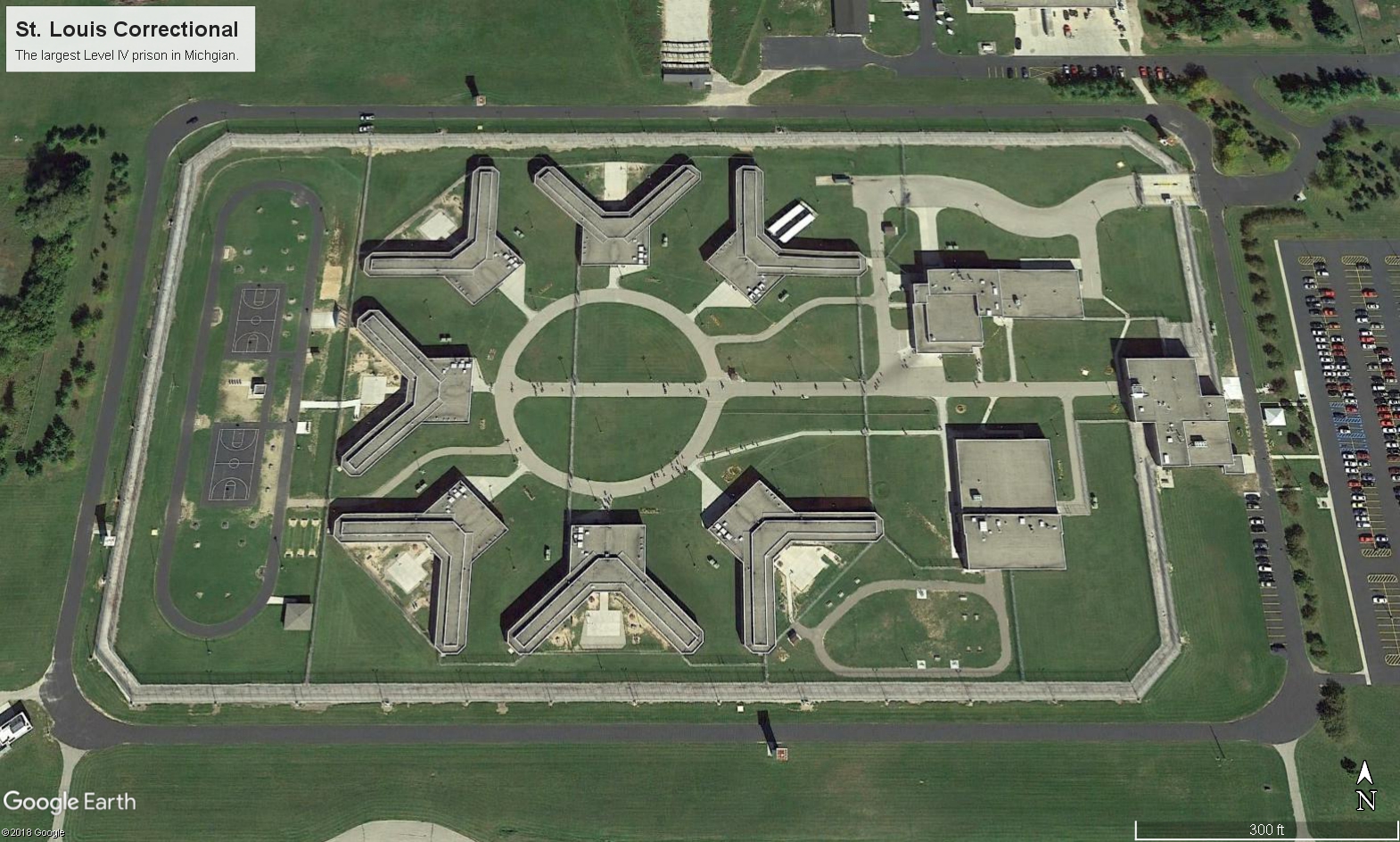
St. Louis Correctional Facility- the largest Level IV prison in Michigan.
Jails and prisons are not known for their hospitality, luxury, comfort, convenience, or aesthetics. They are utilitarian facilities designed for security, control, functionality, and durability. The compound consists of a secure perimeter designed for controlled entrance and egress. Razor wire, cameras, notion sensors, officer patrols on foot and by vehicle, inspections, metal detectors and body searches are the basis of security on the perimeter. Prisons in many ways are based on the military model. The difference being the focus on keeping inmates in. However, with the advent of drones, smuggling contraband like cell phones and drugs in prison security is having to adapt to these new threats.
In the MDOC there are currently four levels of security: Level I, II, IV, and V. Level V is maximum security. I’ve never been there but they tell me it’s not nice. There are two ways to get there. Maximum security is for those that are uncontrollable at lower levels of security or the entry point into the prison system for those serving life or very long sentences.
Level V is one-man cells, highly controlled movement and no creature comforts. No personal property, no gym or yard time, no libraries, TVs, or day rooms. Locked down 23 hours a day with only brief exercise periods outside in a cage. Good behavior is the only way out.
Level IV is two-man cells, controlled movement and limited creature comforts. Basic personal property like athletic shoes, radios, TVs, and books. Locked down 22 hours a day with access to yard time and the day room. Call outs for the gym, library and school are available. There are two types of level IV facilities. There are those that stand alone and those that are part of a multi-level facility. The latter type was the type of level IV that I’ve experienced.
Level IV is also a destination for those whose behavior could not be controlled in general population or for those with more than seven years to serve till their ERD. I spent seven months in Level IV. In multi-level facilities level IV prisoners are segregated and not allowed to interact with those from other levels. Separate yard, gym, library, medical, chow and visits.
In level IV cells the doors lock from the outside. The furniture is bolted to the floor. The toilet is in the cell. The windows have bars over the glass and only a small vent to get fresh air. An officer must let you out of your cell to go to work, take a shower, attend call outs or do anything at all. Church services were held in the housing unit and inmate lead with occasional outside volunteer speakers.
Level II along with level I is called General Population. Level II is as far down as lifers will ever get. Two-man cells and they give you your own room key. Incoming prisoners with a minimum of 5 years to serve and a maximum of 7 years are generally assigned to level II. Prisoners with disciplinary issues in level I and sent to level II. In fact, some people dislike level I so much that they will intentionally earn enough points from minor tickets to get sent to level II.
In multi-level facilities level I and II prisoners go to school together, worship together, attend gym, library and medical callouts together and go on visits together. They used to share the big yard together but there at the multi-level facility I was at they separated the big yard time for level I and II there because there was too much violence.
The cells have a bunk bed, two desks with chairs and two lockers. While the windows have a vent to get fresh air there were no bars over them. Toilets and showers were down the hall. A big improvement over level IV.
One of the best things about level II was access to a microwave oven. It’s no fun preparing Raman Noodles or instant coffee with warm tap water from the bathroom sink faucet in your level IV cell.
Level I facility housing units are mostly pole barn style dormitories with open cubicles. Level V, IV, II and unsecured level I housing units are cell based. There are two types of level I facilities- secured and unsecured. Unsecured level I is for level I prisoners with less than two years to their ERD, ticket free and don’t have certain restricted convictions. These prisoners are generally gate pass eligible to work jobs outside the compound fences. For those qualified, unsecured level I represents an oasis of peace and quiet. The housing unit still has a fence with barbed wire but not the double row that surrounds secure facilities. Unsecured level I has come and gone several times as bed space was required. Technically being located outside the secure facility means that the inmates housed there have limited access to the compound only for medical and the visiting room. They have their own small yard and meals are served in the housing unit.
Secured level I comprises roughly half of the bed space in the MDOC. When the prison population exploded in the 1980s the MDOC went on a building spree and created what they referred to as “Temporary” facilities. Rather than utilizing cells the housing units are an open dormitory design with cubicles subdividing the pole barn structure along hallways. While most prisons were made to last, these pole barns were not designed to remain in service as long as they have and it really shows.
I was at level I Temporary facilities with pole barn housing units and they were really showing their age. Poorly insulated, poorly lighted, bare concrete floors, endless plumbing problems, dusty and a security nightmare. At my last facility they were closing the pole barns one at a time to perform major repairs and updating things like security cameras.
Originally built to house 80 inmates per unit the pole barns have had their capacity doubled to 160 beds, but not toilets, showers, sinks or day room seating. According to the American Correctional Association each inmate should have 60 sq. ft. of space in semi-private sleeping areas. In an 8 man cube the furniture takes up all the space and I only had a couple of square feet in front of my bed. Just enough room to put my feet on the floor as I sat on my bed or looked into my locker.
The pole barns were built in the 1980s and 90s. The biggest thing to change in the MDOC since then is the level of violence in level I. When the prison population expanded, and prison facilities proliferated these level I temporary facilities were like honors units. Due to a few bad incidents the work camps and farms were closed and these prisoners were moved to these new secure facilities. Violence wasn’t tolerated and those that engaged in it found themselves back behind the walls of the old prison in Jackson.
After the closing of the old walled prison and the pressure to reduce cost more inmates were moved into the pole barns including those with violent crimes, less than stellar institutional records or gang affiliation. The result is that the open design lead to problems with theft and violence inside the housing units. To address this while I was there they added wire cage structures to the top of the walls that separated the cubicles in the front and back halls and added additional security cameras. Like putting a Band-Aid on cancer, a cosmetic fix for a truly institutional problem.
Security cameras don’t make things safer. After the fact they might provide evidence to identify the perpetrator but the damage has already been done. And in an ironic twist, the same cameras used to convict are conveniently broken or didn’t show anything when an innate seeks to use video to exonerate themselves. But inmates have to take the Inspectors word for it since they can’t be shown the video since it is a security rule.
The wire caging goes from the top of the wall up to the ceiling to prevent inmates and stolen property from crossing from one side of the housing unit to the other out of sight of the cameras which look up and down the halls. The caging was nothing fancy. It took the inmate maintenance crew two days to install the panels. Only time will tell whether these measures will reduce theft and violence in level I pole barns.
As a cost saving measure a few years ago the MDOC closed the level V prison in Standish. That again had a ripple effect across the MDOC. It wasn’t that there were fewer level V prisoners, they simply waved the security classification to move inmates to lower security levels- V to IV, IV to II, and II to I. The higher the security level the higher the cost of incarceration. Level V costs more than twice the cost to house an inmate in level I. While cutting cost was a political decision when the legislature reduced the department’s budget, it failed to account for the human cost. When inmates are placed in a lower security level it should be because they have demonstrated good behavior and cooperation in completing programming. The issue is that you end up in prison because of bad behavior and time in prison alone won’t improve it. The higher levels are intended to reduce the inmate’s ability to cause mischief through isolation. So, the inmates institutional record at the higher levels by its self my not be a good predictor of what will happen at lower levels. By waving initiates to lower levels, the MDOC let predators lose in the lower security levels. There were still in prison where the general public was protected from than but free to hurt other inmates. But they’re just inmates, right?
Housing units in the MDOC are not air conditioned. During the summer the air temperature inside will often exceed 80˚F and with a heat wave can approach 90˚F or higher. Without air conditioning there is no dehumidification so you also have to account for the heat index as well.
The school, medical and administration buildings where the staff work do have air conditioning and many of the housing unit counselors have retrofit air conditioners installed in their offices. So apparently suffering through the heat is part of the punishment.
For those inmates with certain medical conditions where hot temperatures could put them at risk for a medical emergency their medical classification will include an accommodation for heat related illness that will allow them to utilize designated cooling centers when the facility is under a heat advisory. Heat advisories are issued when the heat index goes above 100˚F. During a heat advisory all strenuous activity is curtailed, no weight pit, no outdoor sports of any kind.
When it gets hot in the housing unit it tends to remain hot. The brick and concrete construction absorbs the heat and holds it long after it cools off outside. I had many miserable nights unable to sleep because it was too hot. There is little air movement because the windows in Level II and IV only have small vents for fresh air. With the cell doors closed there is no way to generate air movement. The level I pole barns have slightly larger windows which open with screens. Unfortunately, the building design prohibits good air circulation. Ceiling fans do little to move air in/out of the building. The bunks closet to the windows are highly coveted because they are the only that benefit from the fresh air.
The heat really takes its toll physically and heat stroke is a real possibility. In housing units with fixed temperature controls in the showers even taking a cool isn’t an option. The small personal fans do almost nothing to alleviate the discomfort.
Most facilities don’t have ice makers in the housing units. Those that do can’t provide enough ice to cool 160 men. You could expect that it would be empty before count time and that there would be a stampede when count clears as guys try to beat the adage about ice water in hell.
A rapper that I’ve never heard of made the news by being in prison. It’s not what you think. Famous people from entertainment and sports were coming to aid in his cause. He had been serving a 10-year probation and was sent to prison for a technical violation. He had apparently been charged for an infraction of the motor vehicle code involving a motorcycle. The charges were dropped but the judge still sent him to prison against the recommendation of the prosecutor.
I’ve met a number of people who were in the same boat. Committing a crime while on probation or parole is a violation of its terms and even if you weren’t in prison before as part of your original case you can still end up there. The problem is that you don’t have to actually be convicted, just having police contact is enough to set things in motion.
To address the parole violation situation in Michigan, instead of sending parole violators back to Quarantine they are sent to the Parole Reentry Center in Detroit, a former prison. Your parole officer can take you there directly while you await a hearing with the parole board or a judge. The problem is like the rapper you can be sent to prison for up to the maximum length of your remaining sentence on a technicality. While on parole or probation you are considered guilty until proven innocent and you are not subject to due process. This means that they can do whatever they want and you have no legal recourse.
Now it is not as bad as it used to be. There have been significant changes made to reduce the number of parole violators being sent back to prison. It is expensive to house them and does not address the underlying causes of recidivism. Now things like substance abuse counseling, restriction to approved activities or even house arrest may be used. In the case of the rapper it was the judge herself that chose to put him behind bars. Sure, he had a poor track record with a number of previous violations but this time was without merit. It took a great public outcry to get him released. What about the others that don’t have such powerful allies? It is clear that the system both in Michigan and nationally is broken when someone like a judge or parole board member can defy counsel or the regulations to impose a punishment. If anyone else was to do this they would be called a vigilante and themselves be subject to punishment. The difference being that they would get due process.
Tom Modell, the spokesman for the Motel 6 lodging chain used to end his commercials by saying, “We’ll leave a light on for you.” A friendly way of letting people know that they were always prepared to receive guests. The MDOC by contrast is more like the “Hotel California” in that “you can check out any time you want but you can never leave.” Prison and county jails for many are like a rat’s maze that is difficult to navigate, full of many dead ends, and all the exits seem to lead right back in.
Like all areas of government in this day and age, financial resources are tight, yet jails and prisons are critically over crowded. Being asked to do more with less has resulted in a situation where jails and prisons more closely resemble warehouses than rehabilitation centers. It has reached the point where correction has been replaced with punishment. To most, the idea of pointless punishment is considered cruel and unusual, but for the MDOC it is business as usual.
After serving a sentence which is on average 127% of the minimum which is 120% of the federal average, many find themselves back on the streets with a large debt accumulated and limited prospects for an income sufficient to live on let alone spare resources to go toward retiring that debt.
It is the practice of county jails to charge booking fees for each suspect arrested and processed into jail. So, whether you are ultimately found guilty or not you have started accumulating debts which will add up. Many jails also charge inmates a daily rate. Any money found on your person at the time of processing immediately goes toward paying the bill. Any unpaid charges will follow you after your release.
In court you must have legal representation and if you can’t afford a lawyer on will be appointed to you. What used to be provided as a pro bono service by a local attorney or through a public defender’s office at no charge now comes with a significant price. When you pay for your own attorney you must pay up front prior to having services rendered. If you are indigent and can’t afford an attorney they will provide you one and then bill you later. In either case you are out thousands of dollars simply to “negotiate” a plea agreement and tens of thousands of dollars to fight your case in court. Only those with significant financial resources can afford to mount a rigorous defense.
Upon conviction, as part of the sentence agreement you will receive a bill for fines, restitution, and court costs. These will follow you to prison and under state law the MDOC will collect from your prison wages and any deposits to your trust account 50% of what you receive over $50 per month, and if you have multiple cases they can take up to your last $20 or $5 if there are federal charges involved.
To ensure that these costs are recouped, the MDOC has the power to seize your assets, and empty your bank accounts and investment savings -anything that is solely in your name. They don’t have the ability to seize anything that is in a joint account or has a second owner named such as a deed to a house or car.
After paying off the fines, restitution, and court costs including court appointed attorney, the MDOC can then charge prisoners a daily rate for their incarceration, until the seized financial resources have been consumed. Paying for your own room and board in prison does not entitle you to any extra privileges, no extra helping at chow, and no mint on your pillow.
In theory the prison chow hall diet is based on 2000 calories per day, but the reality is somewhat less than filling. Most people will lose 10-20 pounds in prison. Overweight people may lose 50 pounds or more as their fat reserves are tapped. For many, physical activity such as weight lifting, rigorous workouts, and sports are part of a daily routine in prison to help the time pass quicker. However, with increased physical activity comes a biological demand for more calories. To supplement the necessary caloric intake the commissary does a booming business. As this is not a basic necessity but is considered a luxury it comes with a steep price. In county jail a package of Raman noodles may cost a dollar, in prison it costs $0.34, while in the world they go for 10-15 cents each. With a captive market, prisoners pay exorbitant prices for low quality products. Catalog vendors, for instance charge $20 for a pair of sweatpants and another $20 for a sweatshirt that you could buy at WalMart for $15 for the set. Most of what is sold is seconds and irregulars, not high quality durable goods.
I found this picture of a prison TV for sale on an Etsy webpage.
Due to safety concerns TVs, radios, headphones, and other appliances approved for purchase must be made of clear plastic so that it is not possible to hide contraband inside. However, some of the plastics used are of an inferior quality and are subject to breakage under conditions of routine usage. A small 13-inch flat screen TV that you probably can’t even buy on the streets will cost you $200.
They say “it sucks to be poor” but it is even worse to be poor in prison. Since the majority of people in prison are from the lover socio-economic classes they and their families are the least able to afford it. Prison didn’t use to be this way. Society paid the cost of keeping the streets safe by paying to incarcerate the violent offenders. Then the “war on drugs” sent a large number of non—violent drug addicts to prison. Prison populations increased dramatically and so did budgets but not at the same rate. Prison officials needing to do more with less have sought ways to charge for services that they previously provided for free. When it’s time to leave prison, you have to turn in your state blues, the state will sell you a pair of khakis cut from the same uniform pattern for $50. Something you wouldn’t even want from the Salvation Army store at half the price.
Dealing with the Quarter Master can be like dealing with a used car sales man. If you lose a towel or a washcloth, they will charge you for them, luxury prices for third world quality. Underwear and socks that are ill fitting and shoes that will ruin your feet. Blankets and sheets are used until they are threadbare and then some. To save money they reduced the number of sets of state blues from 3 pair to 2. At some prisons laundry in only once a week, prisoners have to wear the same set of cloths for days on end.
The MDOC requires that prisoners either attend school or work. Students are paid $0.58 per day for a 5-day school week. Pay rates for the various jobs from porter to kitchen worker and wheel chair pusher to clerks and tutors vary significantly. Most jobs pay less than $1 per day. Depending on whether it is a 3, 4 or 5-day detail or has overtime available some earn as little as $10-15 a month while others may earn as much as $70-100. For those very few who are fortunate to work for the Michigan State Industries (MSI) or Braille Transcription Service income rates may be higher still. Pay rates for prisoners have been stagnate for years and in some cases have gone down significantly, such as when they eliminated bonuses for kitchen workers.
And the cost of living keeps rising so that what little buying power they had has eroded. Currently in the commissary prisoners are allowed to spend $100 per store every two weeks. From this they must purchase their necessary hygiene and food items. For an individual with no outside resources they must live on what little income they have earned from some type of hustle on the yard. There is a great gap between the haves and the have nots. A small bag of instant coffee costs $4, so for many it is the only luxury item they can afford and may preferentially choose that over soap and deodorant.
If you have need of medical service from Health Care there will be a $5 co-pay required for all routine services including teeth cleanings, eye exams, illnesses and non-job-related injuries. If you don’t have the money in your account, service will be rendered but they will take the money out first when some shows up. Additionally, over time the co-pay has been applied to chronic care visits for those with long-term and possibly life-threatening conditions that cause the person to seek medical services beyond the semi-annual exam.
For those who are unable to work or receive outside support, the Prisoner Benefit Fund (PBF) can provide $11 a month to those who meet the criteria for indigent status. This is a loan that must be paid back when there are funds in the inmate’s trust account. To qualify a person must have had no money in their account for the last 30 days. The funds provided are for necessary hygiene only.
Health Care no longer provides basic medical pharmaceuticals such as aspirin for headaches, cough drops, cold pills, antacid, fiber laxative or hemorrhoid cream. In the crowded living conditions colds and other illnesses spread rapidly throughout the population due to poor hygiene and sanitization. Those unable to afford the remedies available for purchase in the commissary must struggle through their illness without symptom relief.
With the inability to earn money to pay for the basic necessities and large debts assessed by the courts most prisoners leave prison without any financial resources at all only to find out that the debt accumulation is not over. On parole oversight fees and electronic tether monitoring fees can cost hundreds to thousands of dollars more. Depending on the type of programing required by the Parole Board there may be additional program fees incurred. All outstanding fees owed at the end of parole will be turned over to a private collection agency on behalf of the state.
The longer a person is on parole the higher the chances of violating that parole. Recidivism rates within the first 3 years of release from prison range as high as 75% for some categories of felonies. Random drug and alcohol testing, random curfew enforcement checks, failure to comply with reporting and work requirements can all result in the revocation of the parole and send you back to prison.
For some the only hope to break this cycle is to “max out” on their sentence so that they can avoid having to deal with parole. The result is that a person doing 2-10 years may be eligible for parole at their earliest release date (ERD) of 2 years may return to prison several more times due to parole violations and received a flop by the parole board and end up doing the full ten years on the installment plan.
For some this is not an option, since the tail on their sentences from multiple convictions have been stacked so that they have a potential 25 to life that they could theoretically have to serve in prison. But in either case it sets up a revolving door whereby a person can expect to return to prison for some additional period of time.
To address the high recidivism rates and the critics accusations of warehousing, the MDOC does offer programming for some categories of felonies. Violent offenders may be required to take Violence Prevention Programming (VPP) or Thinking for A Change. Sex offenders may be required to take Sex Offender Programming (SOP). Those that have drugs or alcohol involved in their cases may have to take Phase 1 and Phase 2 Substance Abuse and additionally have to take ASAP/RSAP which are residential treatment programs. Domestic abuse cases may have to take Bridges. There are group classes, some of which are conducted by Psych Services. Positive reports must be earned or else the parole board may not grant parole. For those without education or with learning and/or psychological disabilities this can be a challenge. Also, the mentality of so many prisoners is to resist authority, a “you can’t make me learn” mentality, or simply a person who likes who/what they are and doesn’t feel the need to change. These programs will do little good to ensure a positive outcome and successful rehabilitation for these people. For some repeat offenders who have completed all the applicable programming and returned with a new case for the same crime no additional classes may be assigned, not even a refresher course. The opposite is also a possibility, a person back on a parole violation may be required to complete the programming a second time even when the violation was on a technicality not a new conviction. In either case all they can do is hope for the best with the parole board. Just as it is true that you can lead a horse to water but you can’t make him drink. You can send a felon to prison but you can’t make him think.
Going to prison is costly both financially and in human terms. Lost productivity which can never be recouped, lost years of family time including weddings, births, and funerals. A debt to society that society refuses to accept payment for. Trust that has been broken by both parties in the relationship but for which separation is not an option. For many in prison the only light at the end of the tunnel is the oncoming train.
In Indiana Jones and the Last Crusade, Indy faces a series of challenges he must solve in order to find the Holy Grail and save his friend’s life. The clue to overcoming one of the deadly obstacles was the “penitent man”. Looking around he saw a number of decapitated bodies and quickly surmised that he needed to humble himself in a hurry or share their fate. The same happens to people who come to prison.
Another synonym for prison is penitentiary. In 1787 the Philadelphia Society for Alleviating the Miseries of Public Prisons developed a prison system where they believed some criminals could be reformed through hard work and meditation. Many members of the society were Quakers, who considered the moral/religious aspect of meditation a key to reformation. They knew that the repentance that comes from the realization of the wrong one has done will lead to lasting change.
People who commit crimes by and large are selfish people who have placed their wants and desires above the needs of others. Many are proud and unashamed of what they have done. When you fill up a prison full of these people, sparks will fly. When two proud people clash there can be only one winner. Like the decapitated bodies in Indiana Jones, heads will roll, unless one of these proud men will humble them self.
Humility comes as the result of awareness regarding one’s selfish, prideful condition and the willingness to admit that this form of behavior is what brought the person to prison. However, some in prison will double down and try to make themselves into the biggest, baddest, toughest, meanest, orneriest, foulest, strongest, most ruthless SOB in the Big House. They lift weights compulsively to strengthen their bodies, they harden their hearts until all empathy for others is gone, and they live only to satisfy their lusts for food, sex, and drugs. They think the way to live is to die to what separates us from the animals, and in the process become animals.
When a person in prison learns to humble them self, they become more sensitive to those around them, which allows them to react quickly, like Indy, to duck out of the way when the violence starts. A humble person has a quiet spirit which allows them to put others before themselves even when they know of the other’s selfish intentions, thereby avoiding the wrath of the proud. We are talking about meekness here, which some confuse for weakness. Meekness is the combination of the character traits of patience and humility. Not exactly something that one would expect from inmates.
So how does one learn humility in prison? The Quakers coming from a Judeo-Christian world view would not have seen meditation as an Eastern Zen Buddhist self-contemplation practice, but rather as a Biblical contemplation practice. They would not expect a person to change on their own, but by the conviction of the Holy Spirit, not by self-revelation, but by illumination of the moral standard revealed in God’s Holy Scriptures. Humility is both the inward and outward manifestation of the change in a person’s world view when they acknowledge God the Father and Jesus Christ His Son for who they are.
James 4:6-10 says, “But He gives more grace. Therefore, He says; God resists the proud, but gives grace to the humble. Therefore, submit to God. Resist the Devil and he will flee from you. Draw near to God and He will draw near to you. Cleanse your hands you sinners; and purify your hearts, you double minded. Lament and mourn and weep! Let your laughter be turned to mourning and your joy to gloom. Humble yourselves in the sight of the Lord; and He will lift you up.”
Prison is a place of stark contrasts and nothing exemplifies this concept better than the contrast between the proud and the humble. The proud are arrogant and unteachable. They will not learn the lessons of correction and if they ever get out of prison will keep coming back, doing life on the installment plan. Those who are humbled are teachable, they will learn the lessons of correction, and when they get out of prison will never come back.
While the original model of a penitentiary failed for a number of reasons, the concept of active participation by faith-based ministries remains a vital and necessary part of the correction system. Rehabilitation cannot be accomplished by a person in isolation, but rather only in the context of Christian community, both in prison and out.
Organizations such as the Salvation Army and Prison Fellowship are well known by the general public for providing social and moral training for those incarcerated. But there are in the U.S. literally hundreds of faith-based ministries dedicated to bringing the gospel into prison. On any given day of the week there are thousands of paid and volunteer workers in prisons and jails across the country, meeting with hundreds of thousands of men and women. From full church services to Bible studies to social/moral education these groups work with prison/jail chaplains to provide resources, programming and counseling that makes rehabilitation possible. No other religion provides this much capital and man power to assist the state in reforming the lives of so many that society has already written off.
Studies have shown that without programming recidivism rates can exceed 75%. With programming provided by the state such as educational, vocational, or psychological, recidivism rates drop to 50%. Faith-based programs reduce recidivism to less than 35%. When combined with additional programs and resources on the outside for when an individual is released from incarceration recidivism rates drop even further. One study even suggested that the first 72 hours out of prison are the key to success. If there is a person/organization there to provide mentoring and assistance and get the individual involved in a church, the recidivism rate falls to less than 10% in some studies.
Over the last two hundred years there have been numerous attempts at prison reform. In each case there was an acknowledgment that the current system was broken and that changes needed to be made. However, each one failed to live up to the expectations and did not result in accomplishment of the stated goals.
In each case the failures could be directly related to three causes: inadequate funding, over-crowding, and poor staff training. Prisons are expensive to operate and since they generate little revenue are a continuing drag on government budgets. Human societies for all of recorded history have failed due to the inability to pay the full cost of maintaining the society, whether it be defense, infrastructure, or social programs. At some point the costs exceed the economic strength of that society.
In the U.S., political parties and their candidates campaign on the ideas of lower taxes and being tough on crime. The two concepts are mutually exclusive, you can’t do both. Being tough on crime means more police, more prosecutors, and longer sentences which translates into significant cost increases. Lowering taxes means that the revenue to pay for government programs becomes scarce, which leads to reductions in services since the elimination of programs can be political suicide.
In corrections this means that every year prisons must do more with less. Costs for food, clothing, services, facilities, and staffing increase. And yet as incarceration rates increase, budgets have been held constant or even reduced. Even the best, most successful rehabilitation programs will be affected by this and will ultimately fail. The result is that prisons and jails become nothing more than warehouses or cattle pens where humans are contained until they must be released to once again wreak havoc on society. The worst possible outcome with the lowest return on investment.
Since the evidence of rehabilitation is incontrovertible and human lives matter, what are we as a society willing to pay to see our sons, daughters, brothers, sisters, husbands, and wives returned to us in a condition where they no longer pose a threat to society or themselves? What are we willing to spend to end the cycle of poverty, violence, and broken homes that results from locking people up? What does it say about a society that claims to be a beacon of freedom and hope, yet incarcerates more people than any other country on earth? When is enough, enough?
There must be more to corrections than retribution. An eye for an eye was Old Covenant philosophy. At least some portion of the church understands that we are now under the New Covenant and that forgiveness and redemption are the philosophy to live by. There should always be repercussions for violating the laws that hold our society together but hate the sin not the sinner. We have all sinned and fall short of the glory of God.
Faith-based prison ministries get this and that is why we need more of them participating in the correction system. These organizations raise their own money from their supporters to fund their prison ministries. This is like free money to the fiscally strapped prisons. In the day and age where outsourcing services is seen as cost effective, what could be more cost effective than free? Sure, there needs to be coordination and oversight and that is where the chaplain comes in. But why turn down programs that have a positive effect on the prison environment and can significantly reduce recidivism?
Moreover, since it is that critical time immediately upon release from prison that is the major decider on whether or not a person will go straight or fall back into a life of crime, the MDOC should be actively recruiting organizations to provide after care, housing, employment/job placement services in addition to mentoring and counseling services. The vast majority of people coming out of prison have lost everything while they’ve been away and most have nowhere to come home to. The state needs to take more responsibility to help these people that they were so zealous to lock up in the first place.
There was a program called the Michigan Prisoner Reentry Initiative (MPRI) whose original goal was to partner with non-profit organizations to help fund and coordinate these types of programs. Yet after only two years the external portion of the MPRI program was cancelled and the funding redirected back into the MDOC, due to claims of misappropriation of funds and mismanagement by these outside groups. Given the history of the MDOC there is more than a little irony in that allegation. There should be considerations made to revisit this decision and encourage more faith-based organizations to come to the aide of these returning citizens.
Given human nature, not everyone can or even wants to be rehabilitated, but that is a minority of the people in prison. A sad but true fact is that those serving life sentences, after a period of adjustment are the best-behaved inmates. Those doing short determinate sentences, such as two years for a gun are almost completely unmanageable. Which takes us right back to my original point about the Penitent Man: those who are willing to humble themselves can be rehabilitated. It is up to the people in society to demand more from their representatives in the legislature and the legislature to demand more from the MDOC and the MDOC to demand more of its staff, contractors and inmates.
“God continues to bless me and answer my prayers even in this warehouse of lost souls” – unknown
This blog contains essays about what life is like behind bars as a prisoner in the Michigan Department of Corrections. Anecdotal stories and observations about crime, punishment and human nature. Names, dates, and locations are not included because it was not good for your health to keep records like that in prison. Even the suspicion that I was writing about my gang leader bunkie, one time, almost got me a severe beating. What is really important are the truths contained in these pages. I am speaking out for the tens of thousands of others who don’t have the skill or ability to do so for themselves.
It would be easy to be bitter about the years I spent in prison, but instead I have chosen to put aside any personal agenda and use my experience as a professional auditor, a trained observer, to record a firsthand account of what life is like on the inside. Writing has been both a healing process as I unburden myself, and an education as I compiled observations and facts that are shocking and disturbing in their scope and complexity.
This can by no means be considered exhaustive. Even a life sentence would not be long enough to experience everything that happens in prison. This is just my humble attempt to humanize those who have been de-humanized. To bring to the public’s attention the waste and corruption that runs rampant in a critical branch of state government; and to help those who have loved ones in prison understand a little better what they’re going through.
If what you read is disturbing I apologize. I tried to refrain from using graphic language except where it was necessary to convey meaning. Prison is not a country club with prim and proper people. On the other hand, if you are outraged by the failings of those entrusted with the responsibility of protecting society and are motivated to contact your state representatives in the legislature to demand better, then I have succeeded in raising awareness of an issue vitally important to our society as a whole.


 A rapper that I’ve never heard of made the news by being in prison. It’s not what you think. Famous people from entertainment and sports were coming to aid in his cause. He had been serving a 10-year probation and was sent to prison for a technical violation. He had apparently been charged for an infraction of the motor vehicle code involving a motorcycle. The charges were dropped but the judge still sent him to prison against the recommendation of the prosecutor.


 Christ, Crime and Punishment