Education Connection

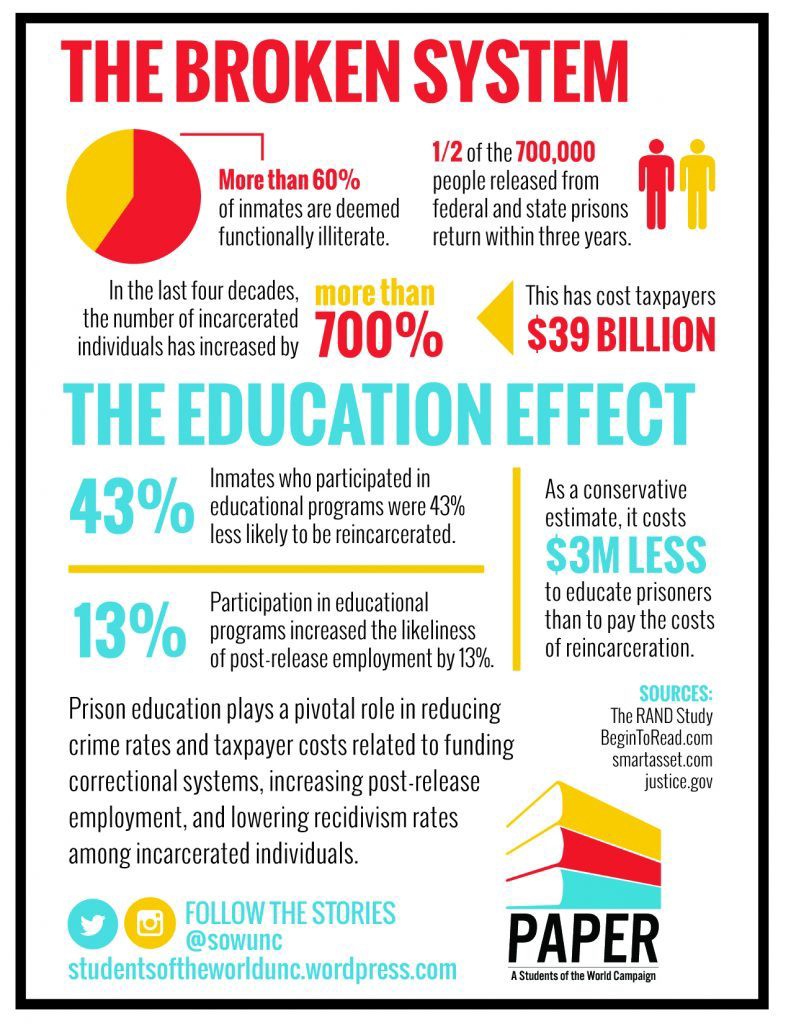
thebroken system

One of the strongest correlations in predicting whether or not a person will end up in prison is the lack of a high school education.  This fact has been known for many years and has been codified into a law that requires inmates without a high school diploma or a GED to attend GED classes.

Even before there was a GED program in the MDOC there were primary and secondary education programs with Jackson Public Schools at the old walled prison in Jackson that allowed inmates to earn a high school diploma.  In fact, until the Pell Grant for prisoners was eliminated under President Bill Clinton there were college classes taught by institutions such as Spring Arbor College, where inmates could earn a B.A. degree.

I worked as a tutor in the GED program for 5 years and had the privilege of working a long side two old timers who had earned their B.A. degrees from Spring Arbor College. They were bright, articulate, knowledgeable, and earnest in communicating their passion for helping men earn their GED.

In the MDOC the inmates who work as tutors are the key to the program.  The reason is both simple and shocking.  First is that peer to peer learning has been shown to be an effective adult learning tool.  Inmates teaching inmates removes the power dynamic from the situation.  Also, there is the ability to establish relationships that would be inappropriate for correction’s staff.

During my time as a tutor I worked directly for three different teachers at two different facilities.  I knew 10 teachers      well enough by interaction with them and their tutors to know about their classroom environments to say that what I am about to share is not atypical.

The first teacher I worked for knew my former employer from a previous career in medical equipment sales.  All teachers in the MDOC GED program are certified educators and all that I am acquainted with had worked in public schools.  My teacher, who I will not name, was no exception.  He worked in primary education for Detroit Public Schools.  In fact, he had been fired by them.  The old saying is “Those who can’t do, teach.”  In prison it goes a step further, “Those who can’t teach, teach in prison.”  Teachers like many others who work in prison are there because they couldn’t make it in the free world.  Like COs that couldn’t make it as police officers, there are those “teaching” in prison who couldn’t teach.  This isn’t the case for all teachers, just like there are good COs, it is just that there are more than a few bad apples.

The second teacher I worked for was the Felix Unger to my first teacher’s Oscar Madison. They were in appearance the “Odd Couple.”  One was nattily dressed and a stickler for organization, the other unkept and easy going.  But being a snappy dresser didn’t make up for his inability to manage his class.  I got along great with him until I made the mistake of correcting him in front of the class, when he incorrectly described how to solve a math problem.  I went from getting a perfect work evaluation to ‘barely meets expectations.’  I had organized his filling system, written standard operating procedures to ensure that all future tutors would be able to maintain the system.  The tutors took attendance, graded work, assigned student testing, maintained educational files, and worked one-on-one with students, while the teacher chatted with students and wrote more tickets than any other teacher.  He did not have the respect of his students and did not have control of the class room.  The result is that the class room did not provide a learning environment for those who wanted to learn.

My second teacher was the complete opposite.  Wild hair and sloppily dressed, but he had a kind and gentle demeanor that commanded the respect of his students. His class room was a quiet, stress-free learning environment, where men succeeded in earning their GED.  It was in this class that I earned my greatest compliment.  I was on a visit and one of my students pointed me out to his family and said, “That man is helping me get my GED.”  And he did.  Just as the COs set the tone for what goes on in the housing units, the teachers set the tone for the class room and it makes all the difference when it comes to educational success.

The third teacher I worked for was not like either of my previous bosses.  He worked for 20 years as a teacher in the MDOC, he had seen it all.  He held court in his class room.  He told stories in a folksy style.  Nothing got under his skin except students that squandered the opportunities given to them.  He wanted the best for his students and did more to help them succeed.  He also saw to the needs of his tutors who he didn’t treat as inmates so much as co-workers.  The respect was mutual.

Education is supposed to be a priority for the MDOC, yet year after year budget cuts to education have reduced the number of teachers in the class room and the resources available.  When the new GED standard came out in 2014 the MDOC was not prepared to change over until 2016.  Even then they still did not have the text books available in all subject matters in sufficient quantities for all students in all classes.  They had bought new computers that were supposed to run new educational software for the students to prepare them for the computerized GED exams. Unfortunately, the computers sat unused for two years and when the new programs were implemented the servers and other hardware purchased were inadequate.


Language arts Math Science Social Studies

Examples of GED textbooks used by the MDOC.

The old GED standard was said to be about equivalent to an eight-grade education. The new GED based on the new high school graduation requirements significantly raised the bar.  Many students who had passed some but not all subject areas were given several opportunities to complete their GED, but when push came to shove the lack of staff to administer the additional tests resulted in some students losing out and having to start over with a significantly elevated bar. This was a real blow to moral and I watched a number of students give up and throw in the towel, resigning themselves to the reality that the new GED standard was unattainable. The new GED was designed to be high school equivalent, while prisoners are anything but.

The old models of self-teaching by students with assistance from the teachers and tutors didn’t work that well under the old GED.  With the significantly higher educational requirements the MDOC needs to rethink how it operates its classes. Self-learning only really occurs after fifth grade because students up to that point lack the necessary vocabulary and learning skills to effectively study on their own. When all you were asking was about three grades of learning many could get by with their life skills to bridge the gap and earn their GED.  Under the new system it is asking too much for inmates, many of whom are functionally illiterate to self-study.  What is needed is a structured class room environment where teachers actually teach and students are expected to learn.

Participation in the GED program was a parole board requirement, but because there weren’t enough teachers or class room space there were waiting lists based on ERD at each facility.  The result was that inmates serving short sentences would go to the head of the list, but if they didn’t have an interest in learning thought that they could wait out their time.  The result was that those who actually wanted to earn their GED and would write kite after kite asking to get into school would have to wait.  And due to their longer sentences were further down the waiting list were prohibited from working in the interim.

In addition to the GED program the MDOC also offers vocational training programs intended to provide marketable job skills to aid inmates in gaining employment upon release. Programs like Carpentry, Electrical & Plumbing, Masonry & Concrete, Horticulture, and Food Service were popular.  These programs were available to those who had a vocational training requirement from the parole board because they had no prior history of employment before coming to prison.  These programs required a GED or high school diploma as a prerequisite.

I knew a guy who was hired to be a tutor in the Masonry & Concrete program as they were setting up the program.  He was a masonry contractor in the free world and knowledgeable in all aspects of the trade.  He was not impressed with the training curriculum and I would trust his judgement on this.  What he also told me made me sick and it should make you angry.  The facility where we were located was very limited in the available class room space.  In fact, the GED class that I was a tutor for was relocated to a much smaller classroom that had previously been used for other programs such as AA, in order to give the larger classroom to the Plumbing & Electrical class.  The room across the hall from my smaller class room was the technology room where the GED testing was held.  They were displaced to make room for the Masonry class. Before the masonry class could begin a secure tool crib needed to be built along one wall of the room to store the tools to utilized by the class.  When they brought the brand-new tools that had been ordered for the class to put them in the tool crib it was apparent that they would not all fit.  With no other storage options available the teacher had his tutors throw thousands of dollars of brand new tools in the trash compactor rather than deal with the situation.  After the class started one day I watched as they tracked cement dust all over the hallways in the school building. the utility closet was half way down the hall and they made a huge mess making mortar for a brick laying project.

The level of incompetence displayed is hard to grasp but it really happened.  My teacher saw it coming and tried to warn them but like every other good idea proposed in the MDOC it was ignored.  They tried to set up this program quickly and on the cheap and then forced it into a facility that could not accommodate it.

I understand that in recent years new programs have been introduced such as Asbestos Abatement for which I have no first-hand knowledge, just what I’ve seen on the news or read in the paper.  It makes a great sound bite but if it is anything like the vocational education classes I’ve seen first-hand then it will be worse than useless and potentially dangerous to the students.

Many of the inmates participating in these programs selected them based on availability at the facility they were housed at, not on what they saw as a potential career that they would actually be interested in.  They are just checking off a parole board requirement to increase their chances of parole.  Given how these programs are run it is a pretty obvious and safe to say that the inmates aren’t the only ones going through the notions when it comes to educational programs.
Disconnected

I was surprised by how many guys I met in prison paid no attention to what was going on out in the world aside from popular culture.  News programming was never on the in the day room.  The only current events discussed were the rumors regarding issues pertaining to the MDOC.  The only politicians that were talked about was the sitting governor and attorney general, usually in connection to a 4-1etter expletive.  In the classroom I encouraged guys to read newspapers and would cut out articles on various topics.  About the only ones I got them to read were the articles about crime or pop culture.  The reality is that the typical inmate was already disconnected from the greater society and only focused on their subculture.

When you are in prison you don’t get much say into who your cell, cube or bunk mates are.  If you don’t get along your option is to lock up.  In an ideal world people can work through the vast majority of their differences, however prison is not ideal.  The divide between an old white guy who never had a run in with the law before coming to prison and a young black man who started on a life of crime at age 12 when he caught his first juvenile case is vast.

There is no love lost between these two, the only thing they have in common is that they were convicted in the state of Michigan.  More than likely they look down on the other and their crime with contempt.  Without knowledge, exposure to others different from ourselves, and acceptance of the differences there will be continued strife.  Not a good thing is a place where might makes right, and violence is the first and, in some cases, the only alternative considered.

Inmates are a captive audience.  So what better place to provide diversity and civics training?  Education is the proven solution to bridging the gap that divided us.  More over by proactively front loading the training the inmates could be held responsible for their behavior in relation to the material.  Outbursts and incidents could be used as teachable moments and remedial training to reinforce the importance of applying the material.  The parole board would have more information to evaluate in regards to the expectations set out for inmate behavior. Raising expectations for behavior sets the bar higher.  Well behaved inmates make for better behaved returning citizens.

In Michigan while on parole, parolees have the right to vote, but most don’t.  They didn’t participate in the electoral process before, failing to engage in the basic rights and responsibility of the democratic process as the center of our society.

Programming in prison currently tries to educate inmates why committing crime is wrong.  What is clearly lacking is teaching inmates about doing the right thing. They hold you responsible but don’t teach you responsibility.  They say “ignorance is bliss,” but in this case we should make an exception.

Deaf, Blind and Dumb

humpty dumpty

While I was in Level II I lived in a handicap accessible housing unit.  Seeing wheelchairs, white canes, TTY telephones, special showers and toilet stalls were the telltale signs that people with disabilities were present.  With the aging population in Michigan prisons it’s not unexpected that there would be physically infirm seniors that required walkers or wheelchairs for mobility, but there were also single and double leg amputees.  While not surprising that there are people from all walks of like, I wondered how those who couldn’t walk got there.

Prison is a place full of people seeking to exploit even perceived weaknesses to their advantage, so it doesn’t help to have those weaknesses clearly advertised. There also isn’t much in the way of empathy from the officers and staff, it is prohibited by policy and tends to be lacking by disposition for those who work in a place like this.  This combination of inmates and staff makes a dangerous environment even more difficult for those who struggle with the basic, necessary activities of life.

One of the men I met there had lost both of his eyeballs to a childhood cancer.  It was incredible enough that he was convicted of a heinous crime but to see what a blind man had to contend with in prison was heartbreaking.  He was a person who had overcome his disability by learning to read Braille, college educated, and lived relatively independently.  I watched him navigate from his cell across the yard to the chow hall, the school building, or medical with little or no assistance. The issue wasn’t what he could do for himself but what he wasn’t allowed to.  He was actively fighting his conviction and the conditions of his incarceration.  In the world he had access to technology that would allow him to process information.  In prison he was forced to rely on an inmate to read his mail, including his legal mail that contained sensitive information regarding his criminal case.

The law library could not accommodate him because they would not provide legal text in Braille.  In essence he was denied the ability to fully mount his appeal, which is a denial of his civil rights.  He wasn’t one to take his setbacks lying down, so he fought the librarian and the administration tooth and nail for both the basic tools he needed and his own dignity.  The courts have ruled that the Americans with Disabilities Act (ADA) applies to prisons with considerations of safety and security limitations.  However, in a place where logic and reason don’t apply it shouldn’t be a surprise that federally guaranteed rights like the ADA would be denied.

He contacted the Department of Justice ADA division in Washington D.C. and they tried to send him the relevant statutes in books on tape format.  The mailroom would not deliver the tapes because they didn’t come from an approved vendor. They also claimed that the letter head on the enclosed documents was fake!  Over and over they found any excuse they could to deny this man.  He fought back by filling grievances, escalating to Step 2 and Step 3, as they were denied and dismissed repeatedly, going all the way to the Ombudsman in Lansing.

I have noticed that those who complain about their incarceration the most are singled out for retribution, abuse, and neglect.  Rather than take the complaints seriously it is easier to dismiss the messenger, saying “they” are only inmates.  I don’t know what happened to this blind crusader, but I’m sure that where ever he is he is still fighting the good fight.  Why would anyone want to make life more difficult for someone who already has more to overcome than just being a felon. All he wanted was a fair hearing.

Being deaf poses a different set of difficulties.  There were two guys, one who was hearing impaired but could function with hearing aids and was fluent in sign language. The second was deaf and could only communicate through signing. While I was in Level II with them the pair was inseparable for obvious reasons.

The officers and staff communicate verbally and relied on the first inmate to communicate with the second.  For official communication there was a state translator, just as when a Spanish speaking inmate needed someone to translate at hearings.  This person wasn’t on site but had to be brought in special for hearings like parole interviews or disciplinary hearings.  One day after I had been moved to Level I, I ran into the first hearing impaired innate.  I asked him how the second deaf inmate was doing.  He just shook his head.  When they moved him, there wasn’t anybody to take his place looking out for the deaf man and we both understood how difficult his situation was.

When you are deaf you can’t hear the CO calls your name over the PA system to come to the officer’s podium, or at count time to get on your bunk.  Unless the officer was a regular unit officer aware of his situation he might be ignored or mistreated.  In prison you have to look out for yourself since no one else will. But when you have a disability you don’t have that ability.  In a place where you learn not to trust others, they are forced to.  And when by some miracle you find someone you can trust to help you and the system takes that assistance away, it is a cruel and unfair punishment.

Not long ago I read in the news that legislation had been put forward that provide a mechanism for elderly and severely infirm inmates that posed no risk to the community to be transferred to a nursing home facility.  I’ve been saying this for several years and it would seem like a no-brainer.  There is a geriatric facility for these inmates, but I understand the conditions there are really bad and they have a hard time recruiting inmates to go there to serve as care givers to assist the inmates sent there to die.  I really can’t imagine a tougher position to fill.

I was also not surprised to read the negative response this legislation received from the Attorney General and victim advocates who claim that any early release, regardless of the reason was an injustice.  All of this just goes to prove that prison isn’t about handing out punishment to suite the crime, it is about vengeance. Inmates are not seen as individual human beings but as numbered animals that don’t have any civil or human rights.  Whether the sentence is 2 years flat or life without the possibility of parole we are still talking about basic standards of care. The burden of support to maintain that level of basic care is placed upon the state. There are only two valid options: Either the state is committed to bearing that cost burden and fulfilling its obligation to care for those wards placed into its charge. Or let some go and only hold on to those who truly are a danger to society.  Not everyone in prison is, not even those who are convicted of a violent crime are. Inmates must be individually assessed and then treated fairly according to a plan, not just lumped into a faceless mass where it is easy to overlook their humanity. The MDOC has chosen a 3rd way which is unacceptable and outrageous. They cling to discredited and outdated policies and procedures that threaten the wellbeing of those they claim to be rehabilitating.

—————————————————————————————————–

As an update to this essay, an article published in the February 26, 2017 Detroit Free Press stated that a Federal Judge in Detroit has ruled that the MDOC for years has violated the ADA.  Specifically, a lawsuit brought by Michigan Protection & Advocacy Service representing deaf and hearing imparted prisoners proved that the department routinely violated the prisoner’s rights under ADA.  It only took the incarceration of a blind social worker who wrote letters to legislators and others regarding the situation to gain traction.  Then the MDOC as it always does in a too little too late attempt to avoid the looming lawsuit issued a policy directive and started to institute changes to avoid the inevitable.  While the court has not yet finalized the consent judgement it is likely that the department will have a federally appointed monitor for two years to oversee the necessary changes that must be implemented in order to bring the department into compliance with the ADA.

This was not the first lawsuit brought against the MDOC in relation to violations of the ADA.  It was simply the first successful class action.  The MDOC is no stranger to having a federally appointed monitor, there has been one in place since the 1980’s when a class action lawsuit regarding prison health care showed how poorly prisoner health was being managed by the department.  This really does raise the question, why is it so difficult to get people to believe when prisoners make claims about the abuses that they suffer at the hands of their captors?

Prison, Paranoia and PTSD

Prison is a dangerous place and it requires a certain set of skills to survive.  A sixth sense of danger, eyes in the back of your head, and acute powers of observation are necessary to avoid the pitfalls and snares of life on the yard.  Prison is full of predators looking for easy targets.  In spite of attempts by the administration to weed out the most dangerous individuals from general population, violence occurs on a daily basis.  If you are blessed to be 6 5″ and 275 pounds there are not going to be very many that will test you. However, those of us with more meager statures need to be wary at all times.  As Kenny Rogers sings, “You’ve got to know when to fold them, know when to walk away, and know when to run.”

It all starts with the arrest.  Some people turn themselves in, some are captured peacefully, and some resist arrest.  All of them end up in jail.  After a stripe search, mugshots, and finger printing the process of incarceration begins with the sound of a slamming door.  Freedom becomes a memory and a hope.  You are no longer in control the decisions are made for you.  This is a traumatic and stressful situation for everyone whether it is your first time in jail or your tenth.

The reality of the situation is that the behavioral characteristics that make for model inmates are the same ones that keep the majority of people out of prison to begin with. Conversely, those with behavior that is not appropriate for a civil society frequently end up in prison and it is where they need to be.  However, their behavior becomes amplified when placed in confinement and surrounded with other like themselves.

When you live a criminal life, you know that others are out to get you; either the police, rival gangs, or a desperate loner.  You never know who or when, just that someone is gunning for you at some time so you must remain hypervigilant at all times.  The streets of the inner city have much in common with the jungles of southeast Asia or the wild, wild west.  Nighttime drive by shootings and raids cause them to sleep in the back of the house with multiple deadbolts on the door and a loaded gun in the nightstand or under the pillow.  During the daytime they always sit with their backs to the wall, always travel in packs, and never go unarmed.

Many of these same patters continue in prison because the same people who were on the streets with them are in prison too.  Turf wars, endless cycles of revenge attacks, arguments, personal slights, and theft leads to confrontation.  A healthy dose of paranoia is not necessarily a bad thing in prison.  The fight or flight instinct has kept man alive for thousands of years.

There are a lot of people in prison today that didn’t grow up on the street and never experienced the criminal lifestyle.  They committed white collar crimes, suffer from addictions, or made poor choices in the heat of the moment that brought them to prison. Many never had any previous police contact or seen the inside of a jail before.  To them prison is a scary place with danger lurking around every corner.  The stress of the criminal justice system can break you easily and many are.  Isolated, alone, and many without support.  They are easy to recognize by the “deer in the headlights” look on their faces.  These people are forced to sink or swim.  They have literally been thrown to the wolves and the survival skills of the zebra need to kick in quickly.  Unfortunately, not everyone learns to have a healthy fear, their paranoia has a deeply profound and long-lasting effect on them.

Psychiatrists have found that long prison sentences under stressful conditions results in Post-Traumatic Stress Disorder (PTSD) the same as those who have been the victims of violent assaults or combat survivors.  Living with stress triggers certain chemical changes in the brain which can have a short-term benefit such as heightened awareness, quicker reflexes, sharper hearing and eyesight.  There are side effects to stress.  Stress is not good for the heart, it disrupts the appetite and also deprives sleep.  It is like being nervous and jittery without drinking the coffee first.  Doing time is emotionally draining.

The difficulty with long term incarceration is that this physical, psychological, and mental stress doesn’t automatically go away when you are released from prison.  I have heard a story about a guy that paroled to his nephew’s house which was right behind the prison and across a farm field.  Every time the emergency count siren was blown he went back to his bedroom and sat on his bed, like Pavlov’s dogs associating the bell with feeding time.

Many people who parole from prison never truly leave it behind.  For those who lived in fear and trepidation find themselves unable to return to a state normalcy that they had before prison.  Relationships that were once open and carefree are now reserved and cautious.  Strangers represent danger and the police are to be avoided.  You evaluate everyone in terms of angles and opportunity, threats and alliances.

While the waking nightmare is over, the night terrors may last for years.  The brain has difficulty processing the present without the filter of past experience, and when that experience is traumatic in nature nothing is simple or safe.  Moving in crowds, such as malls or stadiums is difficult.  Making decisions over a large selection of options in a grocery store can be over whelming.  Driving in unfamiliar areas or to new destinations becomes confusing.

PTSD is a recognized mental condition that many combat veterans have to deal with 10, 20 or even 30 years after the fighting stops.  Research has confirmed that the same is true of ex-offenders.  The experience of prison life leaves a lasting impression that seriously impacts the individual’s ability to function in society, the workplace, or the home.  The dream is that life will go back to normal, while the reality for many is far different.

Counseling and drug therapy will help some, but most will suffer in silence alone and isolate from support groups.  Many will only have basic health insurance and will not be able to afford expensive mental health coverage or high out of pocket expenses.  Self-medicating and destructive behaviors only lead back to prison and further damage.  A vicious cycle that repeats itself.  In some instances, the result is an overdose or suicide. Unlike the soldiers there is no Veterans Administration to serve the formerly incarcerated to help them deal with the symptoms. Prisons don’t take responsibility for those no longer in their custody.  So, who will look out for those in need of help?

Addiction

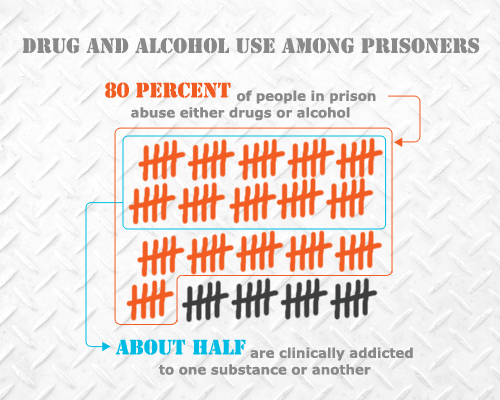
You can’t prove to me that marijuana is not addictive.  On the contrary I can prove that it is as addictive as alcohol, tobacco, or sex.  Just spend any time around prisoners and listen to their conversations and you will know the truth. Conversations in prison are practically fixated on alcohol, drugs, and sex.

Prisoners dwell in the past, sharing stories of their narcistic foibles and conquests. They relive, no doubt with embellishment, for themselves and others what they think of as the best times of their lives.  Some go to great lengths and at great expense to acquire these “necessities of life” while in prison.  They indulge in the illicit spud juice trade or pay outrageous prices to purchase tobacco, marijuana, or other drugs smuggled into prison. One of the really disturbing things is how men justify homosexual activity and claim that they are straight because the give rather than receive.  The first thing that many prisoners want to do when they get out is to stop at the party store and then get laid, even though it may have been 2, 5, 10, or 20 years since they had their favorite drink or smoke.

Addictions may be chemical like heroin, but most are psychological. Any activity that stimulates the pleasure centers of the brain to the point that it upsets the brains natural equilibrium will foster a desire to recapture the feelings of euphoria.  The person seeks anything that will help regain that feeling.  The mind plays tricks by minimizing the negative side-effects.  Alcoholics keep getting drunk regardless of the hangovers or getting sick.  Drug users crash after their bodies can no longer stay awake after days of sleeplessness.  Marijuana smokers get the munchies and fall asleep.  They don’t suffer the negative side effects that slowly kill the body, instead it’s about killing motivation. Brain cells in key sections of the brain are damaged placing the user into a sort of suspended animation. Instead of continuing to develop their lives these heavy marijuana smokers stop growing mentally and emotionally.  They enjoy their party life, not realizing how lame they have become.  They don’t see anything wrong therefore there is no reason to change. They like themselves and those they hang out with.  To quote Forest Gump, “Stupid is as stupid does.”  They reinforce each other’s bad behavior and it only gets worse in prison.

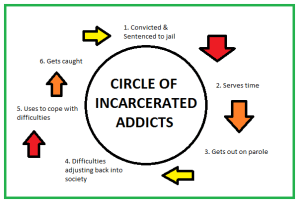
Bad behavior in prison by and large goes unchallenged by any meaningful education, discipline, or constructive alternative.  That’s why programming fails, punishment is ineffective, and the alternatives are unappealing.  Addicts have the highest recidivism rate because prison is not a deterrent.  An addict’s only desire is to recapture the “high” at any cost.

Addicts often have no family support because they have stolen from those they claim to love, betraying trust and have been rejected and cast out.  This only serves to drive the addict deeper into their circle of addicted acquaintances.  They really can’t call them friends because they steal from them too, but they have one thing in common and nowhere else to go or do.

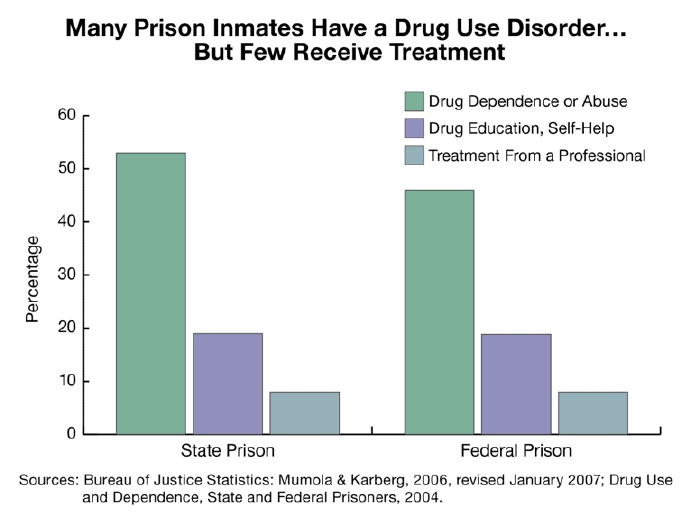
What is called for is an interdiction.  The only way to save an addict from themselves is for someone to break through the barrier of lies that they have surrounded themselves with. You’d think prison would be a place where this happens but unfortunately no.  You have addicts locked up and are failing to provide the type of help that is badly needed. Prisons need more trained therapists to address this issue rather than turnkeys who are apathetic at best and generally hostile towards anything that could result in real change.

Prison should be a place where people who failed to participate as a successful member of a civil society receive the re-education that clearly states what is expected of them without distractions.  The messages need to be compelling and undistracted by competing messages that glorify the lifestyle choices that brought them to prison in the first place.

Aversion Therapy

clockwork orange
from author John Waters “Kant Socratic Ideas” Powerpoint presentation. 

Many people in prison decide to go straight, not because of any compelling argument to do right or any education received, but simply because they can’t stand the thought of having to live in the abysmal conditions of life in prison or with the others they were forced to live with while in prison.  It’s aversion therapy not cognitive behavioral therapy, reminiscent of the novel “Clockwork Orange” written by Anthony Burgess and made into a motion picure by Stanley Kubrick in 1971.

Barbaric, inhumane, and oppressive not simply austere, regimented and controlled living conditions convince many that committing crimes that lead to prison is not for them.  Unfortunately, many do come back because they don’t have the skills, knowledge, and support necessary to stay out.  Once away from the prison environment the impression left by it fades away and it becomes only a bad dream instead of a living nightmare.  The old habits and thought patterns re-emerge and soon it is back to business as usual and it is only by repeated trips back to prison that the lesson is slowly and painfully driven home.

The problem for some is that prison is an improvement on how they were living, homeless and hungry, they were destitute and desperate, either by choice or chance. They can put up with and even thrive in prison, because it is better than where they came from and are in no hurry to return to.  Access to healthcare is a bonus.  A chance to go to school or work in order to earn a few dollars is a luxury not often experienced in their lives.  Often clean and sober for the first time in years they are actually content, if not happy to vacation in jail or prison.

It is ironic that a country that prides itself on freedom, justice, and opportunity; one of the riches, most educated and well-fed countries on the planet resorts to a system where incarceration, arbitrariness and restriction practiced based on impoverishment, ignorance and hunger to coercer, coopt and control individuals by oppressive, denigrating, and manipulative means.  The hallmarks of an Orwellian society.

Many people in the general public believe that convicted criminals get what they have coming to them.  No one is asking to turn prison into a country club with an executive par 3 golf course and an Olympic sized pool.  But ask yourself, if it was your child being sent to prison, would you not rather have it be a productive time of rehabilitation rather than just a place for retribution?  Or citing the old adage “There but for the grace of God go I” recognize that there is no difference between you and those in prison except for the conviction. The vast majority of people have over-indulged in sex, drugs, or drinking at some point in their life, especially when they were young and not risk averse. You simply did not get caught.  Dr. Phil likes to quote a factoid that the average American commits 3 felonies a day due to the number and complexity of our laws.

Not everyone who goes to prison has lived a criminal lifestyle. Many have been law abiding citizens for the majority of their lives, who in a moment of indiscretion committed a criminal act. In our litigious society there is no distinction been the two. Should not the Golden Rule apply to prison?  “Do unto others as you would have them do unto you.”

As a nation we look on the other countries with poor human rights records, yet fail to deal with our own hidden, shameful track record that has resulted in higher incarceration rates than any other country, including Russia and China.  Would it not be better to address the cause of crime rather than the repercussions?  In the long term the present strategy is not financially sustainable.  It goes against the recommendations of the experts who study criminal justice and fails to make our society safer.

So why do some people stubbornly cling to the “tough on crime” position and allow our families, schools, and city infrastructure to fail?  Could it be that their own personal hurts and inability to heal from them has brought them to a place where they no longer have grace and mercy towards anyone that they don’t see as a victim?  They can no longer separate the sin from the sinner, the individual from the crime.  Seeking retribution in the failed belief that hurting others that have hurt them will even the score.  Old Testament ‘eye for an eye’ philosophy.

It is no coincidence that the least violent societies have the fewest while the most violent societies in which law and order still prevail have many.  A society that claims to be the land of the free incarcerates more people than the most totalitarian dictatorship is an anomaly.  Something is not right, there is a breakdown in some fundamental tenant of the society and those who represent it in government service.  Today there are special interest seeking the ear of those in power.  Government that was once of the people, by the people, and for the people is instead of and for these special interests with their narrow and selfish agendas, including those who make profits from mass incarceration: for profit prison corporations, correction officers unions, subcontractors and vendors; and those that benefit from them like judges, prosecutors, sheriffs and legislators seeking election or re-election.  Conflicts of interest that are ignored or even given tacit approval by the general public and the media.

Profit motive is not how prison should be run.  The state has a compelling interest to care for those entrusted into its care.  Inmates as wards of the state do have some civil and many human rights. The term “cruel and unusual punishment” has been enshrined in the 8th Amendment to the Constitution of the United States, yet the U.S. Supreme Court has ruled on numerous occasions regarding common practices which violate this standard including: denial of healthcare, indefinite solitary confinement, minimum standards for nutrition, housing, treatment by staff, juvenile lifer laws, and certain forms of execution.  When the government will not bear the burden for ensuring that the basic needs of inmates are met, how can you possibly think that a ‘for profit’ corporation can do it in a cost-effective manor with a profit margin that will satisfy the shareholders?

Overcrowding, inadequate staff supervision, aging facilities, spending less than $1 per day to feed prisoners; denial of life saving healthcare services, limited ineffective educational/vocational training programs; inadequate mental health services, psychological counseling and programs; systemic violence and abuse. Conditions so difficult that prisoners incarcerated for more than 5 years qualify for SSD due to Post Traumatic Stress Disorder (PTSD). How can anyone think that another human being deserves to be treated like this?  95% of the people incarcerated will one day be released back into society.  Don’t they deserve better?

It is unconscionable to think that the general public would condone the harsh, inhumane treatment of prisoners.  More likely apathy or ignorance regarding the state of prison conditions is the norm.  However, with over 1% of the U.S. population currently behind bars or on parole or probation chances are almost everyone knows somebody who was or is currently serving time in jail/prison. Most people who have spent time in prison don’t like to talk about it and are trying to put it behind them.  Or the stories they tell are so outside of peoples experience that they have a hard time believing.  But I am here to tell you they are true and probably were sanitized so as not to shock you.

If you’ve never heard about the conditions in prison you’re not alone.  Until I came to prison I had no idea either.  It was my own shock and dismay over what I saw and experienced that led me to write this book.  When I tried to tell my family about what I was going through and how badly the people’s taxes were being wasted on prisons, it was then that I realized how universal the problem was, that people didn’t have a clue what was going on behind the walls and razor wire and that the MDOC wanted it that way.  There is a conspiracy of silence.  From time to time articles will appear in the newspaper detailing some incident that has occurred, the appointment of a new director and their vision for the future of corrections, or lawsuit brought against the department, but rarely if ever frontpage news.

The State of Michigan in their budgets set aside money to pay for legal settlements against the various state agencies.  The largest percentage of that fund on an annual basis goes to pay millions of dollars in judgments and settlements against the MDOC for the mistreatment of inmates.  The most infamous being the over half billion-dollar class action judgment for sexual abuse at the women’s prison in the 1990’s.

The issues are real, troubling, and systemic.  Actual practices by staff do not align with public policy set by the legislature or nationally recognized standards established through the American Corrections Association (ACA).  The only recourse left for inmates whose grievances have fallen on deaf ears is to riot, which happens from time to time, but generally fails to get the desired changes and only blows off steam.  And the inmates will be blamed for the incident rather than acknowledge the underlying cause.

It is easier to blame a few malcontents in the population than to address the situation in an honest, objective, and professional way.  Damage has been done, pride wounded, and issues raised that those in charge would rather not have to answer.  And in the end, nothing really changes. Maintaining the status quo, job security, and control of the second largest state budget after public is the objective not reform of the system or those trapped in it.

Teaching Morals Not Respect

In the MDOC there were nearly 1500 assaults in 2015 including over 100 resulting in serious injury or death.  This is down from the previous year and breaks a trend of increasing violence.  This is roughly 3.5% of the prison population, and certainly many assaults were not reported.  I myself was assaulted twice in 2014 at the hands of gang members carrying out ‘hits’ at the direction of their leaders for things I didn’t even have a part in, just collateral damage due to paranoid delusions.

Much of this violence is the result of perceived disrespect.  In prison, respect and the demands to receive it from the others around them is a major focus for some. I observed this mainly from those who grew up on the streets under the influence of gangs rather than in homes under the influence of parents, especially fathers; or from those in broken homes who spent time in the foster care system.

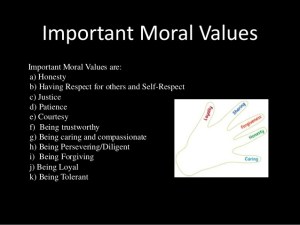
The main difference I believe is that in a properly functioning family the parents teach their children morals, as opposed to the gang subculture that focuses on respect only. Morals are defined as rules and habits of conduct.  In addition to the family, moral education is also carried out by schools and churches.  There are four main aspects to Moral Education according to the World Book Encyclopedia: Inculcation, Values clarification, Moral development and Values analysis.  The goal of moral education is to develop values -the standards by which people judge what is important, worthwhile and good.  Moral values include hard work, honesty, fairness, cooperation, tolerance and respect.

For those that have grown up on the streets having dropped out of school and never attended church their education was a distorted, unbalanced interpretation of those values held by a civil society.  Hard work is to be avoided, easy money is the game.  They dream of getting rich so that they can live the lifestyle, however they don’t see hard work or education as the means to achieve that goal.

To survive on the streets honesty and fairness have been replaced with lying, cheating and stealing.  Every transaction is an attempt to get over on someone else.  A good hustler always makes a little something on every deal.  They will say anything to anyone to get what they want.  They will take what is not theirs without hesitation in order to either have it for themselves or to turn it into quick money.

Cooperation only goes so far.  Gangs use a strict hierarchy of rank and authority that is achieved and maintained by ruthless violence and manipulation.  Disputes are often settled with a gun.  Gangs are at war with each other for territory and economic control of things like drug distribution.  There is no tolerance for anyone outside of the gang. People of other ethnicities, cultures or socio-economic classes are denigrated, derided and targeted for violence and/or exploitation.

Respect is the most highly esteemed value.  In an ‘us’ versus ‘them’ subculture respect is demanded and any perceived slight can result in violence against the individual that “disrespected” them.  Respect is based on how strong, brutal, vicious, cunning, and ruthless you are; in other words, how ‘bad’ you are.  For those in the gang subculture this is what they look up to.

How different this is from the form of respect that the greater society relies on. Respect means having regard for, to avoid violation, to have concern for an individual.  It is this basis for a civil society as opposed to the gang mentality which harkens back to the Wild West where life was cheap and people were regularly gunned down in cold blood.  They believe the myth that an armed society is a civil society, however guns don’t make peace only war.

In prison what was formerly called a knife, shive, or shank is now called a banger. And to ‘bang’ someone out is to cut them up.  There is evidence in every prison bathroom I’ve ever used of knife sharpening in the showers between the tiles or in the toilet stalls between the bricks.  To ‘buck fifty’ someone is to cut their cheek, usually in an attempt to brand them a snitch, so that everyone else that encounters that person in prison will know what they are.

In eight years in prison I have never witnessed a knife fight.  Knives are used to sneak up on somebody and severely injure or kill them.  You seek to catch your victim unaware and attack before they can defend themselves.  Often the tactic involves a group of 2-4 ganging up on a lone individual in an isolated location in a hit and run attack.  There is no intention of giving someone a “fair” fight.

Prison is full of people who committed a violent crime or came from a violent subculture and are predisposed to violence as the primary method of addressing their problems. The Parole Board may require classes such as Thinking for A Change or VPP (Violence Prevention Programming) which are cognitive behavioral therapy groups where students are asked to work through a book and participate in discussions in order to identify the underlying reasons for violence and to provide techniques to manage/control violent outbursts.

The programs taught by the MDOC do not teach morals in an attempt to re-educate offenders, rather they provide tools to manage antisocial behavior.  This is consistent with the philosophy that government does not teach morality, it only legislates it.  This is the reason why punishment is not a deterrent to crime.  Many violent crimes involve passion-unchecked emotions coupled with a complete lack of conscience, while the states solution is to apply logic and reason.  The recidivism rate speaks clearly to the failure of this approach.  Contrast this with the recidivism rate for those who actively participate in Christian faith-based programming which does teach morals. The government doesn’t teach morality, this only comes from the family, church, and schools. Unfortunately, in recent years moral teaching has been removed from schools due to the push for separation of church and state.  So, in an increasingly secular society where church attendance is decreasing and over 50% of marriages end in divorce strong morals are not being taught.

What better place than in prison to teach those who never learned proper morals in the first place? In a controlled environment you should be able to get the inmates undivided attention and yet this is not the case. Too much unproductive free time and distractions coupled with the lack of enforcement of discipline have resulted in an environment that is not conducive to learning.  Just look at the GED completion rates to see the evidence for this.

Punishment fails as a method of correcting bad behavior when the person being punished does not perceive their behavior as bad, rather as normal.  Instead it results in a loss of respect for authority and tends to further entrench the behavior.  It is a bit like when a parent tells a child, “Because I said so.”  No explanation just a command not to do it again.

Our society had become a moral quagmire because it no longer believes in absolutes. Truth is whatever you want it to be.  Morals and societal norms no longer serve as the restraints they once did to rein in aberrant behavior through peer pressure and societal expectations.  Entertainers have pushed the envelope until it has become a garbage bag. They preach a message of unrestrained hedonism.  These modern-day evangelists have millions of disciples living their lives following the philosophy of moral relativism.  So, does it make sense to use television as a baby sitter in prison? Or flood inmate’s ears with violent and sexually explicit song lyrics through MP3 players?

Instead of warehousing people in prisons with lots of free time and no direction, the MDOC needs to find a better way to manage the prison population in order to effect change.  Ex-offenders may never be model citizens after they are released, however they should no longer be the poster-children for a failed system whose faces appear on wanted posters.  Use the time given to each prisoner to instill in them a better understanding of the expectations of a civil society through the application of a moral education.