

A Call to the Church to Stand with Returning Citizens
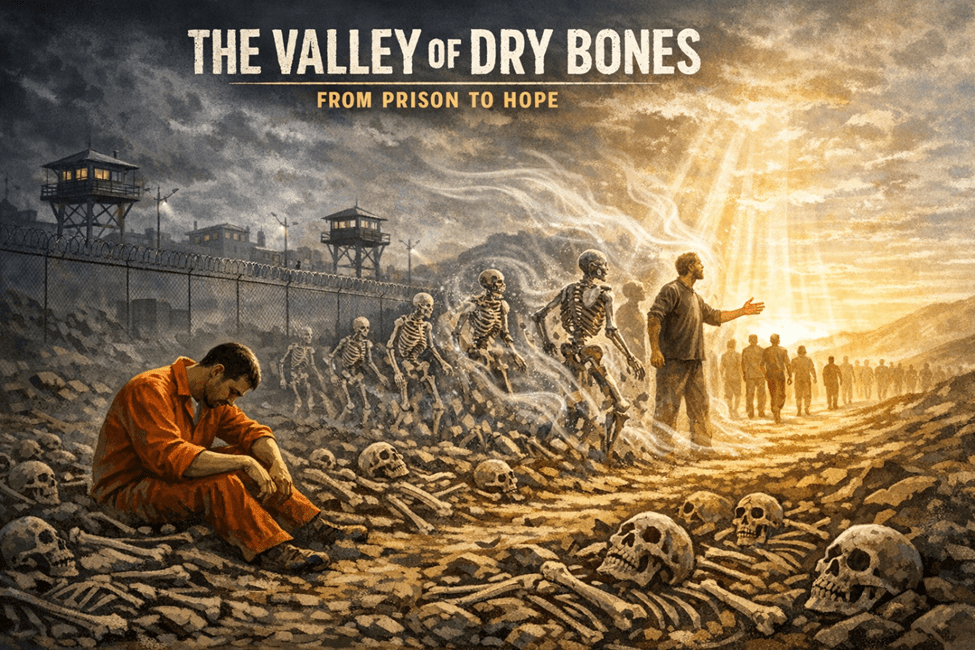
Few images in scripture are as haunting—and as hopeful—as Ezekiel’s vision of the Valley of Dry Bones. A prophet stands in a wasteland littered with bones, remnants of lives that once held promise. God asks him a question that feels almost cruel in its obviousness: “Can these bones live?”-Ezekiel 37:3 It’s a question that echoes today in a place Ezekiel never saw but would have understood intuitively: the modern prison.
Prisons, like Ezekiel’s valley, are full of people society has written off as “too far gone,” “beyond repair,” or “better forgotten.” Yet the dry bones vision is not a story about death—it’s a story about what can happen when we refuse to accept that death is the final word. Below is why this ancient metaphor resonates so deeply with the realities of incarceration.
🦴 1. Dry Bones Represent Lives Stripped Down to Their Lowest Point
In Ezekiel’s vision, the bones are not just dead—they are very dry, long abandoned, beyond any natural hope of restoration. In prison, people often describe feeling the same way:
- Stripped of identity
- Cut off from community
- Reduced to a number
- Disconnected from purpose
- Forgotten by society
Many incarcerated people talk about feeling like they’ve been placed in a valley where nothing grows. Their past mistakes overshadow their humanity. Their future feels predetermined. Their present feels suspended. The dryness is not just physical confinement—it’s emotional, relational, and spiritual desolation.
🌬️ 2. The Question “Can These Bones Live?” Mirrors Society’s Doubt About Redemption
When God asks Ezekiel whether the bones can live, the prophet doesn’t say yes or no. He says, “Only you know.” That’s the tension we live with today.
- We debate whether people can truly change.
- We argue about punishment versus rehabilitation.
- We question whether someone who has done harm deserves another chance.
The valley forces us to confront our assumptions about human potential. Prisons force us to confront them too. The question is not whether transformation is possible—it’s whether we believe it is.
🧩 3. Restoration Begins With Being Spoken To, Not Spoken About
In the vision, the bones begin to come together only after Ezekiel speaks directly to them. Not about them. Not around them. To them. This is a profound detail. People in prison are often spoken about—by courts, by media, by policymakers—but rarely spoken to in ways that affirm their humanity or potential. Change begins when someone:
- Calls a person by their name.
- Sees their story beyond their crime.
- Speaks hope into a place defined by despair.
- Treats them as capable of growth.
Words alone don’t fix everything, but they can spark the first movement of bones coming together.
💨 4. The Breath of Life Represents What Prisons Cannot Provide Alone
In Ezekiel’s vision, the bones come together, flesh appears, skin covers them—but they are still lifeless until the breath enters them. This breath symbolizes:
- Purpose
- Dignity
- Connection
- Hope
- A future
Prisons can enforce structure, routine, and discipline. But they cannot breathe life into a person. That requires:
- Community
- Education
- Mentorship
- Healing
- Opportunity
- Belief
The breath comes from outside the system—through relationships, programs, and the willingness of society to see incarcerated people as more than their worst moment.
🌱 5. The Valley Becomes an Army of the Restored, Not the Perfect
When the bones rise, they don’t become an army of flawless saints. They become an army of people who were once written off. That’s the heart of the analogy:
- The vision is not about perfection.
- It’s about restoration.
Many people leave prison determined to rebuild their lives, reconnect with family, contribute to their communities, and break cycles of harm. But they face barriers that often feel as impossible as resurrecting dry bones:
- Stigma
- Employment discrimination
- Housing restrictions
- Lack of support
- Trauma
- Chronic health issues
- Aging behind bars
Yet, like the bones in the valley, many rise anyway—slowly, painfully, but powerfully.
🔥 6. The Valley Teaches Us That Transformation Is Collective, Not Individual
Ezekiel doesn’t resurrect the bones alone. The bones don’t resurrect themselves. The breath doesn’t come from within the bones. Transformation is a collaborative act. Likewise, prison reform, reentry success, and personal transformation require:
- Community investment
- Policy change
- Compassionate leadership
- Restorative justice
- Support networks
- Public imagination
The valley becomes a place of life only when multiple forces work together.
🌄 7. The Valley Is Not the End of the Story
The Valley of Dry Bones is not a story about death—it’s a story about what happens when we refuse to let death, despair, or desolation have the final word. Prisons can feel like valleys of dry bones. But the vision reminds us:
- No one is beyond restoration.
- No life is too fractured to be rebuilt.
- No story is too broken to be rewritten.
- No valley is too barren for hope to grow.
The question “Can these bones live?” is not a test of the bones. It’s a test of our imagination, our compassion, and our willingness to believe in the possibility of transformation. And if Ezekiel’s vision teaches us anything, it’s this:
Dry bones can rise. But only if we dare to see life where others see only death.
⚖️ 8. The Valley: What Returning Citizens Face
Ezekiel describes the bones as “very dry.” That’s not just death—it’s abandonment. Many returning citizens experience the same:
- No ID
- No housing
- No job
- No community
- No sense of belonging
- Nationally, many states see 40–60% of people return to prison within three years and 82% are rearrested within 10 years, showing how long incarceration impacts behavior and opportunity[1].
The valley is deep. These rates reflect not just individual choices but systemic barriers to reintegration. Based on the latest statistics, the state of Michigan is a bright spot.
Michigan’s recidivism rate is just 21%—the lowest in state history
79% of people on parole do not return to prison. Michigan’s success is not magic. It’s ministry in motion—practical supports that mirror the heart of the Gospel.
🌬️ 9. When God Says “Prophesy to These Bones”
In Ezekiel 37, God doesn’t tell the prophet to walk away. He tells him to speak life. Michigan’s reentry model does exactly that:
- Helping people get state IDs and driver’s licenses.
- Providing transitional housing.
- Offering skilled trades training and post‑secondary education.
- Connecting people to peer recovery coaches.
- Supporting them before and after release.
These are not just programs—they are acts of restoration. They are the modern equivalent of Ezekiel speaking to the bones.
💨 10. The Breath: What Programs Alone Cannot Give
In the vision, the bones come together, flesh appears, skin covers them—but there is no breath until God sends it. Reentry programs can:
- Train
- House
- Supervise
- Prepare
But they cannot breathe hope, belonging, or identity into a person. That is where the Church becomes essential. The Church is uniquely equipped to offer:
- Community
- Purpose
- Spiritual grounding
- Mentorship
- Love without condition
These are the things that turn structure into life.
📉 11. Reality Check: Not All Programs Work
The U.S. Department of Labor’s evaluation—shows the limits of fragmented reentry efforts:
- 72% of participants received education or training.
- 43% received occupational skills training.
- Only 2.3% received on‑the‑job training — the most effective form of workforce preparation.
- Participants were 5.1 percentage points more likely to be convicted of a new crime than the comparison group.
- They were 4.1 percentage points less likely to be employed.
- They earned $693 less on average in later quarters.
Why? Because partial support produces partial transformation. Programs that lack depth, continuity, and real‑world connection often fail to deliver lasting change, especially for individuals with serious prior justice involvement[5].
Bones rattled—but they didn’t rise. This is why the Church’s role is not optional. It is the missing breath.
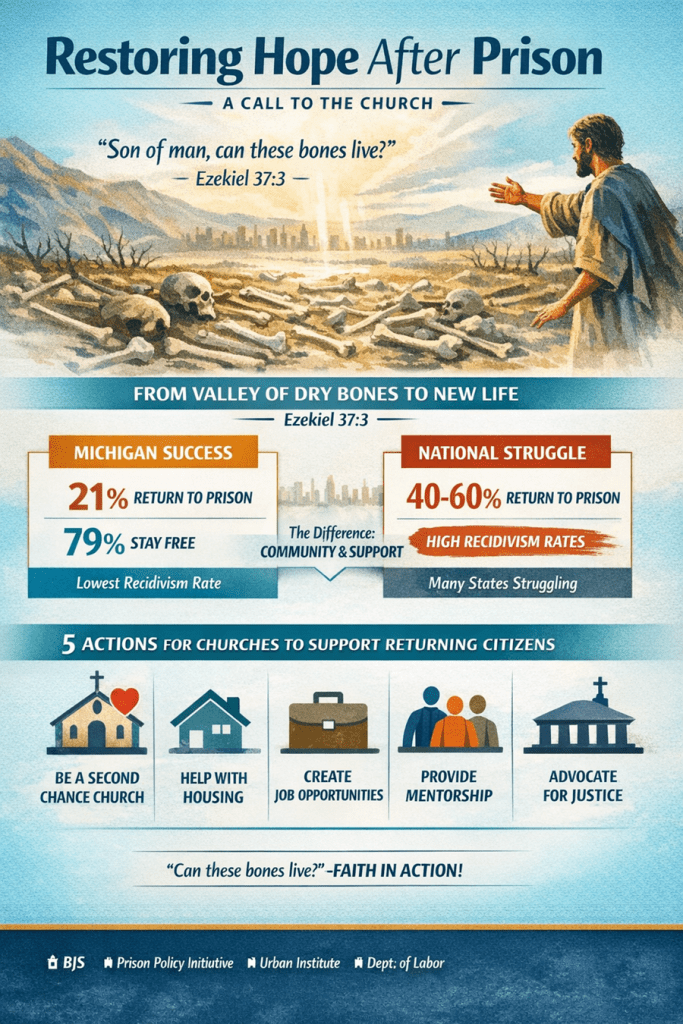
What Churches Can Do: Five Actions That Bring Life to the Valley
These are practical, doable, deeply biblical steps.
✝️ 1. Become a “Second Chance” Church
Many formerly incarcerated people have a very difficult time finding a church that will allow them to worship with their congregation. They are turned away because there is no plan in place to address the “security challenges” that some parolees might pose based on fear, misinformation and prejudice. Returning citizens are a class of the “least of these” that require special handling and care for the church accommodate them. The plan should include how to:
- Publicly welcome returning citizens.
- Train greeters and volunteers.
- Preach on restoration, not retribution.
A church’s posture can be the difference between someone rising or returning to the valley.
🏠 2. Support Housing Stability
Housing insecurity is nearly three times more common than homelessness alone[3]. Formerly incarcerated individuals often face:
- Disqualification from public housing
- Discrimination by landlords
- Lack of savings or credit
This instability undermines health, employment, and family reunification. How the church can help:
- Partner with transitional housing programs.
- Offer rental assistance.
- Create host‑home networks.
- Adopt a returning citizen as a congregation.
Stable housing is one of the strongest predictors of successful reentry.
💼 3. Create Employment Pathways
Unemployment among formerly incarcerated people is 27%, higher than any national rate in modern history[2]. Those who do find work earn 50–60% less than the general population[2]. Stigma, lack of credentials, and legal restrictions all contribute to this economic exclusion. How the church can help:
- Hire returning citizens for church roles.
- Partner with local employers.
- Offer resume workshops and interview coaching.
- Provide transportation to work.
Work is hope. Work is resurrection.
🤝 4. Build Mentorship and Discipleship Teams
Programs in prison like Keryx work because they include aspects of revival, peer led small group accountability, Spiritual engagement and service. Freedom Dreamers and others have created similar programs to provide these necessary functions to returning citizens and the church can help by offering more opportunities in every community.
- One‑on‑one mentorship.
- Small groups for returning citizens.
- Peer support led by formerly incarcerated members.
People rise when someone walks with them.
🙏 5. Advocate for Justice and Restoration
The church can provide a strong voice of reason and compassion in public discourse by:
- Supporting ID access, housing reform, and fair‑chance hiring.
- Partnering with MDOC and local reentry coalitions.
- Educating your congregation about the realities of reentry.
Advocacy is prophecy in action.
Conclusion: The Church as the Breath in the Valley
The path after prison is steep and full of obstacles. But with:
- Stable housing
- Fair employment opportunities
- Access to education
- Community support
- Policy reform
…success becomes not just possible, but sustainable. We must stop asking whether people can succeed after prison—and start asking whether we’ve given them a fair chance too.
Ezekiel watched as the bones rose—not because they were perfect, but because God breathed life into them. The Church is called to be that breath today. Michigan’s success shows what happens when a community invests in restoration. The US Department of Labor’s findings show what happens when support is fragmented. The valley is real. But so is the God who raises the dead. And He invites His people to stand in the valley and speak life.
Here are several faith-based programs in Michigan actively supporting returning citizens on parole or probation. Notably, Michigan’s low recidivism rate (21%) is linked to strong community partnerships—including churches and ministries offering housing, mentorship, and job support.
🙌 Faith-Based Reentry Programs in Michigan
1. Good News Ministries (Detroit)
- Focus: Transitional housing, spiritual mentorship, job readiness
- Services: Bible studies, recovery support, employment coaching
- Website: goodnewsdetroit.org
2. Celebration Fellowship (Ionia & Muskegon)
- Focus: In-prison worship and post-release discipleship
- Partners: Christian Reformed Church, MDOC
- Unique Feature: Operates inside prisons and continues support after release
- Website: celebrationfellowship.org
3. Crossroads Prison Ministries (Grand Rapids)
- Focus: Bible correspondence courses, mentorship
- Reach: Serves incarcerated and returning citizens nationwide
- Website: cpministries.org
4. The Isaiah House (Detroit)
- Focus: Faith-based transitional housing for men on parole
- Services: Recovery support, spiritual formation, job placement
- Affiliation: Catholic Charities of Southeast Michigan
- Website: ccsem.org
5. Nation Outside (Statewide, faith-rooted)
- Focus: Advocacy and peer-led support for formerly incarcerated people
- Faith Connection: Founded by justice-impacted Christians; partners with churches
- Website: nationoutside.org
6. Prison Fellowship (National, active in Michigan)
- Focus: Angel Tree, in-prison ministry, reentry support
- Michigan Presence: Works with MDOC and local churches
- Website: prisonfellowship.org
Michigan’s Offender Success network is a statewide reentry initiative run by the Department of Corrections (MDOC) that provides housing, employment, health, and mentoring support to parolees and probationers. It’s a key reason Michigan’s recidivism rate is just 21%—among the lowest in the nation.
🛠️ What Is Offender Success?
Offender Success (OS) is Michigan’s comprehensive reentry system designed to help individuals succeed after incarceration. It operates before and after release, with staff embedded in prisons and communities statewide.
🔑 Four Major Areas of Focus
| Area | Description |
|---|---|
| Evidence-Based Programs | Cognitive behavioral therapy, violence prevention, and other risk-reduction programs tailored to parole eligibility. |
| Education | High school equivalency, special education, career/technical training, and college degrees. Includes Vocational Villages—immersive trade schools inside prisons. |
| In-Reach | Dedicated staff help parolees plan for reentry before release, bridging prison and community. |
| Community Supports | Housing, job placement, health services, mentoring, and basic supplies provided through regional agencies and local partners. |
🏠 Services Available to Returning Citizens
Eligible parolees and probationers may receive:
- Residential Stability: Transitional housing, rental assistance, landlord partnerships
- Job Placement Assistance: Resume help, employer connections, transportation support
- Health & Behavioral Health: Referrals to providers, recovery coaching, peer support
- Social Supports: Clothing, food, vital documents, mentoring, faith-based connections
🤝 Faith-Based Partnerships
Offender Success actively collaborates with:
- Churches and ministries offering housing, mentorship, and spiritual support
- Local advisory councils that include faith leaders
- Community coordinators who connect parolees to faith-based services
Faith organizations can join the network by contacting their regional Offender Success coordinator or attending local advisory meetings.
📍 How to Get Involved
- Churches can offer space, volunteers, or mentorship
- Service providers can join local advisory councils
- Returning citizens should speak with their parole agent to access services
- Families can call 2-1-1 or use the Calvin University/MDOC Resource Map (Returning Citizen Services) to find local help
📚 Footnotes
- Bureau of Justice Statistics, Recidivism of Prisoners Released in 30 States (2021) ↩ ↩
- Prison Policy Initiative, Out of Prison & Out of Work (2020) ↩ ↩
- Urban Institute, Housing Challenges After Incarceration (2022) ↩
- RAND Corporation, Evaluation of Reentry Programs (2023) ↩ ↩
- U.S. Department of Labor, Reentry Employment Opportunities Study (2024) ↩
Digging Deeper
Are Michigan’s reentry efforts actually more successful than the rest of the U.S.?
To be fair in the treatment of the data that I referenced in this blog entry, I have included the following assessment to highlight the differences in how the data was reported. It is difficult when combining data sources to ensure that the comparisons are accurate unless the definitions of key terms and methods of data collection and reporting are the same. The Michigan Department of Corrections, the US Department of Labor and the Bureau of Justice Statistics are not all using the same definitions so any comparisons must be understood to be more representative of magnitude than an exact arithmetic interpretation. The data is simple a useful tool to draw attention to the success rate of programs that are working better than programs in other states.
High‑level comparison
| Dimension | Michigan | Rest of U.S. (typical) |
| 3‑year return to prison | ~21% returned to prison (≈2 in 10) | Roughly 2–3x higher in many states (often 40–60%+) |
| Trend | Historic low, declining over last decade | Generally flat or modestly declining, still high overall |
| Framing | State explicitly credits reentry supports (IDs, housing, education, jobs) | Reentry often fragmented, uneven by state and county |
| Programming | Statewide, coordinated through MDOC with budget lines for reentry | Patchwork of state, county, nonprofit, and federal grants |
| Evidence quality | Administrative recidivism data, descriptive but not causal | Mix of BJS stats + scattered program evaluations, few rigorous |
1. Recidivism outcomes: Michigan vs national picture
Michigan’s Department of Corrections reports a 21.0% recidivism rate, defined as people who return to prison within three years of parole—its lowest rate on record and a 79% “success rate” for those paroled in 2021.
Nationally, federal studies typically find that around two‑thirds of people released from state prisons are rearrested within three years, and a substantial share are reconvicted or returned to prison. Even allowing for definitional differences (rearrest vs return to prison), Michigan is clearly performing much better than the national norm on basic recidivism metrics.
Key point: Michigan is not just slightly better—it’s in a different tier of recidivism performance.
2. What Michigan is actually doing differently
Michigan’s own reporting repeatedly links lower recidivism to “full circle” reentry support, not just to tougher supervision. Core elements include:
- IDs and licenses: Help obtaining state IDs or driver’s licenses before or shortly after release—critical for work, housing, and services.
- Housing supports: Investment in transitional housing and help finding stable placements.
- Employment & training:
- Job placement assistance and employment services.
- 14 skilled trades programs operating inside prisons.
- 12 post‑secondary education programs, with thousands of graduates.
- Recovery & behavioral health: Funding for peer recovery coaches and recovery resources.
- Continuity of care: Emphasis on support during incarceration and on parole, not just at the gate.
This is closer to a statewide reentry ecosystem than a loose collection of programs.
3. How that contrasts with much of the U.S.
In many other states, reentry looks more like:
- Higher baseline recidivism (often 40–60%+ return to prison within 3 years).
- Fragmented services—short‑term grants, county‑level programs, and nonprofits with limited capacity.
- Weak housing infrastructure—very few dedicated transitional beds, long waitlists, and strict exclusions.
- Limited in‑prison education—far fewer post‑secondary options and trades seats per capita.
- Minimal ID/benefits preparation—people leave without IDs, health coverage, or a clear plan.
So, while Michigan is not perfect, its combination of IDs + housing + education + employment + recovery is more comprehensive than what many states offer.
4. Caveats when comparing Michigan to “the rest of the U.S.”
Raw comparisons can mislead. Important caveats:
- Different definitions: Michigan’s 21% is “return to prison within 3 years of parole,” not “any rearrest.” Other states or federal stats often use rearrest, which is always higher.
- Population differences: Michigan’s prison population has declined to its lowest level since 1991, which may mean more selective incarceration and parole practices.
- Policy context: States differ in sentencing laws, parole practices, and community supervision intensity—all of which affect measured recidivism.
- No randomized evidence at the state level: Michigan’s data show strong association, not definitive proof that reentry programs caused the lower rate.
So: Michigan looks genuinely strong, but we should treat it as a promising model, not a controlled experiment.
5. Reframing “success” beyond recidivism
- Michigan is outperforming national recidivism norms, with about 1 in 5 returning to prison vs much higher rates elsewhere.
- The state has institutionalized reentry supports (IDs, housing, education, trades, recovery) in a way many states have not.
- The direction of change (historic low, downward trend) matters as much as the level.
- True success should also track:
- Stable employment
- Stable housing
- Health and recovery
- Family reunificaiton
- Long-term desistance, not just 3-year returns.
 Christ, Crime and Punishment