Breaking and Entering

breaking and entering

No one in prison likes a thief.  They target those they perceive as weak or look for targets of opportunity.  When lockers are open there are always eyes watching to see what you’ve got.  Being inattentive even for a few seconds can cost you.  Not padlocking your locker or footlocker even for a brief time and leaving it unattended will provide an opening for theft.  While a thief may run up into a cube and open a predetermined locker for a predetermined item in a snatch and grab, most theft is conducted by a cubemate.  They will even come up to you later and lie to your face pretending to empathize with you and your loss.

Some steal for the thrill, some are hungry, some as a passive aggressive way of expressing hatred for an individual, and some are desperate to pay their debts.  Given the culture in prison, the others living in the cube may know who did it and condone the action.  On rare occasions they don’t and then things become interesting.  Theft is premeditated and sometimes conducted by a crew.  Locks may be enough to slow them down but generally once their minds are made up, they will keep trying until they succeed.  In the end if you are marked as a target your property is as good as gone.

Lockers used in prison housing units look like any locker you’ve seen in a locker room at the gym.  A little over a foot wide and about six feet tall and about 20 inches deep.  In Level II and above the lockers are bolted to the wall.  In most Level I cubicle settings they are free standing.  In every housing unit that I lived in, the majority of the lockers exhibited damage from years of abuse.  Due to security concerns, lockers with internal rods used to secure the top and bottom of the door had the rods removed to prevent their use as weapons.  This means that the only point at which the door was secured was the middle.  This left the top and bottom corners susceptible to leverage that could be used to pry them open sufficiently to reach inside and grab whatever was in reach.  At my last Level I the maintenance department was delivering a replacement locker to my housing unit on a weekly basis.  The old lockers were being repaired and the corners of the doors reinforced with steel bar welded into them.   They were then returned to the unit when the next locker was broken into.  Too bad they weren’t being proactive and simply replace all the lockers with refurbished ones.  Just goes to show how little concern they had for the inmates

The footlockers used to be fairly secure.  They were made from ply-wood with metal trim adjoining all the corner seams and a rugged clasp for the padlock.  Over the years the quality of the footlockers decreased to keep the cost down. One time an older style footlocker was stolen in my Level I housing unit by throwing it over the wall from the back hall to the front.  Late at night you could hear the thin wood box being broken up into small enough pieces that they could be disposed of in the trash to get rid of the evidence.  At least 10 years ago a switch was made to an all metal style with a piano hinge lid with a weak clasp and no internal support to strengthen the corners of the lid.  These were easy to pry open.  I had one that was so forcefully pried open by a thief that the clasp broken off at the weld.  When I was moved to a different facility the footlocker was deemed to be damaged and the Property Room would not let me have it back.  I had to order another footlocker to replace it.  The cost was about $100 including tax and delivery.  If you had more property than could fit in a duffle bag you had no choice but to buy a footlocker.  There is a mechanism by which you can try to get the state to reimburse you for damage to a foot locker if you can prove it is the result of staff actions, which they will deny since it was by their inattention and not direct action that the damage occurred.

When unit security is lax the thief will steal repeatedly being emboldened by his success.  A favorite time for theft is during meal times when the majority of inmates are out of the unit for 15-25 minutes.  During that time if the unit officers are not making their presence known then larger items like footlockers will be broken into or TVs stolen.  To avoid the cameras that are positioned to look down the hallways, people and goods are transferred over the walls that separate the cubicles.  Because this problem was so bad the MDOC was forced to erect a metal fencing barrier to separate the front and back hallway cubicles, but not the side by side cubicles.  You can’t identify suspects if you can’t find them on camera with goods in their hands.  When it is an inside job it is even more difficult.  Even eyewitnesses will not say anything because being a snitch in prison is not a healthy vocation.  It is safer to not get involved unless the cubemates act as a group to deal with the situation since none of them wants to be the next victim.

There are a lot of people in prison who made a living by stealing out in the world and old habits die hard.  Most people in prison will continue on living how they lived in the world and even embellish on it.  But thieves are the worst.  They have no moral sense of conscience to dissuade them.  Only the threat of physical violence by getting caught by another inmate will slow them down.  They don’t even worry about getting caught by staff since the odds are so strongly in their favor.  When caught there is usually only a slap on the wrist for punishment.  Officers may write tickets, but only in extraordinary cases will theft between inmates result in restitution.  In contrast if the theft is against the state, they will charge exorbitant replacement costs.

When a thief is identified in the housing unit, he is a marked man.  Generally speaking, the only recourse is violence, and that only feeds into the dysfunctional prison culture.  If you don’t have anything to lose and feel like you have a chance to win you might try to seek revenge or have others help you.  If you don’t have acquaintances or accomplices to do this or can’t risk losing a parole, you may have to simply accept it.  It certainly helps to put things in proper perspective.  Nothing is more important than freedom, it is after all only stuff.  But for those who have little or nothing and everything they do have is hard won with scant resources and no ability to replace the stolen items then the stakes can be much higher.  People have died in prison in disputes over a single Raman noodle which costs $0.34.

50 Things I Learned in Prison

  1. Toothpaste is a better glue than Elmer’s.
  2. Ramen noodles can be the base ingredient in a gourmet meal.
  3. RAP music is Really Awful Poetry.
  4. Sometimes you have to pay extra just to get the basic free service.
  5. You can’t trust authority. If you see their lips moving you know their lying.
  6. You can educate ignorance, but you can’t fix stupid.
  7. Privacy is an illusion and personal space is dimensionless.
  8. The only difference between COs and inmates is that the COs lack conviction.
  9. While the menu looks good on paper, the reality is something completely different.
  10. Prison beds have more in common with a medieval torture rack than a place to sleep.
  11. Not only is justice blind, it is deaf, mute, and retarded.
  12. Inmates can be charged outrageous prices for inferior products because they are a captive market.
  13. Common sense is not very common.
  14. Prison health care services are careless, dental services are toothless, and the mental health services are crazy.
  15. Prison is like Motel 6, they’ll leave a light on for you.
  16. Mother doesn’t live here so you have to clean up after yourself.
  17. Behavioral issues are best handled with diesel therapy.
  18. Even when you are right you’re guilty.
  19. It’s their house and their rules, I’m just a guest.
  20. Floor sealer makes good shoe polish.
  21. Coffee is the nectar of the gods.
  22. Eating gas station vending machine food in the visiting room is like dining in a 5-star restaurant compared to the chow hall.
  23. Silence is not only golden, it’s priceless.
  24. I miss my Lazy-boy!
  25. It’s pronounced “pole-ees”.
  26. “Snitch” is a four-letter word.
  27. Hygiene is not optional
  28. Forty qualifies you as old.
  29. Fifteen minutes on the phone goes by in a heartbeat.
  30. Men gossip worse than women.
  31. The truth will not set you free.
  32. Beards are a fashion statement, tattoos are a fashion faux pas.
  33. There is a direct relationship between a man’s IQ and his level of respect for women.
  34. You are guilty until proven innocent, and since no one is innocent, QED.
  35. There is no place like home.
  36. The general public is not getting their money’s worth from the MDOC.
  37. It’s the Michigan Department of Corruption.
  38. Dogs at the pound get treated better than inmates.
  39. Prison is no place for picky eaters.
  40. The prison pay scale is criminal exploitation.
  41. Lawsuits are cheaper than proper health care.
  42. Inmates are like mushrooms: Kept in the dark and fed BS.
  43. Low expectations lead to poor outcomes.
  44. Might makes fright.
  45. If you don’t get your hopes up you won’t be disappointed.
  46. You can’t force someone to change; they have to want to.
  47. Harsh prison sentences punish more than just the guilty party.
  48. Some fashion statements should be revised before being made public.
  49. Dental floss can mend anything.
  50. The way to claim success is to keep changing programs before the failures become too evident.

You Might Be A Prisoner If:

An homage to Jeff Foxworthy

  1. You try to buy things with Ramen Noodles.
  2. You call out in a restaurant “Cookie for a burger!”
  3. You send a written request to your doctor for an appointment.
  4. Three times a day you stop what you’re doing and go sit on your bed.
  5. You never make phone calls that last more than 15 minutes.
  6. All the outfits in your closet are identical.
  7. You can tell military time but you don’t salute officers.
  8. You get signatures in your day planner for every appointment.
  9. You get your hair cut with children’s safety scissors.
  10. Instead of being chased by a posse, the posse travels with you.
  11. You wish your gin had been brewed in a bathtub.
  12. You sleep with the lights on for safety.
  13. You gossip worse than women about other men.
  14. You expect and accept “No” for an answer.
  15. You are willing to stand in line at the worst restaurant in town.
  16. You work for only pennies an hour.
  17. You have to pay your roommate to get him to take a shower.
  18. You paid for your tattoos with coffee.
  19. Convictions are something on your rap sheet, not something you believe.
  20. Earning a GED is considered a significant achievement.
  21. You answer when people call you by a number instead of your name.
  22. Instead of working 9 to 5 you have hard labor from 5 to 9.
  23. You use a Bible as a doorstop or a wedge for your bunk.
  24. You think HOPE is a four-letter word.
  25. You think that instant coffee is the elixir of the gods.
  26. You think that life and death is just fun and games.
  27. You watch free cable but are not staying in a hotel.
  28. The way you say ‘Thank you’ is “Good lookin’ out” and mean it literally.
  29. All your worldly possessions fit into a duffle bag but you don’t deploy overseas.
  30. The majority of the furniture in your room is bolted to the floor or walls.

Everything Is Backwards In Prison

Backwards

  1. We lock our closets but we can’t lock the bathroom door. In fact, in many prisons there isn’t a bathroom door.
  2. The best food you get to eat is vending machine food in the visiting room or gas station food from the commissary. The chow hall food is practically inedible.
  3. The windows don’t have any curtains but still fail to let much light in.
  4. It is dark in the housing units, yet people complain when you turn on the lights.
  5. When you do turn on the lights they are still not bright enough to read by.
  6. Bath soap and shampoo are used to wash your personal dishes.
  7. The day room is most crowded at night.
  8. We use chairs as a ladder to climb unto the top bunk instead of sitting on them.
  9. Emergency count is never an emergency and always takes longer than regular count.
  10. In the chow hall they feed grown men kid’s meal portions.
  11. Disposable plastic silverware is used over and over forever.
  12. Guys talk about the ugliest women as if they are beauty queens when they would never give them a second thought out in the world.
  13. We refill the ink barrel of our favorite disposable pen.
  14. We recharge disposable batteries.
  15. Laundry comes out of the wash looking dirtier than before it was washed.
  16. Headphones are used to block out sound.
  17. The family we were tired of listening to can’t talk long enough on the phone.
  18. We sometimes have to lock-up to get free of a bad situation.
  19. New flat screen TVs have smaller screens than the old CRTs and cost 50% more.
  20. Some work only to steal.
  21. The MDOC pays students to go to school.
  22. Some inmates have their people put money in other prisoner’s trust accounts because they can’t have any in their own.
  23. We brush our teeth before meals.
  24. No good deed goes unpunished.
  25. Bad behavior is expected.
  26. We learned that the truth will not set you free.

The Ministry of Silly Walks

Silly Walks The British comedy troupe Monty Python made fun of government bureaucrats in a sketch called ‘The Ministry of Silly Walks.’  In it they portrayed a number of characters with striding characteristics each more outrageous than the next.  If you spend any amount of time in prison you will quickly come to understand that life is stranger than fiction.

The Chain-Gang is the standard method of transporting prisoners outside of the facility. It involves not only the use of handcuffs but also belly chains and leg irons.  The intention is to make it impossible for a person to escape by making it impossible to run. Your hands are cuffed at your sides so that you can’t even scratch your nose.  Your ankles are cuffed together with about 16 inches of chain.  The result is that you cannot take a full stride but must shuffle your feet along.  To see a line of men walking this way is like viewing the March of the Penguins.  Arms hanging limp at their sides, straight legged they shuffle single file at the direction of the officers.  After only a couple of steps the bruises will begin to form as the front leg jerks the cuff of the back leg.  The cuff rests on the ankle bone making it very uncomfortable, especially for those with cankles.

In level IV you are locked down 20+ hours a day.  When you have the opportunity to get out of your cell to go someplace like the chow hall you tend to take your time in order to savor the fresh air and every possible minute outside of your cell.  The Level IV Shuffle looks a lot like the Chain-Gang except that there are no restraints involved.  Hands shoved into pants, legs straight, feet dragging as you slowly move in the intended direction. Progress needs to be sufficient so as to not incur the wrath of the guards who are impatiently escorting you in a scene that looks a bit like herding cats.  Men who have been locked down separately from their associates group up to carry on conversations from their last promenade at the slowest possible pace.

With the closing of state mental hospitals, the prison system has become the dumping ground for the mentally disturbed.  Without adequate mental health care, they end up in trouble with the law for trying to self-medicate or anti-social behavior.  Psychiatric care in prison frequently devolves in sedation.  When they are not sleeping the day away on their bunks you can spot them by their slow, zombie like walk known as the Thorazine Shuffle. At some facilities there are whole units dedicated to housing those participating in outpatient therapy.  At chow time it looks like a scene out of “The Night of The Living Dead” as they stagger to the chow hall.

In prison, how you walk can be part of your fashion statement or possibly a result of it. There is a fashion trend known as “Sagging” in which young men wear the waist of their pants on their upper legs thus exposing the tops of their boxers.  The pants tend to be extra-large and as a result the crotch sags down to their knees.  This fashion statement is meant to defy authority since it is against the rules and could result in a ticket.  The practice of Sagging occurs both inside and outside of prison and is an anti-authority statement.  To keep the pants from falling down one hand must be occupied holding the pants in the designated position.  Activities that require both hands place the individual at the risk of dropping their pants.  One time I had an older gentleman tell me that he had warned his son that if he didn’t keep his pants pulled up properly that one day it would be his downfall. Sure enough, the son tried running from the police with his pants sagging and they fell down and he was captured.  In prison the fashion statement is taken to the extreme with pant waists below the butt exposing two pairs of prison shorts plus boxers in a multi-layer effect.  This fashion faux pas knows no bounds because I have seen guys wearing extremely over-sized sweat suits jogging on the track with one had desperately trying to hold their pants up.  You’d think they’d learned their lesson the first time when they originally got caught.

The average age of prisoners is increasing in Michigan and is now over 40 years of age. This is the result of both the increased length of sentences keeping in prison longer and the number of seniors now coming to prison, many for the first time.  As a result, there is an increasing number of prisoners with physical infirmities that either need a cane or a wheel chair to get around.  We refer to these as Sticks and Wheels.  Now just about everyone in prison is looking for an edge and having a medical disability is a frequent way guys attempt to get that edge.  Having a wheel chair or cane may qualify a person for a special early chow detail and use of an assistant to carry their meal tray.  And not two hours later the same guy may be spotted in the weight pit doing squats or running on the track. I’m not saying that everyone in a wheel chair or using a cane is faking it, but I’ve seen more than my share of miracles.

At the other extreme I’ve seen guys in such poor health that moving from a bunk or toilet to a wheel chair is almost borderline impossible.  Broken bodies that cannot run the gauntlet of double doors, narrow halls and over-crowded living situations.  Men in such poor health that they need to be in assisted living watched over by a nurse and not a guard.  Those who can no longer care for themselves let alone hurt another person.

Putting an air of confidence is important but it can be taken a bit too far on occasion resulting in a walk straight off a Paris fashion runway or a 1970s Superfly movie.  Long leg stride with loose hips and wide slung shoulders, one arm thrusting sharply down. Head erect, eyes forward checking to make sure that all eyes are on him.  All that’s missing is the purple pimp suit with the felt hat and feather.  Someone who knows they’ve got it all going on and are “too cool for school.”  This walk is usually associated with a person who sees them self as a gangster living the hip hop lifestyle.  It is a walk meant to impress, but in prison we’re still not sure who.

As mentioned before there are a lot of seniors in prison and early mornings on the big yard look a bit like early mornings at the mall.  Mall Walkers are health conscious seniors who walk as a primary means of exercise.  Since there are no malls or indoor tracks they have to go out to the big yard and walk the track in the early morning, which allows them to beat the crowds of younger people later in the day.  Since the seniors tend to be early risers and the younger people sleep in it is just part of their natural cycles to separate themselves.  To be a true Mall Walker in prison takes dedication since you’ll be outdoors in all kinds of weather undeterred by only the most brutal winter weather or monsoonal rains.  Mall Walkers tend to walk alone with their thoughts.  They are not the fastest people on the track and probably don’t work up a heavy sweat, but have heeded their doctor’s warnings and will get a couple of miles in before retiring to a park bench for the rest of the day.

The middle age counterpart to the Mall Walker is the Power Walker.  More than likely many Mall Walkers are retired Power Walkers.  Power Walkers are people who can no longer run due to health conditions like bad knees. They follow their doctor’s advice to get their heart rate elevated for at least 30 minutes 3 to 5 times per week.  Many Power Walkers remember their youth from 5-10 years ago when playing softball on the weekend didn’t take all week to recover from it.  Brisk walking with swinging arm motion really gets the blood pumping, burns calories, and reduces stress.  It is also a good way to get out of the house.  Out in the world many of these people would probably have a large dog to walk.  In prison they walk singly or in pairs and are forced to weave in and out of traffic as they move at a higher rate of speed than the average track walker.

The most dedicated athletes on the track is the Weekend Warrior.  They run laps, do calisthenics and play sports, but this is a fair-weather crowd.  If it is rainy or too cold and snowy they prefer to stay indoors and play cards.  They have a well-rounded exercise program easily distinguished from the Weight Lifters and Body Builders who are in the weight pit or doing calisthenics religiously, but rarely if ever run.  This group is least likely to continue their regiment once they get out of prison.

The Body Builders are distinguished from the Weight Lifters by their goals. Weight Lifters brag about the massive amount of weight they can lift while Body Builders are regularly seen in front of the bathroom mirror flexing. The Weight Lifters and Body Builders are the most prone to sports injury and suffer long term disability because of their “no pain, no gain” philosophy.

The Average Joe out walking the track however isn’t there for any health benefit.  They are there because there is nothing else to do.  They walk in groups of two to six people wandering aimlessly around the track.  They gossip, joke, tell tall tales, and brag about what brought them to prison. They promenade around the track making it difficult for all the other groups by turning it into an obstacle course.  At times the track looks more like rush hour on a Detroit freeway than a NASCAR race because of them.

1-Ply

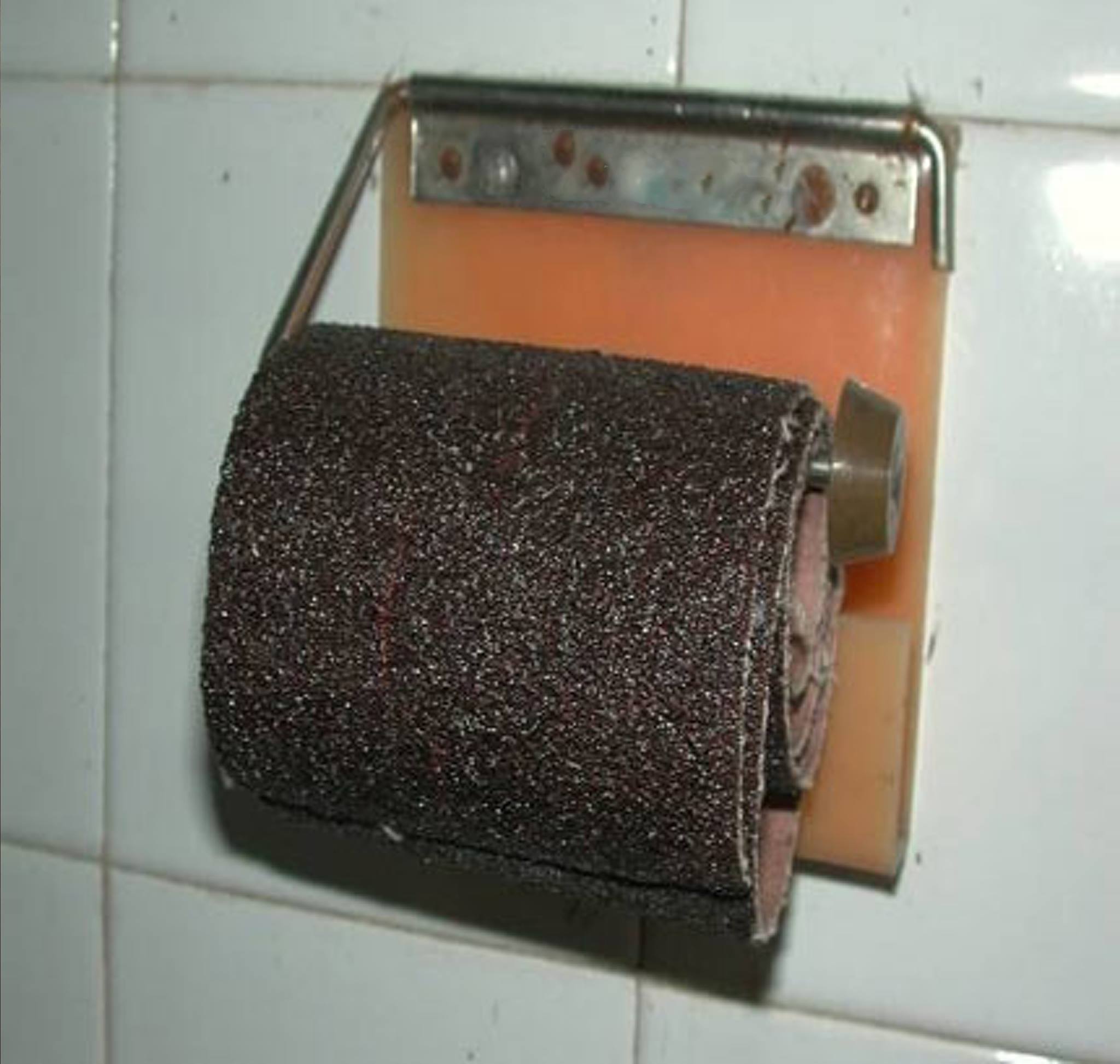
sand paper

Nothing epitomizes the prison experience better than the 1-ply toilet paper that is available for personal hygiene.  It is bought in bulk, delivered by the pallet to the housing units but passed out sparingly, used thoughtlessly, and discarded unceremoniously.  Toilet paper (TP) is essential and yet taken for granted.  There is nothing cottony soft about the industrial grade sandpaper that is purchased for prisoner use.  Think of the flimsiest, least absorbent, roughest TP you have used in a public bathroom.  Now imagine having to use it 24/7/365 instead of once in a blue moon.  The idea should rub you the wrong way, let alone the reality.

There are however at least 101 uses for TP in prison.  Besides the obvious use as Kleenex for blowing your nose it has other uses that you would have thought of at home.  TP is used for wedging between the bunk bed and the wall to keep the bed from shaking when your bunkie hops off the top bunk. The average is between 4 – 8 rolls for every bunk. In the higher security levels, the bunks are secured to the floor, so depending on the distance 2 rolls may be squashed together to bridge the gap.  In Level I the bunks are generally free range and so a single roll is sufficient since the bunk can be pushed into the wall.

TP is a useful substitute for paper towels in the kitchenette.  Paper towels are had to come by so TP is used to clean up the mess left by the previous microwave chef.  Wads of TP can serve as pot holders for a hot dish.  TP also serves as napkins for wiping fingers and faces.

TP is also used as ear plugs.  The housing units are noisy and ear plugs are very helpful for getting a good night’s sleep.  If you don’t have a pair of real foam ones that are sold in the commissary then wads of TP stuffed in the ears will work in a pinch.  With 160 guys living in a space originally designed for 80 there is a good chance someone in your area either saws logs in their sleep with a chain saw or stays awake all night laughing at the TV or working on their latest rap song.

Partial TP rolls are carelessly abandoned in the bathroom stalls by owners who have dropped them on the filthy floor and do not want to risk contaminating their locker with stray fecal material or rolls that have become wet sponges soaking up sweaty toilet water and urine.  More than once I accidentally dropped brand new rolls on the floor of the bathroom. You just have to write them off and move on.

Large commercial rolls in the bathrooms were ruled a fire hazard and removed from the housing units.  The metal hardware that was abandoned has become a theft target for those trying to arm themselves.  Although few were successful at liberating the metal bars and brackets that were so securely attached that they will still be standing when the building has fallen down around them.

As ubiquitous as TP maybe it sometimes becomes a valuable commodity. When the TP supply runs out in the housing unit a day or two before the supply truck is scheduled to deliver more, guys will resort to theft to get a roll when nature calls.  Someone else’s unattended roll left carelessly on a desk or a bunk may become wobbly.  Why inconvenience yourself or your bunkie when you can grab someone else’s wedge?

TP rolls constantly fly around when lobbed randomly from cube to cube in an undeclared war over music volume or sports rivalries.  This certainly beats the alternative when AA or D cell batteries begin to fly!

TP is hoarded by those who don’t want to do without.  But you can’t take it with you. I’ve seen COs fill trash bags full of rolls when shaking down a cube.  But as with all the other cat and games that inmates and COs engage in the previous owners of those TP rolls will reload in just a matter of days by hitting up every CO on every shift for rolls from the stash that was relocated from their cube to the officer’s station.

Even the card board box the case of TP is shipped and stored in may have a second life as building materials for art projects or shelving units inside lockers.  This card board is considered contraband and the inmates really aren’t supposed to use it.  But depending on the whims of the housing unit counselor or COs they my or not make a point of removing these temporary infrastructure improvements.  And the cat and mouse nature of the inmate/CO relationship will result in these structures being rebuilt as soon as they are removed like a beaver damning a stream with single-minded determination.

While you might not think of it TP is a useful art supply.  More specifically the card board tube at the center of the roll finds a second life as a container for holding colored pencils or pens. It may also become a work of art by incorporating the stiff card board into building structures created by hobby craft enthusiasts.

TP my not be the most glamorous thing but you certainly miss it when the nice 2-p1y that so many enjoy in the free world is not available.  There was a better grade of TP available for $0.78 per roll in the commissary, but when most inmates don’t have any source of outside support and the average pay for prison jobs is less than $1 per day, the price for TP puts it out of reach. Also compared to the $0.50 per roll or less that most people pay in the free the prison cost makes it a luxury item with a 50% mark-up.

Satanic Psalms

In prison, rap lyrics are the only style of music that you hear being recited endlessly without the aid of a radio or MP3 player.  People don’t just sing along, they have memorized the words and meditate on them: “get money”; “bitches” and “ho’,”: “nigga”this and “nigga” that; Steal, Kill, and Destroy.  Rap lyrics are satanic psalms.

A friend once said that he didn’t think he’d be able to go to the bathroom out in the world because there wouldn’t be some guy in the next stall rapping.  There are wanna be rappers in the housing units, the chow hall, the school, waiting in lines-everywhere, not just on the yard.  They speak out loud into the air, but mostly to themselves.  Some original pieces, but most what they have learned from commercial artists.

Like your home town or gang affiliation, there are certain artists that are liked and others that are disliked.  Most have studied intently the biographies of their favorite artists and follow them on TV, radio, and in print.  When the next song comes out they gotta have it and discuss it among themselves like theologians or philosophers seeking to get all of the nuanced meaning out of the lyrics.

When a person spends their time, hour upon hour, meditating on, thinking about, internalizing and identifying with the ideas, lifestyle and morality expressed in music, it penetrates down deep into the bones and psyche. The old adage is true “you are what you eat.”  By saturating yourself in rap music you become enamored with violence, sex, drugs, gangs, selfish and self-gratifying behavior.  It is all you know, destroying any desire to learn about anything else.

By allowing rap music into prisons by way of TV, MP3 downloads and television, the MDOC allows the perpetuation of these errors in thinking: the dysfunctional and dystopian world view, the depraved and denigrating view of women, the glorification of violence and drugs as a way of life that brought so many to prison in the first place and keeps returning them in through a revolving door.

By living in an isolated sub-culture that has no redeeming value, no positive contribution to the greater society, fails to provide for itself through legal means, fails to utilize government programs as they are intended but rather uses the resources to perpetuate the lifestyle from generation to generation. The result is that 25% of the American population which identifies itself as African-American represents 50% of the incarcerated in the U.S.

Proverbs 23: 7 says, “For as a man thinks in his heart, so he is.”  Prison is intended to take a person out of a society in which they committed the offense and be rehabilitated so that they can be released without exposing the society to further risk.  As long as rap music is allowed to remain in prison, with its sub-culture, then it is undermining attempts at rehabilitation by singing its siren song.

Psalms 1:1-5 says, “Blessed is the man who walks not in the counsel of the ungodly, nor stands in the path of sinners, nor sits in the seat of the scornful; but his delight is in the law of the Lord, and in His law, he meditates day and night.  He shall be like a tree planted by rivers of water, that brings forth its fruit in its season, whose leaf also shall not wither and whatever he does shall prosper.”

Psalms 1 makes it clear that if you do the right things and think about the right things, you will be successful in life.  Prison needs to be about training those who have broken the law, not only to do the right thing next time, but to think in positive, constructive ways.  Education, both vocational and moral must be taught to those who do not have socially acceptable job skills or behavior. Raise the expectations for those in prison to change their behavior, to acquire the knowledge and skills required to make a legal living.  In some cases, it may need to be looked at like trying to deprogram someone who has spent time in a cult.  You have to remove them from the environment and then present compelling reasons to change, coupled with new information to overwrite the old.  Intensive programming like that must occur not only in the classroom or therapy group, but in the housing unit as well.

It doesn’t do to give the kids a bath when they are muddy and then let them go out and roll around in the muddy backyard.  You need to plant grass and provide other activities for them to participate in if you want them to stay clean.  The MDOC is only just beginning to understand this concept. Vocational students are being placed in housing units together with the intent of fostering a living environment that will make the learning process more effective.  If you don’t create an environment where you go to bed at a reasonable time and get up ready to work in the morning, the vocational training will not be placed within the context of developing good work habits or work ethics.

Sex offender programming is being conducted in sex offender housing units. This is a step in the right direction, however, if you don’t remove pornography and sexually explicit materials from the unit or block overtly sexual images from TV you are not going to help the person with a sexual addiction.  The same is true of violence and drugs.  Violent people need to be removed from conflict and drugs and alcohol need to be removed from the grasp of the addict.

If the MDOC can’t control the environment in prison then they aren’t really in control, the inmates are.  Very few people will successfully be able to change with help, let alone on their own in a negative environment.  It is the exception, not the rule, for a person to rise from poverty to wealth from illiteracy and ignorance to knowledge and comprehension, or from addiction to health.  You have to take the person out of the place where the problems allowed to flourish or fix the place before you can begin to address the problem effectively.

A simple place to start with is rap music.  It is not an attack on any specific ethnic group or race, but a necessary step to take control of undesirable sub-cultural influences that have a negative effect on the prison environment and is contrary to the departments goals for rehabilitation and correction.

Room Without A View

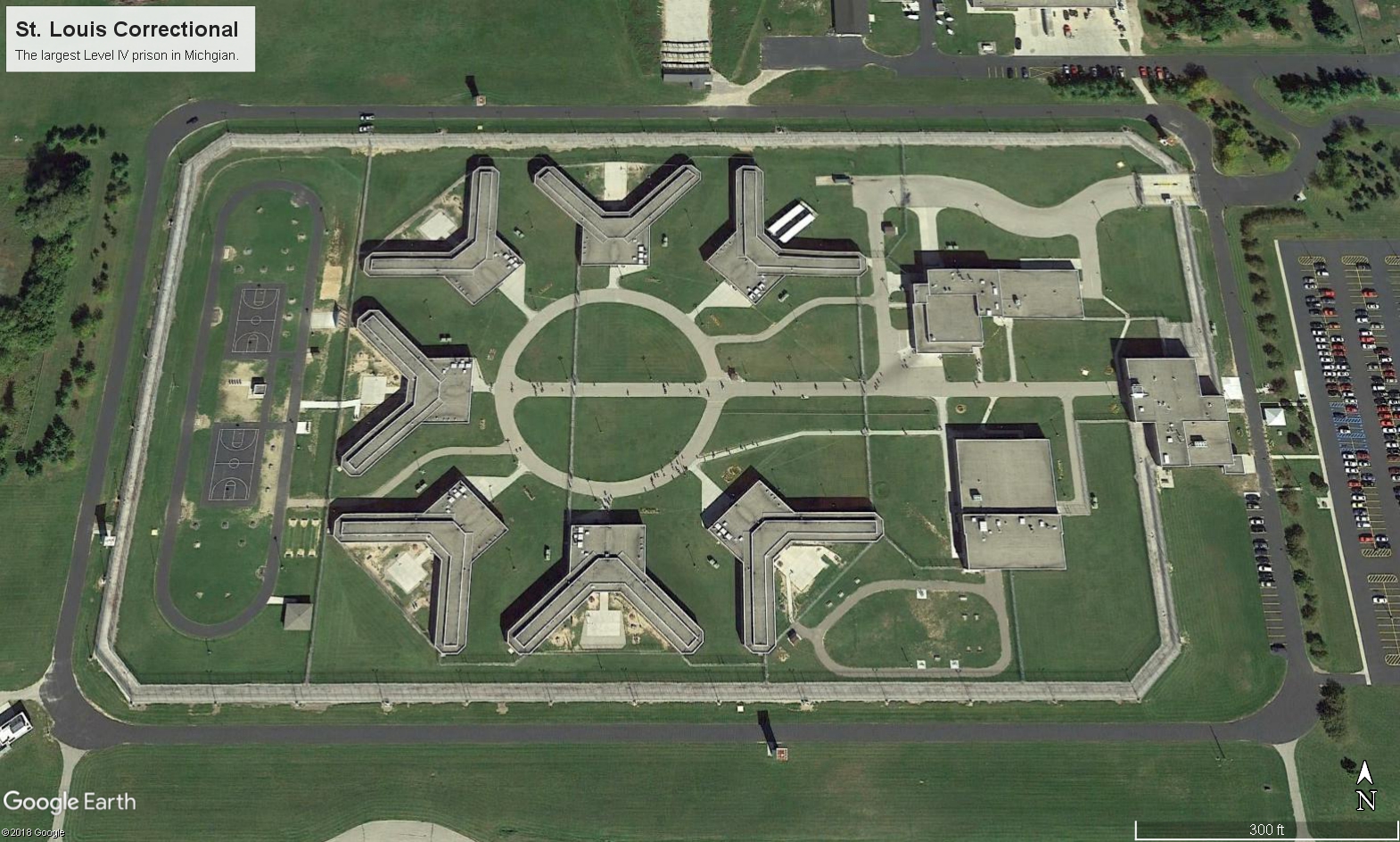
St. Louis Correctional

St. Louis Correctional Facility- the largest Level IV prison in Michigan.

Jails and prisons are not known for their hospitality, luxury, comfort, convenience, or aesthetics.  They are utilitarian facilities designed for security, control, functionality, and durability. The compound consists of a secure perimeter designed for controlled entrance and egress.  Razor wire, cameras, notion sensors, officer patrols on foot and by vehicle, inspections, metal detectors and body searches are the basis of security on the perimeter.  Prisons in many ways are based on the military model.  The difference being the focus on keeping inmates in.  However, with the advent of drones, smuggling contraband like cell phones and drugs in prison security is having to adapt to these new threats.

In the MDOC there are currently four levels of security: Level I, II, IV, and V. Level V is maximum security.  I’ve never been there but they tell me it’s not nice.  There are two ways to get there.  Maximum security is for those that are uncontrollable at lower levels of security or the entry point into the prison system for those serving life or very long sentences.

Level V is one-man cells, highly controlled movement and no creature comforts.  No personal property, no gym or yard time, no libraries, TVs, or day rooms.  Locked down 23 hours a day with only brief exercise periods outside in a cage.  Good behavior is the only way out.

Level IV is two-man cells, controlled movement and limited creature comforts.  Basic personal property like athletic shoes, radios, TVs, and books.  Locked down 22 hours a day with access to yard time and the day room.  Call outs for the gym, library and school are available. There are two types of level IV facilities.  There are those that stand alone and those that are part of a multi-level facility.  The latter type was the type of level IV that I’ve experienced.

Level IV is also a destination for those whose behavior could not be controlled in general population or for those with more than seven years to serve till their ERD.  I spent seven months in Level IV.  In multi-level facilities level IV prisoners are segregated and not allowed to interact with those from other levels.  Separate yard, gym, library, medical, chow and visits.

In level IV cells the doors lock from the outside.  The furniture is bolted to the floor.  The toilet is in the cell.  The windows have bars over the glass and only a small vent to get fresh air. An officer must let you out of your cell to go to work, take a shower, attend call outs or do anything at all.  Church services were held in the housing unit and inmate lead with occasional outside volunteer speakers.

Level II along with level I is called General Population.  Level II is as far down as lifers will ever get.  Two-man cells and they give you your own room key.  Incoming prisoners with a minimum of 5 years to serve and a maximum of 7 years are generally assigned to level II.  Prisoners with disciplinary issues in level I and sent to level II.  In fact, some people dislike level I so much that they will intentionally earn enough points from minor tickets to get sent to level II.

In multi-level facilities level I and II prisoners go to school together, worship together, attend gym, library and medical callouts together and go on visits together.  They used to share the big yard together but there at the multi-level facility I was at they separated the big yard time for level I and II there because there was too much violence.

The cells have a bunk bed, two desks with chairs and two lockers.  While the windows have a vent to get fresh air there were no bars over them.  Toilets and showers were down the hall. A big improvement over level IV.

One of the best things about level II was access to a microwave oven.  It’s no fun preparing Raman Noodles or instant coffee with warm tap water from the bathroom sink faucet in your level IV cell.

Level I facility housing units are mostly pole barn style dormitories with open cubicles. Level V, IV, II and unsecured level I housing units are cell based.  There are two types of level I facilities- secured and unsecured. Unsecured level I is for level I prisoners with less than two years to their ERD, ticket free and don’t have certain restricted convictions. These prisoners are generally gate pass eligible to work jobs outside the compound fences.  For those qualified, unsecured level I represents an oasis of peace and quiet.  The housing unit still has a fence with barbed wire but not the double row that surrounds secure facilities.  Unsecured level I has come and gone several times as bed space was required.  Technically being located outside the secure facility means that the inmates housed there have limited access to the compound only for medical and the visiting room.  They have their own small yard and meals are served in the housing unit.

Secured level I comprises roughly half of the bed space in the MDOC. When the prison population exploded in the 1980s the MDOC went on a building spree and created what they referred to as “Temporary” facilities.  Rather than utilizing cells the housing units are an open dormitory design with cubicles subdividing the pole barn structure along hallways. While most prisons were made to last, these pole barns were not designed to remain in service as long as they have and it really shows.

I was at level I Temporary facilities with pole barn housing units and they were really showing their age.  Poorly insulated, poorly lighted, bare concrete floors, endless plumbing problems, dusty and a security nightmare.  At my last facility they were closing the pole barns one at a time to perform major repairs and updating things like security cameras.

Originally built to house 80 inmates per unit the pole barns have had their capacity doubled to 160 beds, but not toilets, showers, sinks or day room seating.  According to the American Correctional Association each inmate should have 60 sq. ft. of space in semi-private sleeping areas. In an 8 man cube the furniture takes up all the space and I only had a couple of square feet in front of my bed. Just enough room to put my feet on the floor as I sat on my bed or looked into my locker.

The pole barns were built in the 1980s and 90s.  The biggest thing to change in the MDOC since then is the level of violence in level I.  When the prison population expanded, and prison facilities proliferated these level I temporary facilities were like honors units.  Due to a few bad incidents the work camps and farms were closed and these prisoners were moved to these new secure facilities.  Violence wasn’t tolerated and those that engaged in it found themselves back behind the walls of the old prison in Jackson.

After the closing of the old walled prison and the pressure to reduce cost more inmates were moved into the pole barns including those with violent crimes, less than stellar institutional records or gang affiliation.  The result is that the open design lead to problems with theft and violence inside the housing units.  To address this while I was there they added wire cage structures to the top of the walls that separated the cubicles in the front and back halls and added additional security cameras.  Like putting a Band-Aid on cancer, a cosmetic fix for a truly institutional problem.

Security cameras don’t make things safer.  After the fact they might provide evidence to identify the perpetrator but the damage has already been done. And in an ironic twist, the same cameras used to convict are conveniently broken or didn’t show anything when an innate seeks to use video to exonerate themselves.  But inmates have to take the Inspectors word for it since they can’t be shown the video since it is a security rule.

The wire caging goes from the top of the wall up to the ceiling to prevent inmates and stolen property from crossing from one side of the housing unit to the other out of sight of the cameras which look up and down the halls.  The caging was nothing fancy.  It took the inmate maintenance crew two days to install the panels.  Only time will tell whether these measures will reduce theft and violence in level I pole barns.

As a cost saving measure a few years ago the MDOC closed the level V prison in Standish. That again had a ripple effect across the MDOC.  It wasn’t that there were fewer level V prisoners, they simply waved the security classification to move inmates to lower security levels- V to IV, IV to II, and II to I.  The higher the security level the higher the cost of incarceration.  Level V costs more than twice the cost to house an inmate in level I.  While cutting cost was a political decision when the legislature reduced the department’s budget, it failed to account for the human cost. When inmates are placed in a lower security level it should be because they have demonstrated good behavior and cooperation in completing programming.  The issue is that you end up in prison because of bad behavior and time in prison alone won’t improve it.  The higher levels are intended to reduce the inmate’s ability to cause mischief through isolation. So, the inmates institutional record at the higher levels by its self my not be a good predictor of what will happen at lower levels.  By waving initiates to lower levels, the MDOC let predators lose in the lower security levels.  There were still in prison where the general public was protected from than but free to hurt other inmates.  But they’re just inmates, right?

Housing units in the MDOC are not air conditioned.  During the summer the air temperature inside will often exceed 80˚F and with a heat wave can approach 90˚F or higher.  Without air conditioning there is no dehumidification so you also have to account for the heat index as well.

The school, medical and administration buildings where the staff work do have air conditioning and many of the housing unit counselors have retrofit air conditioners installed in their offices.  So apparently suffering through the heat is part of the punishment.

For those inmates with certain medical conditions where hot temperatures could put them at risk for a medical emergency their medical classification will include an accommodation for heat related illness that will allow them to utilize designated cooling centers when the facility is under a heat advisory.  Heat advisories are issued when the heat index goes above 100˚F. During a heat advisory all strenuous activity is curtailed, no weight pit, no outdoor sports of any kind.

When it gets hot in the housing unit it tends to remain hot.  The brick and concrete construction absorbs the heat and holds it long after it cools off outside.  I had many miserable nights unable to sleep because it was too hot.  There is little air movement because the windows in Level II and IV only have small vents for fresh air.  With the cell doors closed there is no way to generate air movement.  The level I pole barns have slightly larger windows which open with screens.  Unfortunately, the building design prohibits good air circulation.  Ceiling fans do little to move air in/out of the building.  The bunks closet to the windows are highly coveted because they are the only that benefit from the fresh air.

The heat really takes its toll physically and heat stroke is a real possibility. In housing units with fixed temperature controls in the showers even taking a cool isn’t an option.  The small personal fans do almost nothing to alleviate the discomfort.

Most facilities don’t have ice makers in the housing units.  Those that do can’t provide enough ice to cool 160 men.  You could expect that it would be empty before count time and that there would be a stampede when count clears as guys try to beat the adage about ice water in hell.

Prisonisms

Prison:

  1.  A place where persons convicted or accused of crimes are confined; a penitentiary or a jail.
  2. A place or condition of confinement or forcible restraint.
  3. A state of imprisonment or captivity.

While prison is a physical place made up of buildings with barred windows, locked doors, and surrounded by fences intended to keep people securely and safely away from society; it is also a state of mind that imprisons the spirit in ways that no parole can ever free them from.

-ism:

  1. Action, process, practice.
  2. Characteristic behavior or quality.
  3. State, condition, quality.
  4. Distinctive or characteristic trait.
  5. Doctrine, theory, system of principles.
  6. An attitude of prejudice against a given group.

ism is a suffix added to the end of a word which transforms the root word.
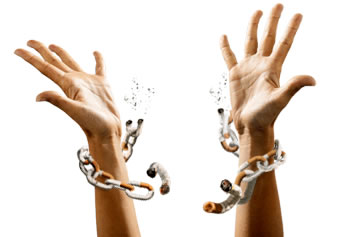
breakfreechainPrisonisms are the shackles that bind the mind and spirit that can only be unlocked from the inside.  They are the prisons of our own making that we have confined ourselves within, often for a life sentence.  Only God has the power to commute your sentence.  No amount of education or re-education, counseling, or religious programming can set you free.  A popular Bible in prison is the “Free on The Inside” Bible published by Biblica explains in simple English how God can set you free, but it all starts with you.  You have to take the first step.  For many people fear is what keeps them bound.  Fear of change, fear of the unknown, fear of being ridiculed or ostracized by their associates, fear of being alone.  Prisonisms are often the root cause of recidivism.  Errors in thinking that cause an individual to slip back into a pattern of criminal behavior, if they ever left it.

Alcoholism: Psychophysiological dependence on alcoholic beverages.

Substance abuse is a major underlying factor in crime.  Studies report up to 90% of crime is related to or committed under the influence of drugs or alcohol.  This continues to be a problem for those who are incarcerated. “Spud juice” prison home brew is readily available and consumed in amounts sufficient to get drunk, as often as a prisoner can afford to. Brewing alcohol in prison is big business and an organized crime.  Teams coordinate the theft of ingredients from the chow hall and individuals steal from other initiates to pay their bar tabs.  Half-hearted attempts by custody staff to prevent theft from the kitchen and lax security in the housing units makes this possible.

AA/NA groups are held in every prison, but too many attend these groups for the wrong reasons.  They want to look good for the Parole Board rather than change their ways.  For those individuals, coming to prison wasn’t hitting rock bottom and they are not prepared to admit that they are powerless over their addictions.  They are dying for a drink.

Barbarism: An act, trait, or custom characterized by ignorance or crudity.

The corrections officer’s union advertises that their job is the most dangerous job in the state, which propagates the stereotype.  Violence in prison is accepted by far too many as being part of the sentence.  The price you pay for committing a crime against society is to serve time in the “Thunderdome”.  Some prisons have the reputation of being gladiator schools.

Coming to prison is a rite of passage for being a gang member and a fertile ground for recruiting new members. “There is safety in numbers” is the recruiters mantra. “Us” versus “Them”, predators versus prey, CO’s versus inmates, black versus white, gang versus gang, strong versus weak, young versus old.  The old wild, wild west idea of an armed society is a polite society is propagated from one generation to the next.  Defy authority; rules are made to be broken; stupid is as stupid does; ignorance is bliss; life imitates art imitates life.  A vicious cycle of depravity.  Life is cheap.  Only the strong survive.

Some people say that capital punishment is barbaric.  I can tell you from first-hand experience that it’s not the only thing barbaric about the criminal justice system.

Dogmatism: Arrogant, stubborn assertion of opinion or belief.

In prison there is no mutual cooperation because everyone believes that they’re right and everybody else is ignorant. “I’ll see it when I believe it” describes the state of unreality many prisoners live in “LaLa Land”. Students arguing with teachers over school rules and policy.  Everyone is convinced that they have the best, most accurate insight into human behavior.  They know the best way to get things done whether it be cooking, cleaning, or jailing.  Life could be so much better if everyone else did it their way.  They deny your reality and substitute their own.  They rearrange and reinterpret the facts to fit their own conclusions.  “I’m right and you’re wrong.”  When something doesn’t work out or they get caught it must be somebody else’s fault.  There must be a snitch, “I’m too slick to get caught.” Conspiracy theories; slavery; white power; “sex, drugs and rock-n-roll”; reality television is real; sports and hip hop will make you a millionaire; easy money; every woman wants what I’ve got; Orange is the new black; Next time I won’t get caught; I’m a bad man; A tough guy; A gangster; A fighter and a lover.  “I’m never gonna change, but I’m never coming back to prison.”

Until attitudes change, lifestyles will not change.  Dogma blocks any attempts to enlighten through the willful disregard of truth.

Hedonism: Pursuit of or devotion to pleasure.

“If it feels good, do it.”  Impulse control is an issue for many people in prison.  Their daily pursuit is pleasure: food, TV, alcohol, sex and not necessarily in that order.  They don’t worry about others, they are the most selfish people on earth, only concerned about themselves.  They look for ways to “get over” on people.  Their idea of work is doing nothing for something.  They always look for the easy way out, getting someone else to do it for them.

They trade the main course for an extra dessert.  Up all night, sleep all day; Party animal; Eating machine; Rap star; Pop culture trivia expert.  They have multiple baby’s mamas, none of which is their current wife or girlfriend.

They have never worked a day in their lives (legitimately).  They never have a dime in their trust accounts because they owe restitution, but always go to the store.  They live on coffee and honey buns (the breakfast of champions) and nacho do’s.  They deny themselves nothing today and put no thought towards tomorrow or how their actions impact others.  “Eat, sleep and be merry for tomorrow die” is their mantra.

Fatalism: The doctrine that all events are predetermined and unalterable.

For some, coming to prison was inevitable.  They see themselves as the product of their environment.  The child of poverty, growing up in a broken home, raised by their grandmothers because their addicted mothers were unfit, never knowing their fathers. Running wild on the streets; never having anything of their own except a record; state raised.

Entitlement mentality: Bridge Cards; Welfare; Cash Assistance; Unemployment; No education, can’t get a job, but why bother?  They take no responsibility for anything.  The system is broken, the cards are stacked against me.  The cops are out to get me.  A felon can’t get a job, so I’ll keep selling dope on the corner and see how long I can stay out of prison before I get caught or killed. Dropped out of school to hustle, doesn’t see any value in earning a GED.  Book learning can’t prepare you for a life on the streets. Life is hard so I have to be hard too.  Life is painful so I take drugs to dull the pain.  Life is a bitch and then you die.  There isn’t anything else, no after life – no god would be so cruel as to make us live this way.

Without the good news of the gospel of Christ the people parish.  Fatalistic people need a compelling reason to live life as if life – both theirs and others – really matter.

Institutionalism: Use of public institutions for the care of those who are mentally disabled or who are criminally delinquent, or incapable of independent living.

In the 1980s two things happened to cause an explosion in prison populations: Mental hospitals closed leaving the mentally impaired no place to go except the streets which in turn lead them to prison.  The second was the imposition of longer prison sentences. Prison became a maze with no way out for many people.

Prison is a highly structured place: set times to eat, work, study, and play. This is something that many in prison couldn’t change on their own.  The state provides three meals a day, shelter and clothing.  No responsibility to do anything for yourself.  For those who lived on the streets, it doesn’t get much better than that.  Also, for those with mental issues, they are getting some mental health care such as counseling and medication to help regulate their mood or to help them sleep.

For some spending long periods of time behind bars leaves them behind. Family and friends move on or die, technology advances put them at a disadvantage and leave them so lost that the world they return to is foreign to them.  They simply seek to return to the security of the simple life that they’ve come to an accommodation with in a love/hate relationship.

Puerilism: Childish behavior in an adult.

Many men in prison are literally and figuratively in a state of arrested development. Grown men who are very immature.  They throw temper tantrums, act out to get attention, and have no self-discipline.  Gray hairs acting like teenagers: following youth culture, music, and dress styles.  They insist on having their way and will make a scene to get what they want, when they want it.  Many have the attention span of a humming bird. Afflicted with ADHD or other mental disorders, they are unable to focus long enough to learn anything from their required programming.  Forced to sit through classes without the benefit of medication that would allow them to concentrate, they are disruptive to others and have disciplinary problems.  They run the yard like they ran the streets and are unable to lay down when they receive tickets and have to serve LOP (loss of privilege) which only compounds the problem.  Unable or unwilling to follow directions or obey rules, they can’t complete a program or a parole.  Self-medicating to try and regain a “normal” feeling only compounds the issue. They are more like the pirates than the Lost Boys living in Neverland.

Diabolism: Devilish conduct or behavior.

While the barbarians are sociopaths, the truly diabolic are psychopaths. They have no conscience.  You can see the predatory look in their eyes, like the big cats eyeing the wildebeest.  They test the fences always looking for weaknesses to exploit.  They know exactly where all the security cameras are.  They are loners who are never alone.  They surround themselves with minions that aspire to be like them.

They hate the world they live in and anyone who is not like them.  They judge everything and condemn what they determine to be soft.  They despise those who have prosperity and happiness, just like the Grinch. They are distrustful of any authority.  They live life by their own rules. They demand respect but rarely give it.  They value no life but their own.

When given a choice between a legal or illegal opportunity, they always choose the illegal one. They see themselves not just as living on the fringe of society, but outside it as true outlaws.  They are rebels without a clue.  They are truly a menace to society.  They are pathological liars who believe their own lies.  The truly unrepentant and unremorseful. The only thing they regret is getting caught.

These are the ones that Christ died for because nobody else would.  They are filled with legions of demons that only Christ can excise.

Defeatism: Acceptance of or resignation to the prospect of defeat.

Many people who come to prison proclaim their innocence and mount a boisterous and rigorous appeal.  There are others, however, who arrive beaten up and broken down by the criminal justice system.  These people have resigned themselves to the end of their lives as they know it. Whether they are actually guilty or not doesn’t matter at this point. They have lost everything: family, friends, jobs, assets and just want to get their prison sentence over with.  Emotionally and spiritually drained, they have lost faith in society and the government bureaucracy that they thought once cared for them and have now given up hope of a happy ending.

These people are more or less law-abiding citizens who ended up in prison after their first encounter with the criminal justice system and never imagined that they’d be on the inside looking out.  Facing long prison sentences, they are ill prepared for life behind bars.  They are not hardened criminals, but someone who made a mistake, a lapse in judgment and will pay for it with the rest of their lives even after they are released.  They have gone through a life altering experience and it has broken them.  They have no energy, the has gone out of their eyes.  They don’t feel like they have anything left to life for.  They feel abandoned by God and their prayers go unanswered.

These are the least of these that Jesus said we should give a cup of water to. They need to know that Jesus hasn’t left them or forsaken them.

Parasitism: The characteristic behavior or mode of existence of a parasite.

There are two types of parasites in prison.  Those who live life vicariously through others and those who are a financial drag on society.

Social parasites are busy bodies, gossips, rumor mongers, ear hustlers, nosey neighbors. They don’t have a life of their own so they are in everyone else’s business.  They can’t keep a secret and don’t really try.  They are information brokers.  They butt in where they don’t belong, join in conversations uninvited.  By focusing on everyone else around them they never address their own issues.  God is the only one they should be listening to and he would gladly use their talents to spread His gospel among all men.

Financial parasites live off the largess of others.  They borrow from family and friends, bunkies, cubies, and the “store man.”  They may be either too lazy to work or enjoy living far beyond their means.  They have an entitlement mentality and believe that someone will take care of them: parents, spouse, significant other, or the government.  They don’t adequately monitor their spending habits or cash flow and have frequent confrontations with their debt holders.  Their solution to their financial problems in prison is to lock up and ride out, then start over someplace else.

In the world foreclosure, repossession, calls from collection agents and bankruptcy are familiar events.  Payday lenders, pawnshop brokers, welfare, cash assistance and SSID are their way of life. They won’t do anything to jeopardize these by getting a GED or job training.  The only debt they don’t have is a debt of gratitude.

Parasites need to learn that the only one we should be dependent upon is God.  He wants to provide all they need if they would only agree in return to be generous to others.

Here are a few more –isms that can be used to describe some facet of prison and the prison experience. If you aren’t familiar with the word look it up in a good dictionary:

  1. Absurdism
  2. Activism
  3. Adventurism
  4. Antagonism
  5. Aphorism
  6. Chauvinism
  7. Classism
  8. Criticism
  9. Cronyism
  10. Despotism
  11. Determinism
  12. Egotism
  13. Elitism
  14. Empiricism
  15. Escapism
  16. Euphemism
  17. Exhibitionism
  18. Existentialism
  19. Externalism
  20. Favoritism
  21. Idealism
  22. Indeterminism
  23. Individualism
  24. Inerrantism
  25. Infantilism
  26. Instrumentalism
  27. Intellectualism
  28. Intuitionism
  29. Irrationalism
  30. Legalism
  31. Mannerism
  32. Materialism
  33. Narcissism
  34. Nepotism
  35. Obscurantism
  36. Obstructionism
  37. Opportunism
  38. Optimism
  39. Paralogism
  40. Particularism
  41. Passivism
  42. Paternalism
  43. Patriotism
  44. Pauperism
  45. Perfectionism
  46. Pessimism
  47. Pragmatism
  48. Privatism
  49. Professionalism
  50. Prohibitionism
  51. Racism
  52. Recidivism
  53. Relativism
  54. Sadism
  55. Sexism
  56. Skepticism
  57. Solecism
  58. Stoicism
  59. Terrorism
  60. Vandalism
  61. Vulgarism


Phone Tag

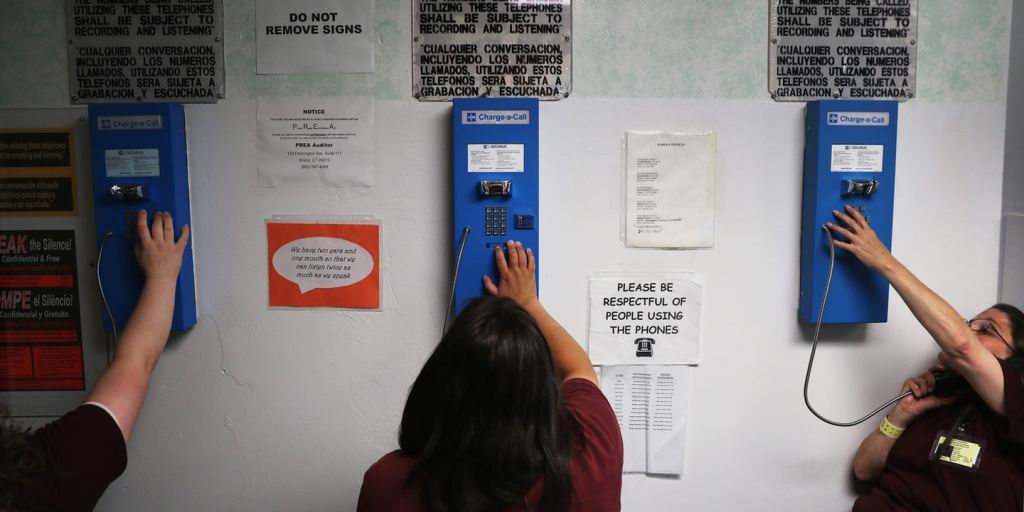
This is what the phones in the housing unit looked like at my last Level I facility.

Communication with friends and family in the free world is very important to those serving time in prison.  There are four primary means of communication available to inmates: phone calls, email, snail mail, and visits.  For some visits are a rare treat to savor, while these other forms of communication take precedent and occur at greater frequency.

In the housing units and on the yard are phones that can be used when the housing unit or yard are open.  Collect and pre-paid debit calls can be made to a limited number of phone numbers each month (check for change to the phone policy).  Except for calls to lawyers, the calls are recorded and possibly monitored.  A phone call can last 15 minutes.

Given the ratio of inmates to phones there is almost always a line of people waiting to get on the phone.  There is no privacy in prison and the phones are no exception.  The phones are clustered together making it easy for other inmates to overhear half of the conversation.  Many prefer to use the outdoor phones since it tends to be a little quieter than in the housing units.

Phone service is under contract with a private service provider that is responsible for the upkeep of the system.  It seems that at any one time at least one phone in four is out of service.  Men in prison experience high levels of stress and frustration and tend to take it out on those they are talking to on the phones and when that is not good enough they take it out on the phones themselves.  The current carrier is Global Tel Link (GTL).  Phone rates are a national issue and both the FCC and the federal courts have gotten involved trying to set fair rates.  Prisons are captive markets and almost every vendor under contract to the MDOC to provide services and products to inmates take advantage of that by charging significantly more than what the general public normally pays with a free market. With the MDOC these higher prices generally translate into so portion of the proceeds being shared by the department.  In the real world we would call this a kick back, but it is business as usual for Corrections.  In the case of GTL, they offered to set up a fund where the states portion of the revenue proceeds would go to buy cell phone detection and blocking technology to combat the growing problem of contraband cell phones in prisons.  (At the time of the contract award it was against federal law for the states to utilize this form of technology.)  The result is that prison phone calls cost $0.34 -$0.37 per minute, depending on whether they are collect or debit calls.  Long distance and international calling rates were even higher.  Now this is far better than the county jail were calls could cost $1.00 per minute, which is outrageous and far beyond what calls cost in the free world.  It is clearly a case of the state and counties making profit from those that can least afford it.  At one point the courts ruled that it was predatory pricing and ordered that phone rates be reduced, however the phone companies that provide services to prisons and jails successfully lobbied to get a stay while further study was done.

Either an inmate can put money on a disbursement to GTL to setup a debit account to pay for phone calls or those that receive the calls can either contract with a phone carrier that will allow them to receive collect calls and then bill their account or they can put money on a debit account of their own with GTL.  When I was in the county jail the hardest phone call I have ever had to make in my life was to my mother.  Fortunately, it was a land line and the carrier allowed them to accept the charges.  Cell phone carriers don’t work that way and you have to set up the prepaid debit account.  I was fortunate enough that I had the luxury of calling home collect and put money on a debit account so that I could call my family’s cell phones in case of emergency or vacation. Most people in prison don’t have that luxury.  I made it a practice to call home for 15 minutes once a week for the 8 years that I served behind bars.  This probably ran into the thousands of dollars in order to keep the lines of communication open.  Not everybody in prison will be able to afford this, although I knew several married guys who called home daily to talk to their wife and kids.

Being able to have the ability to pick up the phone and make a call is a major comfort to people in prison.  I knew a lot of guys whose priority was putting money on the phone instead of purchasing commissary items.  If you have a loved one in prison the best thing you can do for them is to set up a pre-paid debit account so they can call your cell phone and talk to you any time they can.  In a place so full of stress and hostility, being able to hear a friendly voice is a comfort and a blessing beyond words.

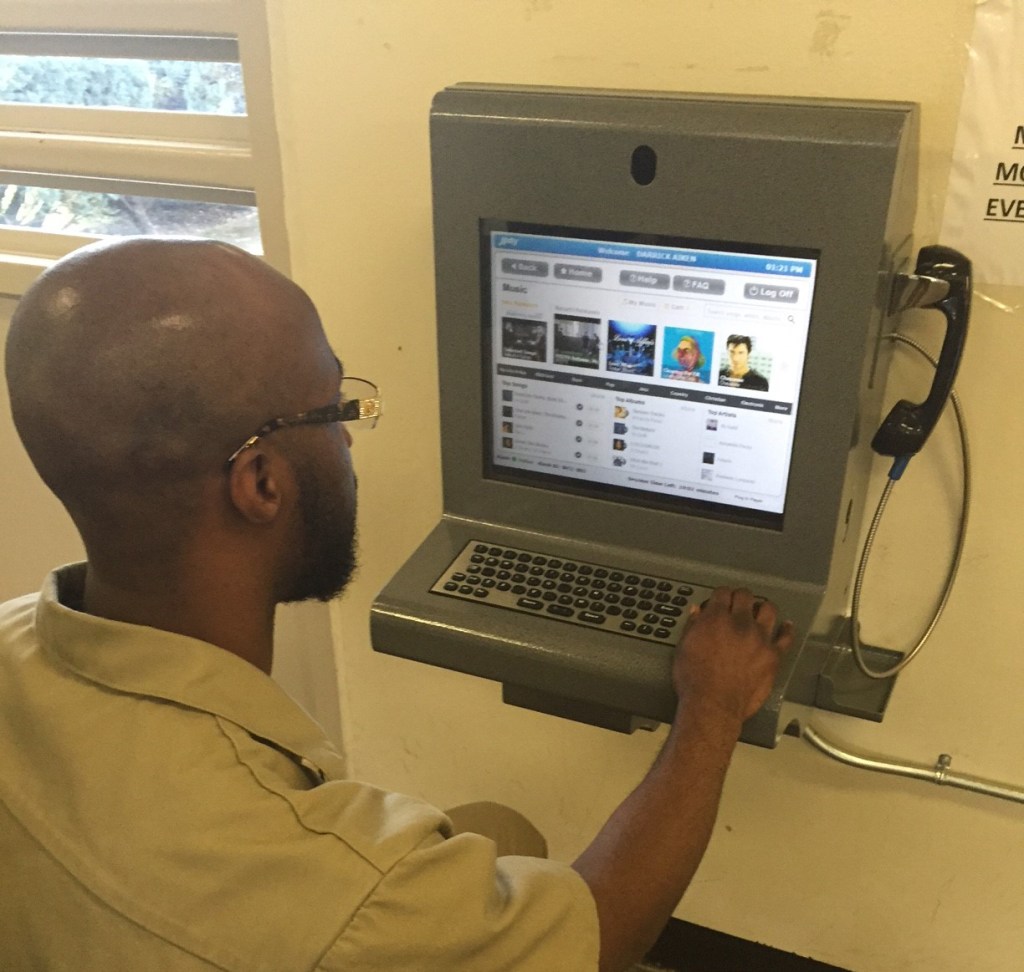
This is what a JPay kiosk looks like. You can send and receive email using a very limited function computer terminal.

Starting around 2010 the MDOC brought in another vendor JPay to provide a form of electronic communication.  Friends and family can register on the JPay website and buy “stamps” to send what amounts to email to prisoners.  In the housing units, prisoners can then use a kiosk with a monitor and a keyboard where they can send and receive JPay messages.  The inmate can only send messages to people who have registered on the JPay website to communicate with them. The inmates can also buy “stamps”.  It costs about $0.50 per “page” to send a message.  Messages can even have photo attachments.  These messages are subject to the MDOC mail policy.

Snail mail through the good old USPS is also a good way to keep in contact with inmates. In 2017 the prisoner mail policy was updated due to contraband being sent to prisoners. Envelopes are discarded because of drugs being hidden in the adhesive under stamps, flaps, or address labels. Also, black or blue ink only, no colored ink, borders, or water marks.  Photos printed on plain paper only are permitted.  Forget sending stuff like newspaper articles, magazines, church bulletins, etc.  Greeting cards also have restrictions.

Children will longer be able to send their daddies refrigerator art.  It is as if the MDOC wants to discourage people from sending snail mail to prisoners.  The same thing has occurred in county jails where the only permissible format is a postcard.

Prisoners can purchase letter sized envelopes with metered postage.  The story is that back in the day, prisoners actually purchased postage stamps but that these would be treated like currency and used to pay prison debts among prisoners who would send the stamps to people in the free world who could return the stamps to the USPS for cash.  I can’t verify this but it was told to me by a lifer bunkie who had been down since the 1970’s.  It is an example of how those held against their will will attempt to find ways to circumvent the system.  And that a few will ruin it for everyone.